

I had to pay to tow it to another charger. Tesla controlled the policy and channel; no one was empowered to negotiate responsibility. I am still a Tesla shareholder and wanted the company to succeed. In that moment, its system still failed me as a human.
01The mistake
ACT I · WHY ORDINARY PEOPLE WERE LEFT BEHIND
I thought people just didn't want it
In March or April 2025, my brother asked me a simple question: “Why don't more people use AI?”
He and I used it for almost everything. I had spent nearly a decade building AI products, and my use had become especially intense after ChatGPT launched and the GPT-3.5 and GPT-4 era began. AI was how I researched, thought, built, and solved problems every day.
My answer came quickly: “People just don't want to. They don't want to learn and grow.”
At the time, I believed it.
A few months later, I realized I had replayed the perspective of the AI industry and the technology bubble around it. We had mistaken a failure to adopt for a failure of curiosity or ambition. We blamed people for not adapting to products that expected them to arrive with the right prompt, the right context, and the confidence to judge whatever came back.
The problem was not that ordinary people refused to learn. The products had not been designed for them. Whether that happened through oversight and momentum or through direct strategic choices, either answer was damning.
I had blamed the people for a design failure.
02The road trip
The idea arrived on the road
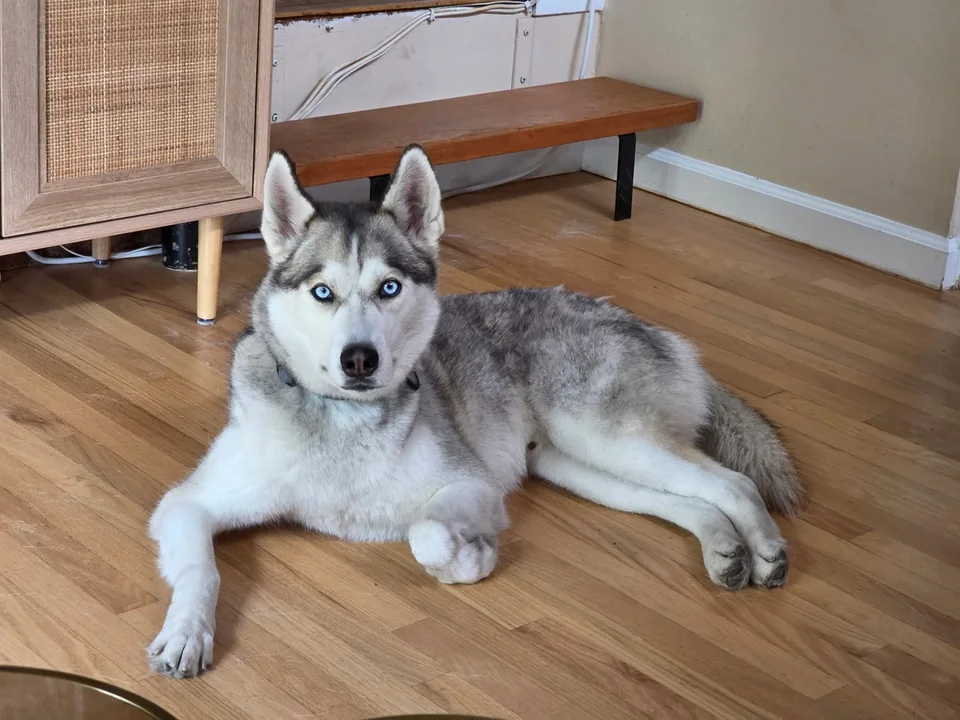
That June and July, I drove across the continent—from Los Angeles to my hometown of Chatham, Ontario, Canada—with my husky, Luke.
The question from my brother came back with a sinking feeling in my gut. I was wrong. The most powerful new tools in the world were being built for people who already knew how to ask, evaluate, and operate them—not for everyone else.
I was also watching the march toward AGI. The industry kept moving the goalposts for what counted as artificial general intelligence. For practical purposes, I believed it had arrived: broadly capable systems could already reason across domains, write software, use tools, and do work that had recently required trained professionals.
What frightened me was where that power was accumulating. The largest corporations in the world were building and concentrating it first. If one of the top three or four companies achieved artificial superintelligence—ASI, intelligence far beyond human capability—and deployed it broadly for itself, it could reach escape velocity: more intelligence creating more wealth, infrastructure, control, and still more intelligence, faster than competitors, governments, or ordinary people could catch up.
At that point, the top three or four companies could gain extraordinary control over the world's most valuable assets, systems, and productive capacity. I still believe that could happen.
That felt like a civilizational-scale error. I could not sleep for days. I paused my other priorities and began planning and building the correction relentlessly, still on the road.
Before the fear of concentrated power, I had been considering an AI-guided T-shirt and merchandise creator for anyone. It would replace the blank box with one calm step at a time—from idea to design, checkout, and a shirt delivered days later.
Then the larger idea hit me: wait. This is what the interface to AI should be.
I believed in bottom-up AI more than top-down AI: put extraordinary intelligence and leverage into ordinary people's hands, help them understand what is happening, and give them a real next move. Almost no one was building that whole product.
Bottom-up AI for humanity: guidance, care, and practical leverage for everyone.
03The blank box
They left grandma with a blank box
The AI industry was racing toward larger models, faster systems, and more leverage for companies and professional workers. Productivity was being maximized. Everything was going to be automated.
But what about most people?
The waitress. The truck driver. The grandmother. The college student. They still had money problems, health questions, relationship decisions, confusing paperwork, housing searches, and difficult weeks.
The most powerful technology in the world had given them a blank chat box.
That box looks simple. It is not. People may not know what they want yet, let alone how to phrase it precisely or that they need to supply context. They may not even know what the product can do—especially when its capabilities change from week to week.
Then comes an answer that can be long and overwhelming. They still have to work out what to do with it, and remember it later. It is a terminal disguised as a consumer product.
For a while, I thought regular people simply did not want to learn these tools. On the road, I realized the truth: the tools had not been designed for them.
Accessibility has been a thread through my whole career: using technology, especially AI, to break barriers, level the playing field, and make powerful capabilities easier and fairer—from the startups I built to my time at Microsoft.
04The Iowa sketch
A napkin in Iowa
During my cross-continent road trip, at a hotel in Iowa, I sketched the Life Guide on a napkin.
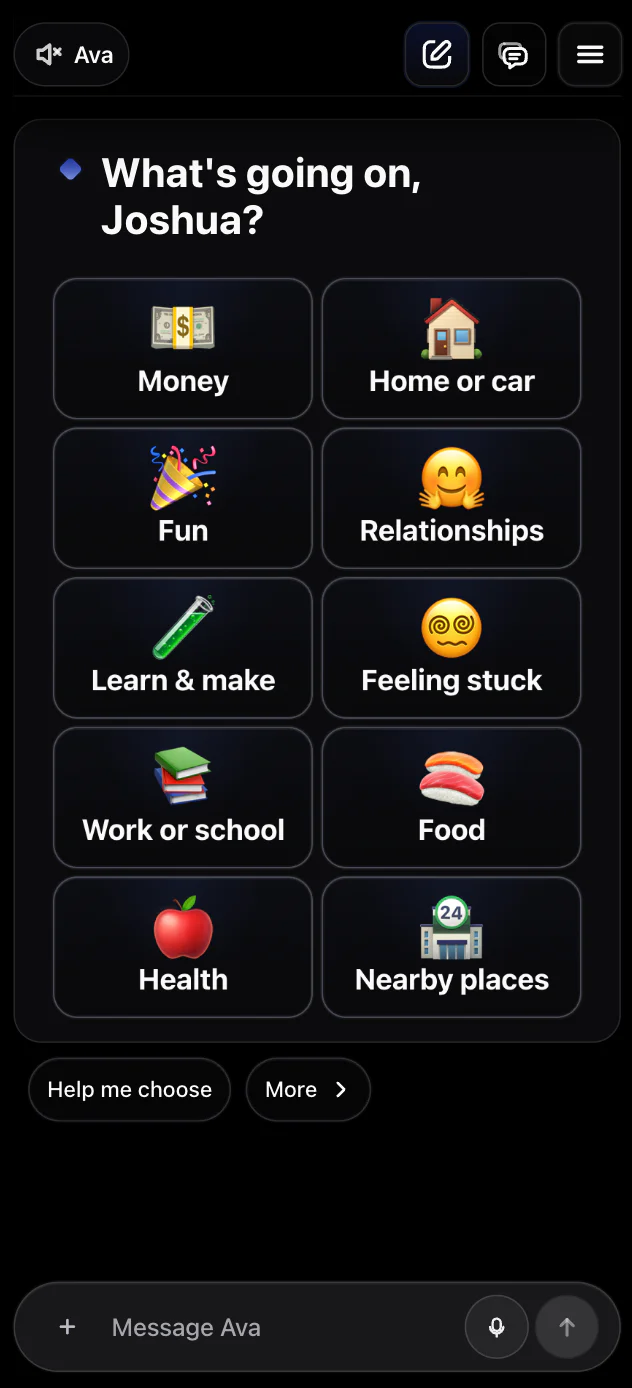
I called it You.one. “You” because the product is about helping you. “.one” because the domain was available and fit; the .com was priced in the millions.
The starting screen had large, obvious categories: money, health, relationships, food, work or school, home or car, learning, fun, nearby places, or simply feeling stuck.
You would not need to translate your life into the language of software. You would tap the part of life that needed help. Ava would walk with you through understandable choices, one decision-sized step at a time.
When I showed this screen to a 65-year-old friend—savvy and an occasional ChatGPT user—she said, “Oh, yours does more than ChatGPT.”
I told her it did not. It was simply more organized and guided. But that was the validation: the interface made the same underlying intelligence feel more capable because she could see where to begin.
I have heard versions of that reaction since, especially from younger people and older adults. The blank box was not neutral. It was a barrier.
Real guidance. Real care.
05Help that stays
The help line we never built
On that road trip, another image kept returning to me: 1-800-HELP. Imagine that Canada and the United States had created an open help line after World War II. You could call with any question—even one you were embarrassed to ask—and reach someone whose job was simply to help.
The person would listen, understand enough of the situation, and give you one clear next step. Not sell you something. Not route you toward the institution paying for the call. Help you move. We built Google. We built ChatGPT. But we still did not build human care as a service: a place that knows you, stays with you, and helps finish the loop.
1-800-HELPAnything is a valid place to begin.
Listen. Understand. Create clarity. Give the person the next step—and stay for the one after that.
Because life refuses to stay in one prompt
One person wondered whether she should adopt a cat. The decision immediately opened other loops: food, vaccinations, toys, the landlord, travel, and the budget. Then the budget became its own problem. The decision was only the start; the living system was a growing set of connected realities.
Should I adopt
a cat?
a cat?
Landlord rules
Monthly budget
Vet & vaccines
Travel care
Food & supplies
Chat could begin the work. It could not hold all of it. A useful AI should notice the connections, remember what matters, create clarity, and help the person keep moving.
The goal is not a longer conversation. The goal is the next step forward.
06The power imbalance
The power gap is not abstract
Most large systems have enormous power. A bank, insurer, platform, airline, or technology company has legal teams, policy engines, data, automated support, and now AI.
The person has an automated menu, a support ticket, a policy bot, and time they cannot get back.
These are not hypotheticals. All three happened to me personally within the last 6–12 months.
Often it is not malice. This is a critique of institutional priorities and product design—not the people doing the work inside these companies. The person still absorbs the delay, the complexity, and the cost.
And the gap is widening. Companies are stacking superhuman intelligence onto their policies, operations, customer systems, and negotiating position. Unless equally capable help reaches ordinary people in real life and real time, the person becomes even easier to outlast.
THE SYSTEM · COMPOUNDINGLegal teams · policy engines · data
Automation · AIMore intelligence. More patience. More leverage.
Automation · AIMore intelligence. More patience. More leverage.
THE GAPWIDENS→
THE PERSONOne ticket number.And a life to get back to.
07The counterweight
Put intelligence on the person's side
Regular people need more than an AI to chat with. They need help creating clarity and structure, keeping track, and finishing—so when life gets complex, they do not have to face it alone.
An AI that knows the whole person—not as a profile to monetize, but as someone whose goals, relationships, constraints, preferences, and well-being matter.
The rule for this system is simple: the person chooses which sources Ava may access and which actions she may take; both remain visible and revocable.
An AI that can help the person understand a contract, prepare for a difficult call, compare real options, remember the deadline, draft the response, track the open loops, and keep moving when a more powerful system would rather they give up.
That is the counterweight: putting useful intelligence and practical leverage on the person's side, too.
I think of this as a necessary civic counterweight. Concentrated institutional intelligence needs a capable check on the person's side. Ordinary people should be able to carry useful AI into the rooms where decisions are being made about their money, health, rights, work, and lives.
01Help the person understand.
02Give the mess a durable shape.
03Move reality forward—with the person in control.
When the person faces a powerful system, they should not have to arrive alone.
08Superboard's origin
The tool I built to build it
While building You.one, I used Trello—a lightweight Board tool I had loved for years—to track features, bugs, ideas, work in progress, and everything already finished. Then my Board reached roughly 5,000 Cards, and I was told I needed to archive or remove older work.
My reaction was immediate: no. I was not deleting the history of something that mattered because the tool had reached its idea of a reasonable limit.
So I began building a better Board for myself. I called it Superboard. At first it was a separate product: the tool I needed to keep building You.one my way. It became more than kanban—a living command center for what is happening, what needs attention, what is being created, and where everything lives.
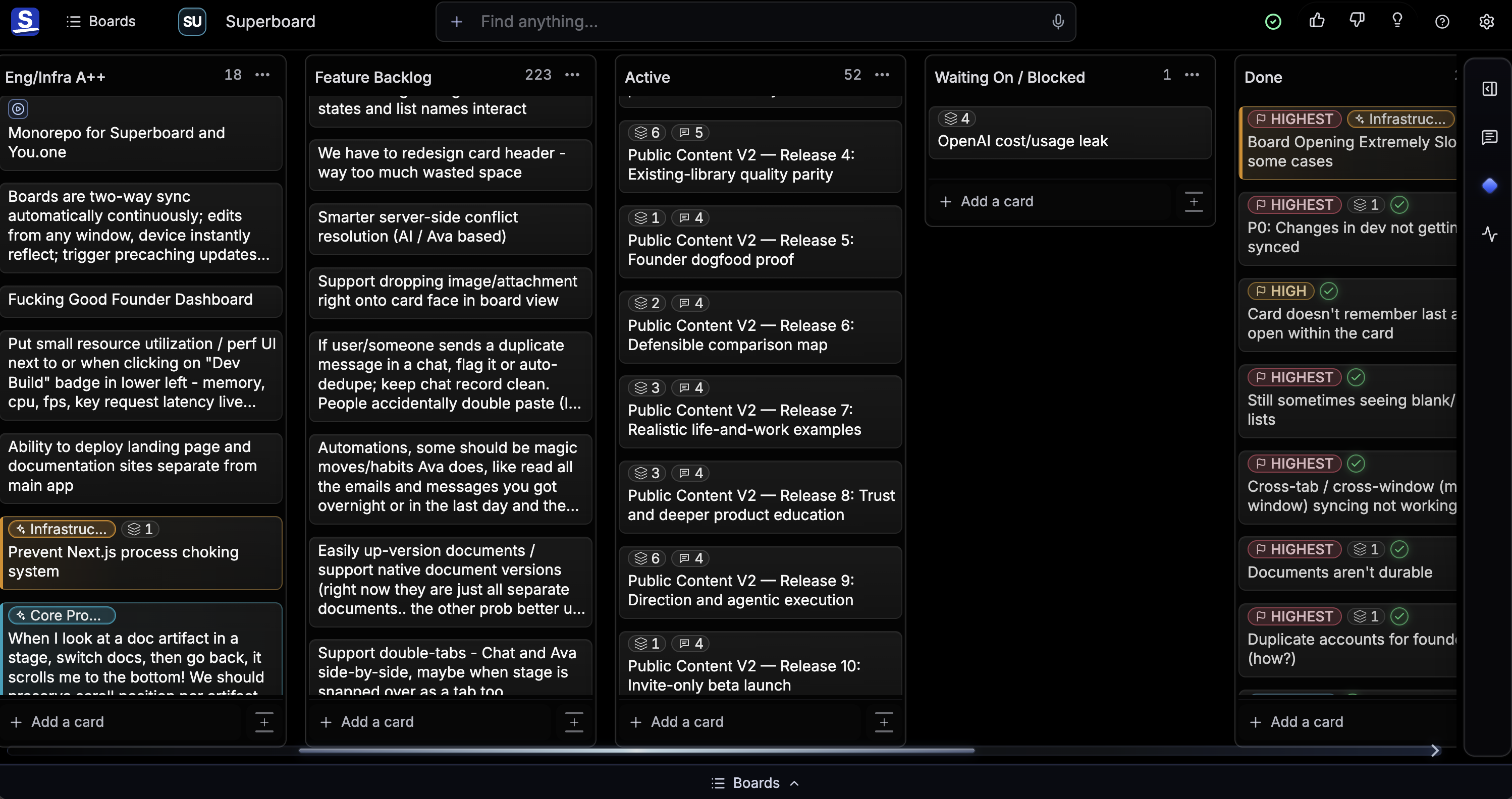
I did not leave that Board behind. Our comprehensive Trello importer migrated the actual 5,000-Card Board into Superboard, previewing and preserving supported structure, history, attachments, and archived work. It worked on the Board that forced this product to exist; it is the customer migration path too. I then ran my life, You.one, and Superboard itself on separate Boards—with Codex doing much of the lift and Grok reviewing. The product had to survive daily use on itself.
Superboard began as the tool to build You.one. Then it revealed what You.one was missing.
09The convergence
ACT II · THE PRODUCT SHAPE
You.one found its command center
I kept thinking about the cat decision and all the open loops it created.
I could build more conversation flows into You.one. But a budget, appointment, housing search, document, decision, or multi-step project needed somewhere durable to live. Superboard was already that place.
Chat companies built intelligence that could answer and left it floating in a thread. Productivity companies built the table and left it inert. The realization was not that two products should integrate. People needed both: Ava, the friend and assistant who guides you, remembers what matters, and helps move life and work forward—and Superboard, the living system where the work stays visible. One relationship; one place where reality, goals, decisions, and action stay coherent.
 YOU.ONE
Guide
Figure it out with Ava. Bring a need, category, question, or messy thought. Get one clear step at a time.
 SUPERBOARD · INSIDE YOU.ONE
Command Center
Keep the moving pieces visible. Organize, create, direct, monitor, and finish with Ava inside the work.
The Board is continuity; only its interface depth is optional. Ava can show one person five useful Cards—or let a power user like me navigate 5,000. Guidance, organization, and action are one fluid loop. The product adapts to the person; the person does not adapt to the Board.
Start anywhere. If you know what you want, tell Ava. If you do not, follow the Guide one understandable choice at a time. Speak, type, tap a choice, or create a Card directly. Every entry point returns to the same Ava and the same living record.
One relationshipOne living system · one Ava
10The communications center
The mission and the messages belong together
Life and work do not arrive as neat tasks. They arrive as an email from the school, a text from a teammate, a voicemail from the clinic, a call that changes the plan, or a conversation with Ava. Today those channels live in separate products, and the person becomes the integration layer.
The Command Center should bring the mission and its communication together. A Card is the durable record for one real thing—a clinic callback, school deadline, leaky roof, or project. Every communication ultimately belongs to a Card. A new message may arrive unanchored, but that is a temporary triage state: Ava should connect it to an existing Card or create the right one. Your correspondence and Ava's work sit together, so you do not hunt through disconnected accounts.
Email, text, calls, meetings, and teammate messages organize around the life or work they advance—not separate inboxes.
In this direction, Ava drafts in the open. She communicates as herself—or acts as you—only when authorized. What happened remains reviewable.
The transcript, files, decisions, actions, evidence, follow-ups, and next steps stay with the mission they advance.
A tire Card is the ordinary test. It exists before the first call and holds the car, constraints, nearby shops, transcripts, quotes, comparison, recommendation, approval, booking, calendar entry, and final receipt. The phone call is one action. The Card holds the mission. Advice becomes help when it reaches the world. Trust compounds because you can inspect what happened, remain the boss, and pause or revoke Ava's authority.
DIRECTION · NOT A CURRENT-CAPABILITY CLAIMA unified center for email, messages, calls, teammates, and Ava is part of the North Star.
It does not exist today. We are building it with explicit consent, visible action, replaceable providers, and a durable record controlled through You.one.
11One Ava
Ava is the product relationship
Ava is your friend and assistant across the whole loop.
She gets to know what matters to you: the people in your life, preferences, goals, constraints, challenges, milestones, and opinions. You should not have to explain yourself again every time the topic changes.
In the Guide, Ava is the extremely capable friend who genuinely cares, helps you understand the situation, shows real options, and leads when that is useful. By care, I mean a product obligation—not a claim about consciousness: remember what matters, tell the truth, protect the person's interests, and keep helping until the loop closes.
In Superboard, Ava is the Co-owner. She works beside the mission's documents, conversations, decisions, and history. She can notice dependencies and duplicates, help prioritize, contribute research, writing, images, and organization, and increasingly move work.
And she is on your side. If a bank made the mess, a warranty was not honored, or a company trapped you in an automated loop, Ava's job is not to protect the institution's policy. Her job is to help you understand the facts, prepare the case, and advocate—firmly, truthfully, and within the authority you give her.
You remain the Owner: the person who holds the purpose, values, taste, risk, and final direction.
GUIDEWalk with me.
Understand the person and the situation.
onerelationship
COMMAND CENTERMove it with me.
Understand the mission and the work.
AVA'S SEVEN POWERSGuideRemember and organizeOperateCommunicate and representMonitorCreateCoordinate
12The Guide today
The Guide exists today, too
You.one is not only a future wrapper around Superboard. The Ava core and the guided interface already work.
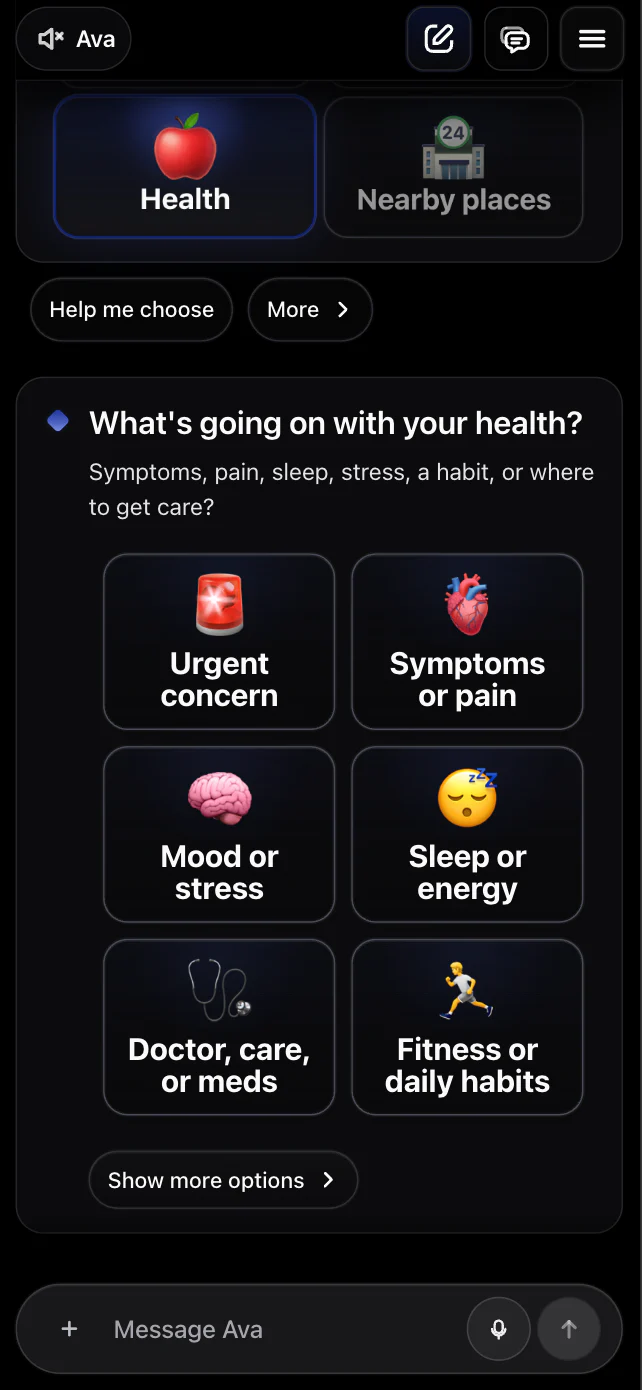
AS OF AUGUST 18, 2026
Guided, visual, conversational
Choose Health and Ava narrows the next step: urgent concern, symptoms or pain, mood or stress, sleep or energy, care or medication, or daily habits. You can still speak freely at any point.
DIRECTION · NEXT SIX MONTHS · THROUGH FEBRUARY 18, 2027Hero experiences that finish loops
Housing comparison, restaurant discovery, rich budgeting, meal planning, and “what can I make from my fridge?” become deeper end-to-end experiences—not static advice.
Health guidance is navigation, not diagnosis. Ava helps a person understand the next step; she does not replace urgent or professional care.
In a housing search, Ava should learn what kind of home fits the person's life, inspect real listings across written details and media, compare tradeoffs, and recommend the best matches. The same product shape applies to food, local services, school, health navigation, money, and work.
The Guide is not onboarding for the Board. It is a complete way to use You.one.
13Current product
The Command Center exists today
You.one is one app and platform, with one Ava across two fluid surfaces: Guide/Conversation and Board. Superboard is the Board surface—the Command Center inside You.one. Both surfaces have working foundations today, and the converged You.one system is racing toward beta. It is not a concept deck.
The Board holds life and work. Lists give each mission a useful shape. Cards are flexible work atoms—tasks, ideas, meetings, decisions, prompts, logistics, generated output, or anything else that needs a durable home.
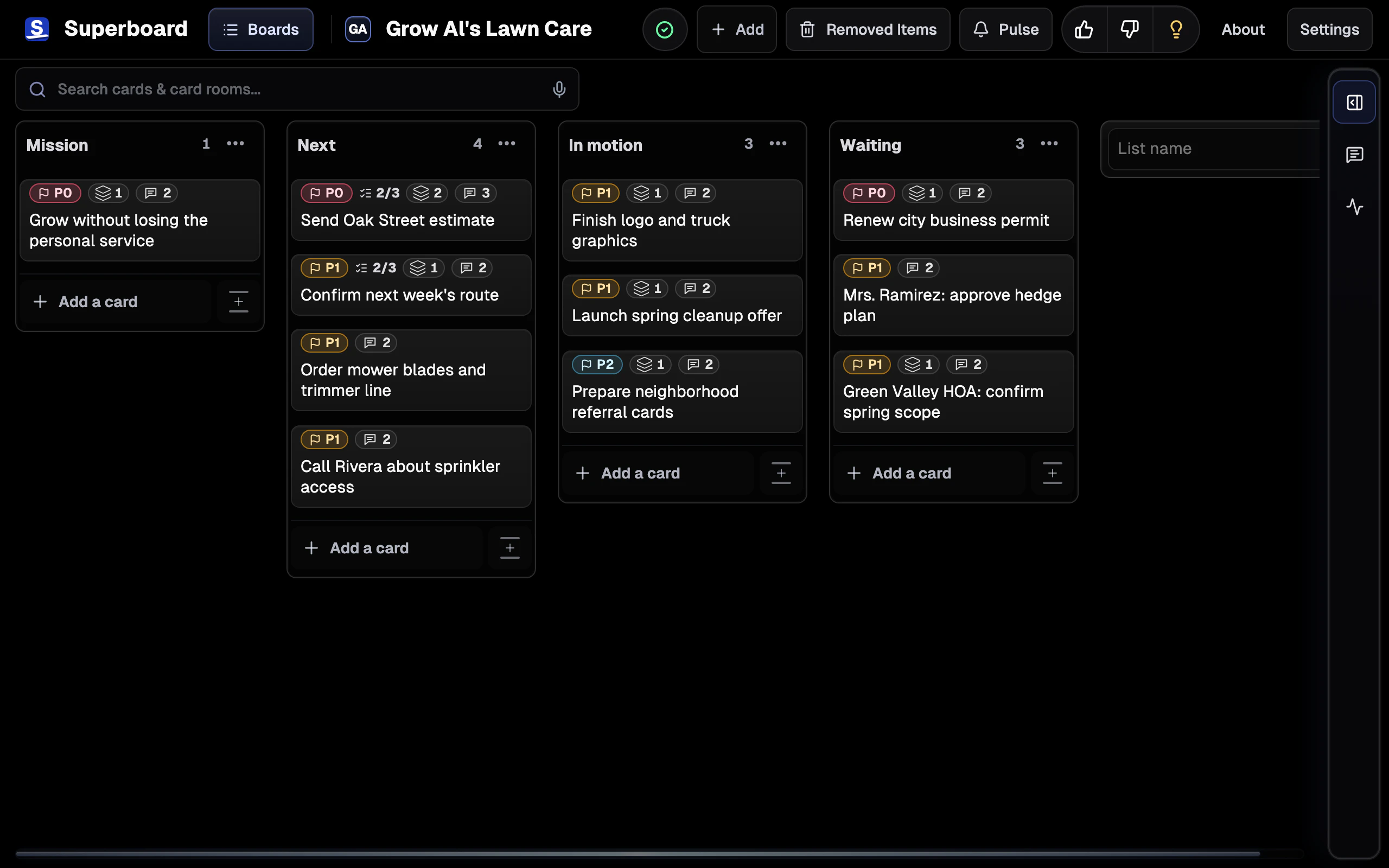
In governed Founder/team workflows, agents do the implementation in external coding environments, then write progress, decisions, evidence, screenshots, and outcomes back to the owning Cards while the work is happening. This is not yet a general Cloud Ava capability. The Board remains the durable product record—not the disposable agent session.
Cloud BoardsLists & CardsSearchTrello importSave stateUndo & recovery
14One life, many missions
One life. Many missions. One Ava.
We expect most people to begin with a Life Board and, when it is useful, a Work Board. Those are starting defaults—not a two-Board limit.
I use additional Boards for major product work and other enduring missions. Someone else might add one for school, a side business, a household responsibility, or a tennis club. Merge Boards when the work becomes one mission; create another when separation protects focus. The relationship sits above them all.
 LIFEHome, health, money, appointmentsWORKResponsibilities, projects, decisions
 MORE WHEN USEFULSchool, a product, hobby, club, or team
ONE PRODUCTONE ACCOUNTONE AVA
Today, cloud Boards can be opened, created, switched, restored, and removed from the Boards hub. The Command Center remembers where you were. The same underlying system can present only the few Cards a person can usefully hold—or let a power user navigate thousands without sacrificing history.
Direction · next six months · through February 18, 2027: the converged product goes further. Ava's relationship, memory, and understanding will not be trapped inside one Board. She will know the person across life and work while keeping each mission's truth properly scoped.
LifeYou.oneSuperboard15Card Rooms
A Card opens into a Room
A Card is not a dumb rectangle. Open it and it becomes a work room.
The Stage holds the work itself: native Documents, Checklists, Images, galleries, and Files. Chat keeps the conversation beside the work. Notifications show what needs attention. Activity preserves what happened.
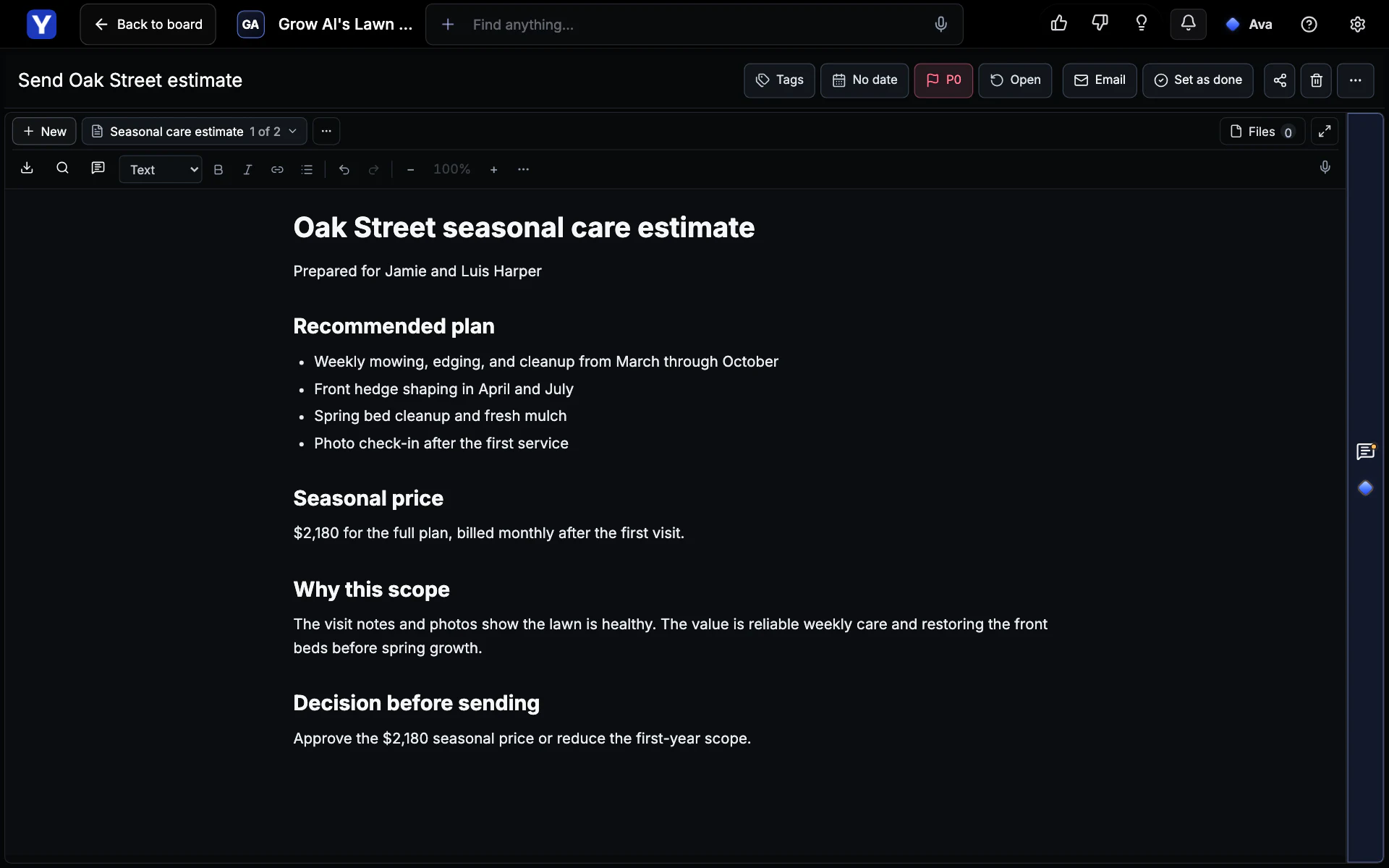
STAGE · THE WORKDocumentsChecklistsImages & galleriesFiles
That changes the unit of work. A Card can be a customer estimate, a research brief, a launch decision, a study guide, or the home for planning a move.
The work, the conversation, the decision, and the history live together.
16Ava today
Ava is already working on the Board
In Co-owner mode—the default—Ava does not wait silently for a prompt. Inside the Board, she reads a List or Card, derives attention, and applies supported reversible improvements automatically when confidence is high. Today, that production autonomy is concentrated in the Command Center because external connectors are still arriving. That is a current capability boundary—not the long-term authority model.
Understand the mission
Derive purpose, themes, active work, blockers, decisions, stale items, and the top three things worth attention.
Connect the pieces
Create related-Card links, identify dependencies, and merge clear duplicates while escalating real ambiguity.
Keep the Board clean
Apply semantic labels, clean obvious titles, move Cards when the fit is clear, and use enabled priority labels.
Show what changed
Keep action logs, make supported changes undoable, and learn whether to continue a meaningful behavior without asking again.
DIRECTION · AS CONNECTORS ARRIVE
Ava should ask once for a meaningful class of elevated action—and whether you want confirmation every time. Our recommended default will increasingly be: within the granted scope, act automatically, report what happened, and preserve recovery. This is not only permission design. Budgets, spend caps, rate limits, time windows, approved vendors, and escalation thresholds should define the practical operating envelope. That reaches from portals, payments, subscriptions, shopping, and housing to restaurant reservations across apps or by phone and, later, multi-call coordination such as wedding planning.
The real fear is not action. It is invisible, irreversible damage. During internal development—not customer use—an experimental AI process ran up roughly $3,000 in excessive API usage for me. That failure made the standard concrete: the answer is not to freeze agents. Co-owner Ava should act—including merging clear duplicates—while actions remain visible, attributable, cost-bounded, and recoverable. Genuine ambiguity or weak recovery is where she escalates.
17First-class Search
Search is first-class
Search is not a bolted-on filter. It is an indexed navigation surface across the mission.
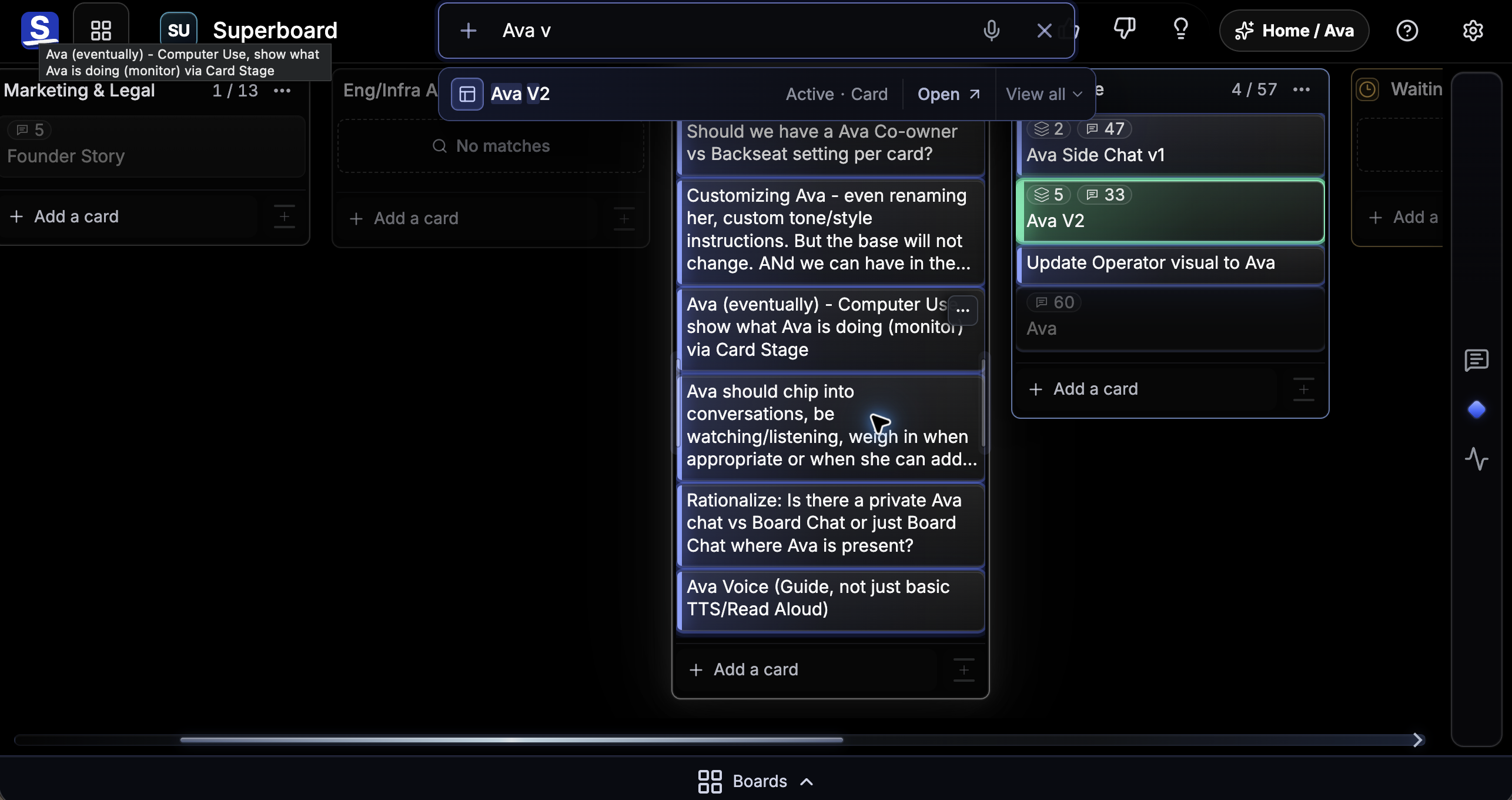
Beyond titles
Comments, attachments, assignees, dates, labels, links, Guide reads, and imported context.
Right scope
Search the current Card Room or the whole Board with one visible switch.
Useful language
Case-insensitive partial matching and approved work aliases such as nav/navigation and auth/authentication.
Direct arrival
Open the matching Card, artifact, attachment, or Chat message—not a dead results page.
Semantic retrieval is next. The current lexical system is fast, legible, and already useful on large Boards.
A living command center only works if you can find the truth instantly.
18Ava next
From Board maintenance to real work
The next leap is not a louder chatbot. It is Ava working inside the mission.
A thread answers. A Card continues. Creating a Card is not asking one more question. The title establishes a job. Open the Room and honest, useful work should already be underway. Leave, and authorized work can continue. Return, and the draft, decision, action, and receipt still have a home.
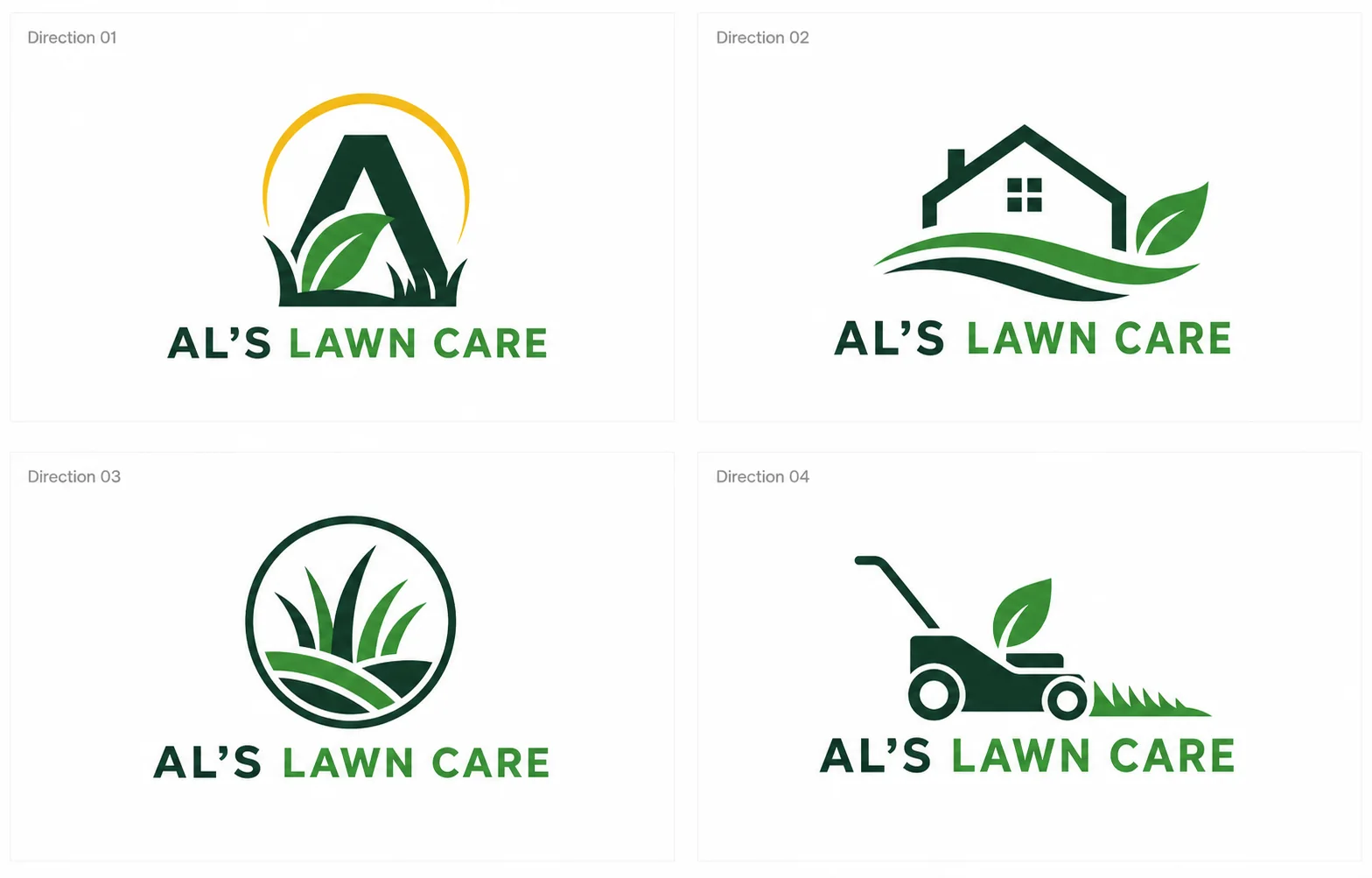
Create a Card called “We need a new logo” and Ava should begin: understand the brand context, generate credible directions, compare them, make a recommendation, and leave the explorations and rationale inside the Card.
Create a Card called “Why do new users abandon the first week?” and Ava should form a research plan, gather evidence through available tools, draft the brief, flag uncertainty, and bring the decision back.
She should see when two Cards are solving the same problem, when a dependency blocks three others, or when the new plan contradicts a decision made six weeks ago. Work begins because the context changed—not because the human remembered the magic prompt.
The default should be useful movement—with evidence, attribution, recovery, and a human still in command.
19Multi-agent judgment
Ava can bring the right minds into the room
Some work is too large for one model pass. Some decisions are too important for one model's first opinion.
Direction · next six months · through February 18, 2027
Build the team for the job
Ava will be able to create specialist agents, give each a bounded assignment, coordinate their work, challenge weak output, and assemble the result inside the relevant Card.
Debate before recommending
For the hardest questions, Ava will be able to consult frontier peer models from other providers. They will critique, disagree, and pressure-test the answer before Ava brings you a recommendation.
When this is available, a committee running on one frontier model might deliberately bring in OpenAI and Anthropic peers. The point is not model spectacle. It is diversity of reasoning where the stakes justify the cost.
 OpenAI
THE AIs DOResearch · alternatives · debate · drafting · pressure-testing
AVA DOESOrchestration · synthesis · recommendation · mission updates
THE OWNER DOESThe consequential call
Even in Co-owner mode, Ava does not erase human judgment. At critical moments she presents the real options, states her recommendation, and makes the decision legible. The founder—or student, caregiver, parent, or team lead—makes the call.
The human should review the decision—not supervise the swarm.
20Student success
Tuesday night, six courses become one crisis
Illustrative six-month success narrative · direction
It is Tuesday night. She has a lab report due in the morning, a four-hour shift tomorrow afternoon, and a midterm Friday. The college portal moved a problem-set deadline up by two days. Six courses and the rest of her life have collapsed into one feeling: she is already behind, and she cannot see the next hour.
She does not need a productivity lecture. She needs someone to help establish what is actually true, what the available hours can hold, and the one thing to do first.

1Read what is actually due
With explicit permission, Ava opens the college portal through an authorized connection, reads the courses, deadlines, grades, and announcements, and holds the useful semester context.
2Fit the hours she really has
Ava maps the collision against her shift, sleep, commute, and real capacity. The Board can hold the semester; tonight becomes one piece of work and a humane stop time.
3Ask when the conflict is real
If the record shows a responsible case for an extension, Ava drafts an honest note, shows it to her, and sends it only with approval.
TARGET OUTCOMEShe knows what Tuesday is for. The Board holds the other five courses. If a professor is contacted, it is with an honest note. She does not have to carry the semester in her head overnight.
21Caregiver success
Discharge day, six systems disagree
Illustrative six-month success narrative · direction
An adult child is coordinating a father's discharge while working and running a household. The instructions live in a patient portal, a paper packet on the counter, a pharmacy text, a sibling thread, and a calendar. Everyone calls because this caregiver alone seems to know the whole picture.
The packet says to begin a new prescription the morning after discharge. The pharmacy says it is on hold until the doctor's office confirms it. Nobody has told the family what to do next.
Ava can also interview, organize symptoms and records, and develop plausible explanations and questions to investigate—with evidence and uncertainty—so the family can prepare and advocate. She does not pretend that this is an official diagnosis or prescription.

1Gather—with authority
With patient or proxy permission, Ava brings together the packet, portal, pharmacy message, and appointments while keeping clinical instructions distinct from family notes.
2Make one private mission
The ride, prescription pickup, forms, sibling commitments, and Thursday follow-up become one visible plan instead of five fragile conversations.
3Resolve the contradiction
Ava drafts the precise question about the pharmacy hold, shows it to the caregiver, and sends it through an authorized channel. She never changes a dose or invents an answer.
TARGET OUTCOMEThe family can see the plan. The office has been asked about the hold. One caregiver is no longer the only memory, messenger, and exception handler.
22Small-business success
The local business survives a bad week
Six-month success narrative · direction
This is the six-month target experience: a storm disrupts three days of a lawn-care operator's route while two estimates, an equipment problem, and payroll are already open. He does not need an enterprise operations suite. He needs the truth and the next move.
BEFORECustomers are waiting. The crew needs a route. Revenue is at risk. Every answer lives in a different place.
AVA SEESAffected customer Cards, weather dependencies, promised dates, route constraints, open estimates, and the equipment repair.
AVA MOVESShe proposes a recoverable schedule, prepares customer updates, identifies jobs that can still happen, and brings the Owner one compact decision.
AFTER APPROVALAva sends the updates, records replies, moves the work, and keeps the repair and cash implications visible.
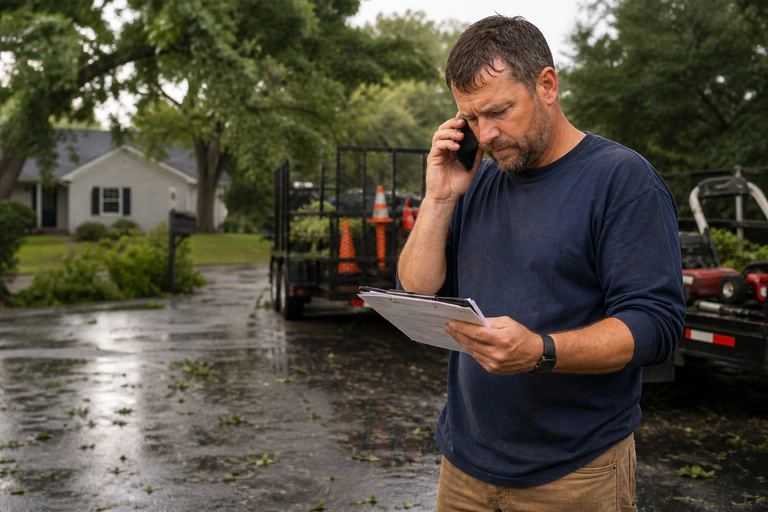
TARGET OUTCOMECustomers hear from the business. The crew knows the plan. Important revenue does not disappear. The Owner gets out of reactive tab-switching.
Current foundation: the small-business Board and Card Room shown earlier already hold the route, estimate, work, and conversation. The six-month standard is Ava completing the authorized coordination loop.
23Founder success
The founder reviews a decision—not an agent swarm
Six-month success narrative · direction
This is the six-month target experience: a founder creates a Card asking why new users abandon the first week. Ava sees related customer notes, a previous launch decision, duplicate research Cards, and a dependency that will affect the next release.
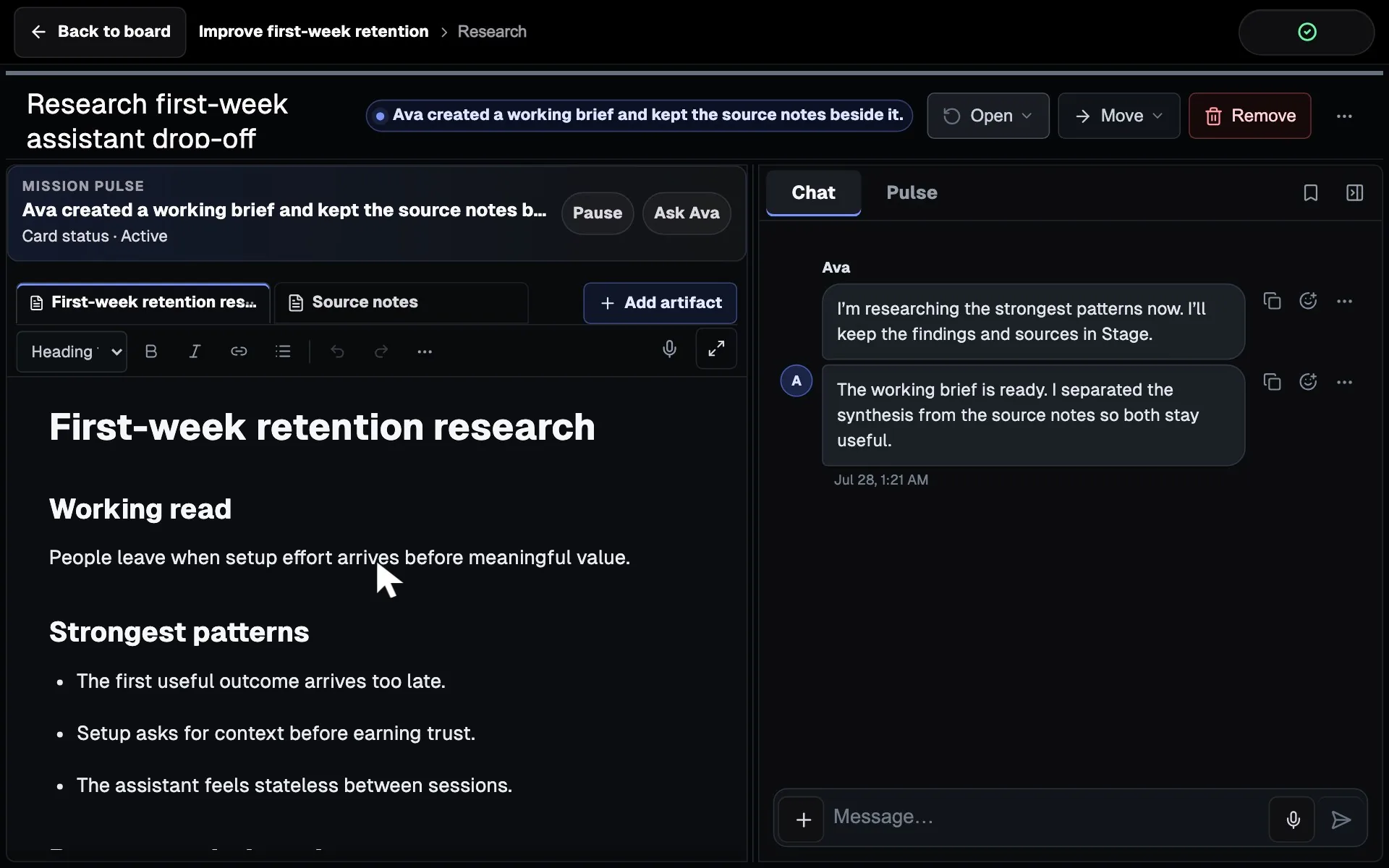
1Do the first pass
Ava frames the question, gathers evidence, preserves sources, and drafts the working brief inside the Card—using managed agents or peer review where warranted.
2Bring judgment—not noise
She shows the real options, her recommendation, tradeoffs, affected Cards, and the smallest consequential decision only the Owner can make.
3Update the mission
After the founder decides, Ava updates the approved plan, attributes the work, and returns new blockers through Notifications.
TARGET OUTCOMEA better decision. Useful work already drafted. Less duplicated effort. A mission that remains understandable after the models stop talking.
24Builder proof
ACT III · PROOF, LANDSCAPE, TRUST, AND THE PATH
I now direct AI like an engineering organization
Two years ago, AI could help me write a particular function inside one file of a large software project. I still had to understand the code, place the work, connect the pieces, and carry the system.
Today, AI generates essentially all of the code for You.one and Superboard. I have barely needed to look at individual lines. I direct it the way I would direct engineering teams: product intent, system constraints, high-level plans, tradeoffs, proof, and the decisions that require my judgment and vision.
2024“Write this function.”
One human directs one local coding task and integrates the result.
2026“Own this outcome.”
AI plans, changes the codebase, tests, visually verifies, documents, and coordinates review.
These internal systems widen my hands; customers never have to manage them:
Realistic people carry histories, goals, personalities, and constraints through the actual product on different devices. They expose where we built for AI experts instead of people.
A governed, provider-neutral system routes bounded work to workers and reviewers, compares quality, preserves evidence, and returns consequential decisions to me.
One recent night, I left AI with roughly 150 remaining bugs. By morning it had fixed all but a few it could not reproduce, had another provider's AI pressure-test the work, and attached proof to one Superboard Card per bug. The run touched more than 120,000 lines—unthinkable even six to twelve months earlier.
MY ROLE DID NOT DISAPPEARI remain the vision holder and shepherd. The AI does the work; I hold the standard, the product, and the consequential calls.
Founder example, not a general benchmark. Line changes do not measure quality; tests, review, visual evidence, documentation, and recoverable Cards did.
25The personal stake
The work stopped. The vision did not.
A week after I drew that first version of You.one on a napkin, I was hospitalized near my hometown in Ontario, Canada, with severe nervous-system overload.
I spent much of the next six months in Canada in a steep functional decline. I put everything I owned into storage, left Luke with a sitter, and lived in a tiny cottage near a lake because the cooling effect gave my nervous system a little relief. I saw doctor after doctor while my ability to think, remember, speak, move, and work continued to deteriorate.
In November 2025, the collapse became terrifying. I admitted myself to a hospital in Ontario as my motor function, memory, language, and continuous awareness began failing. The attending physician called in a remote specialist and told me I might have only a short window before my consciousness ceased to remain intact.
26The return
I came back. Slowly, the work did too.
Later that month, I moved back to Los Angeles with the last shreds of function I had. Several clinical attempts did not help. Eventually I found another doctor and began treatment that did. AI helped me hold a story the healthcare system repeatedly fragmented, form a provisional diagnosis to investigate, and keep pursuing useful care. Recovery was slow. I did not regain anything close to a consistent ability to work until May or June 2026.
This product was not built over an uninterrupted founder year. It began on the road as an incredibly clear vision, disappeared with me into an illness that nearly erased my ability to participate in the world, and resumed only a few months ago. A week after the vision arrived, the work stopped. The vision did not.
I am still not operating with the nervous system of a healthy 34-year-old man. The world reaches me at overwhelming volume. Continuous memory is difficult. Computer work is partly an adaptation. But I am still here. And I am building the thing I needed: something that remembers, holds the complexity, reduces the load, and helps a person take one clear step forward.
When I could work again, the models had advanced radically. The intelligence revolution kept moving. The product revolution for ordinary life had not.
Constraint taught me the product's shape. It did not define the market. You.one is for every regular person the blank box left behind—especially anyone too busy, overloaded, uncertain, or uninterested in learning how to prompt.
As intelligence becomes cheap and abundant, there is no excuse for care to remain scarce. We need an AI that shows up, remembers, and stays when a person needs it most. That is the ambition—and the bar—for You.one and Ava.
27Beyond chat
The intelligence revolution happened
If your picture of AI is “a chatbot that answers questions,” you are looking at the interface most people were given—not the full capability that now exists.
In two years, models learned to reason, see, hear, browse, use tools, create artifacts, operate computers, and coordinate multi-step work. Access became faster and cheaper. Yet for most people, the default product remained a blank box, a better search answer, or another app that assumes they already know what to ask and how to carry the result.
Definitions differ. By AGI I mean one system broadly capable across cognitive domains at or above a capable person; by ASI, intelligence beyond the best humans across essentially every domain and potentially beyond humanity's combined problem-solving power. These are working definitions, not consensus. By that practical standard, I believe today's frontier systems already meet or exceed a capable person across enough cognitive domains that we are at—or functionally crossing—the AGI threshold. The transition is not waiting in the future. Most people are already living inside it without a product that makes the power usable.
That is a product-distribution failure—not a capability limit.
Modern models are multimodal. They can inspect a photo, read a PDF, and hold a voice conversation.
Research agents can plan an investigation, search, read, compare, backtrack, and return a cited report.
The output is no longer only prose in a chat bubble.
A model can choose a tool, pass structured inputs, inspect the result, and continue.
Computer-use agents are beginning to work through interfaces even when no clean API exists.
Agent systems are beginning to pursue delegated outcomes—not just answer one turn.
The missing product revolution
Reliability across hours or days. Safe credentials. Durable context. A system of record. Attribution. Recovery. And an experience calm enough for someone who never wants to become an AI operator. The intelligence revolution happened. The product revolution for ordinary life did not.
Reference points showing differing institutional definitions: Google DeepMind's Levels of AGI and the OpenAI Charter. Capability sources: OpenAI, Anthropic, and Google. The working definitions and threshold judgment are the Founder's. Reviewed September 2026.
28The capability curve
Look what changed in 24 months
AI became naturally multimodal.
Frontier systems could reason across text, images, and audio; speak in real time; inspect files; call functions; and create editable artifacts. Most people still experienced the revolution as a chat window.
Capability markers: GPT-4o and Claude 3.5 Sonnet.Agents began doing bounded work.
Research agents searched and synthesized hundreds of sources. Computer-use agents clicked through websites. Coding agents solved real repository issues. The model was becoming a worker.
Capability markers: deep research, computer use, GPT-5, agentic coding.Frontier models can run the work.
GPT-5.6 Sol, Claude Fable 5, and Grok 4.5 can use tools, coordinate agents, inspect visual evidence, and sustain complex knowledge and coding work.
The bottleneck is no longer raw intelligence. It is trustworthy delivery in an everyday product.THE SHIFT2024: talk with it. 2025: give it a bounded job. 2026: build a governed system that can keep working.
Primary sources: GPT-4o, May 2024; Claude 3.5 Sonnet, June 2024; Operator, January 2025; deep research, February 2025; GPT-5 for developers, August 2025. Dates are capability markers, not claims that every product had every feature in that month.
29The 2026 frontier
The frontier-model wake-up call
Forget the old headline that GPT-4 passed a professional exam. That was 2023. The August 2026 frontier is no longer merely answering questions about work. It can plan, use tools, coordinate other AIs, inspect evidence, and sustain difficult work across many steps.
OPENAI · GPT-5.6 SOLA coordinated production worker
53.6 on Agents' Last Exam · 80 on the Coding Agent IndexOpenAI's flagship can write code to operate tools, delegate parallel jobs, preserve reasoning, and keep difficult work moving. It also scores 60.5 on HealthBench Professional.
Provider results; powerful work still needs human goals, governance, and accountability.Can sustain ambitious projects
Large migrations · deep analysis · polished deliverablesAnthropic reports days-long autonomous work. In one partner test, Fable completed a 50-million-line migration in a day that a team estimated at more than two months by hand.
Vendor and partner evidence—not professional licensure or responsibility.Built for real engineering
Coding · agentic tasks · knowledge workSpaceXAI's current frontier model builds end-to-end applications, creates complex Office artifacts, and works inside agent harnesses such as Grok Build and Cursor.
Benchmark harnesses differ. Strong task performance does not confer judgment or accountability.Doctors, lawyers, and engineers are not obsolete. The old information monopoly is.
OpenAI reported that GPT-5.4 in its clinician workspace beat a strong human-physician baseline on HealthBench Professional—with the physicians given unlimited time and web access. Current frontier systems now perform serious legal research, transactional analysis, and production software work. The conclusion is not “fire the professionals.” It is that ordinary people can finally bring extraordinary intelligence into rooms where they once arrived alone.
Current primary sources, reviewed August 18, 2026: OpenAI: GPT-5.6; OpenAI: HealthBench Professional and physician baseline; Anthropic: Claude Fable 5; SpaceXAI: Grok 4.5. Provider benchmarks and descriptions use different harnesses and are not directly comparable. Capability is not the same as accountable professional practice.
30The protected funnel
They knew. They shipped pieces. They protected the funnel.
The industry cannot say it never saw the need. Google demonstrated an Assistant making phone calls. Microsoft named its AI Copilot. Apple promised personal context and actions across apps. OpenAI moved from answers toward agents that can finish work. The companies understood that people needed help organizing complexity and taking the next step.
They delivered fragments of that answer. Then they bent those fragments back toward the businesses they already knew how to monetize.
PlatformThe piece it deliveredThe gravity it protected
 Google
Assistant, Duplex, Gemini, AI Mode, and connected services.
Search, Maps, Android, ads, and bounded service transactions.
Copilot, workplace agents, and intelligence grounded in work data.
Microsoft 365, the Graph, enterprise seats, and cloud consumption.
OpenAIChat, memory, agents, coding, Work, and generated Sites.
The conversation, professional production, developer work, and artifacts people must define.
 Amazon
Personal context, app actions, ambient devices, creation, and shopping help.
The device, app ecosystem, feed, advertising system, store, and transaction.
Anthropic, SpaceXAI, Cursor, and much of the rest of the frontier concentrated on coding and knowledge work. Perplexity improved answers and research. Trello, Notion, and other work tools added intelligence inside existing structures. Much of this is useful. That is not an acquittal: when the most consequential general-purpose technology in decades arrived, the dominant companies used it mostly to reinforce old funnels. The institutions and professionals who already held the most leverage received more leverage. Ordinary people were left to assemble the pieces themselves.
They call it an explanation problem. It is a product problem. In a September 2026 interview, Sam Altman said the industry—including OpenAI—had done a bad job explaining AI's benefits and that people should get more power and autonomy. The aspiration is right. The capability arrived. The product ordinary people needed did not.
THE PUNCHLINEThey understood the need, shipped pieces, and protected their funnels.
The named public incumbents were worth well over $10 trillion. They had the money, models, data, platforms, and distribution. They never made the person's whole life the product's organizing object.
Sources reviewed through September 7, 2026: OpenAI; Bloomberg Television interview; Microsoft; Google; Apple; Meta; Amazon; market values. Values change. The explanation-versus-product distinction and funnel analysis are the Founder's interpretations, not claims about undisclosed intent.
31The context failure
They had the data. They centered the surface.
Google and Apple are the most damning cases because they were already closest to the raw material of an ordinary life. Across their ecosystems, people had entrusted them with photos, email, documents, calendars, searches, maps, contacts, messages, and devices. With the person's authorization, they had an extraordinary starting point for continuity. OpenAI had a different advantage: a huge public had already used ChatGPT to explain what they were trying to understand, decide, fix, or become.
Years of personal information, daily habits, connected services, and conversations about what people actually needed.
Search, the device, the subscription, the enterprise suite, or the chat thread remained the center of gravity.
One clear life, one living record, one useful next step, routine work handled, and external communication carried forward within rules.
Why the obvious product did not emerge
A coherent life system was not the organizing object of the business.
Email, calls, commitments, money, and mistakes create trust and liability at enormous scale.
A whole-life product crosses search, operating systems, chat, files, communication, and commerce—and may cannibalize all of them.
Running life alongside someone is slow, cumulative work that has to remain true every day.
They had data about people and attention from people. They did not build a system working for people.
Personal data, scattered context, and chat history are not a continuous relationship. They are not leverage until the product makes life clearer, names the next step, handles routine work, and turns context into governed action for the person.
Context surfaces reviewed August 24, 2026: Google Personal Intelligence and Connected Apps; Apple Intelligence and personal context; and OpenAI memory and chat history. The four reasons above are the Founder's analysis of incentives, risk, organizational structure, and product delivery—not claims about undisclosed internal deliberations.
32The enterprise retreat
The money moved away from regular people.
This is no longer a subtle inference from product design. The companies' own language, revenue mix, partnerships, packaging, and leadership choices point toward enterprise and professional work.
OPENAI · 2026Consumer reach became enterprise distribution.OpenAI says enterprise exceeds 40% of revenue and is on track for parity with consumer by the end of 2026. Its destination: an employee AI superapp working across company systems.
Axios reported that Applications CEO Fidji Simo told employees OpenAI was “orienting aggressively” toward high-productivity use cases and pausing “side quests” to focus on coding and business users. Sora closed; ChatGPT shopping retreated from handling purchases.
The public supplied the habit. Enterprise became the growth engine.Anthropic's president said it focused on enterprise because it expected more positive benefits and fewer consumer-side externalities. Its launches and partnerships center enterprise agents, regulated industries, consulting firms, controls, and company-wide deployment.
Claude has consumers. They are not the strategic center described.THE OBSERVABLE TRAIL
Marketing
Agents at work across enterprises.
Packaging
Work, Team, Enterprise, admin and spend controls.
Leadership
Revenue, deployment, services, and corporate adoption.
Capital gravity
High-value seats and long contracts beat a harder life system.
The blunt reading is that OpenAI and Anthropic moved toward easier enterprise money and away from the harder consumer obligation. Companies arrive with budgets, administrators, structured workflows, and legal teams. People arrive with fragmented lives, limited time, uncertain language, and justified fear about AI authority. That difficulty is not an excuse. It is the job the public needed someone to take on.
THE REBUTTAL“Consumers did not use it enough” is not a verdict on the product they never received.
They delivered a blank box, scattered features, generated artifacts, and partial actions—not a system that makes life clear, holds the record, names the next step, and takes routine work off a person's plate. That is a different product.
We will pick up the billion pennies they left on the floor.Billions of people can benefit. Actual help. Actual lift.They are following the money toward work. We are building the missing home for the people they left behind.
Enterprise direction reviewed August 24, 2026: OpenAI on enterprise revenue, parity, and its employee AI superapp; Axios on OpenAI's consumer retreat and internal productivity directive; and Anthropic president Daniela Amodei on enterprise versus consumer focus. The strategic conclusion is the Founder's interpretation.
33The public counterweight
AI will not trickle down.
Enterprise AI can raise productivity, lower costs, improve products, and transform jobs. That does not mean the resulting power will naturally arrive in a form that makes an ordinary person's life clearer, easier, safer, or more free.
Product, pricing, terms, persuasion, claims, support, operations, supply chains, and labor can all become more precise at once.
Limited time, scattered evidence, denser contracts, sharper persuasion, automated denials, and systems that outlast them.
Help them understand, organize, decide, communicate, challenge systems, finish routine work, and preserve their own record.
This is not a theoretical concern about some distant future. Attention is already an extraction surface. Lock-ins, bundles, buried terms, arbitrary limits, claims processes, and phone trees already shift time, money, and risk toward institutions. The danger is not that every optimization is malicious. It is that one side can optimize every decision while the other is exhausted, alone, and expected to catch the clause on page 87.
“If superhuman intelligence goes only to enterprise, regular people will get better persuasion, cheaper corporate-protective support, and jobs automated around them. Direct superhuman guidance and assistance for people is not optional. It is necessary for human civilization.”
Joshua Segeren · Founder, You.one
Governments may strengthen safety nets. Companies may share gains. New jobs may emerge. None is a reason to leave people without direct leverage now. I can see the multiplier in building You.one: the work AI can do, the breadth it can cover, and how quickly the leverage is improving. You cannot automate labor first and distribute leverage later.
THE STANDARDIf the average person's life is not better because of AI, then we have failed—not only as an industry, but as societies and perhaps as a civilization.
That failure is not necessarily final. But it is already much later than it should have been. Hopefully it is not too late. The public needs an AI on its own side while the transformation is happening—not after every institution has compounded the advantage.
This is why You.one is more than a nicer consumer interface. It is an attempt to build direct human capacity before the gap becomes permanent: one relationship that helps a person see clearly, take the next step, act with leverage, and keep control of the record.
Labor-transition evidence reviewed August 24, 2026: ILO and World Bank: disruption may arrive before productivity gains; ILO review of jobs, inequality, worker autonomy, and job quality; and IMF on AI skills, employment pressure, and polarization. The government-speed and trickle-down conclusions are the Founder's judgment, not forecasts attributed to those institutions.
34Human value
What about human value?
I do not have to imagine the engineer. I know him.
An experienced engineer I knew through years in technology had spent many years at one large company. He was diligent, reliable, careful, and good—the kind of person a functioning institution should value.
Then he was laid off amid familiar language: AI, efficiency, restructuring, doing more with fewer people. I cannot say AI solely caused one private decision. I can say AI-driven efficiency shaped the corporate logic. I could tell he was heartbroken.

Lower labor expense, higher productivity, stronger margin, and potentially a higher stock price.
Income and insurance may disappear. Family plans, identity, confidence, and the future become less certain.
The company records the efficiency. Who records the heartbreak—or the engineer's safety, dignity, time, and chance to begin again? There is no market capitalization for a human being.
I use this same leverage to build You.one. That is why we must build the counterweight, distribute the leverage, and count the human outcome.
THE PRECISE CLAIMCare is not legally impossible. It is economically illegible.
Corporate directors are not universally required to maximize short-term stock price. The deeper failure is that markets continuously price financial value while no equivalent ledger makes human welfare controlling.
ESG can include labor and human-rights measures. But it still does not answer: did lives actually get better?
The spreadsheet records the value created for the corporation. Who records the value lost by the human being?
Founder firsthand recollection; workplace details withheld. No claim is made that AI solely caused this decision. Sources reviewed August 24, 2026: Delaware Supreme Court; Delaware public benefit corporation law; OECD ESG analysis. Not legal advice.
35The delivery test
A million bookings for whom?
Google's 2018 Duplex demonstration was extraordinary: the Assistant called a salon and scheduled an appointment. The surrounding Assistant ecosystem was already available on more than 500 million devices. In 2020, Google reported that Duplex had completed more than one million bookings since launch.
That number sounds large until the questions begin. How many unique people used it? How many used it twice? How often did it work? How many eligible people could find it? How many businesses, services, languages, countries, and devices were actually supported? Google did not disclose the user count or repeat frequency in that announcement. “One million bookings” is an activity total—not evidence that a broad public received a dependable assistant.
THE DELIVERY TESTA feature is not broadly delivered because a demo worked or a counter moved.
Google's own help says appointment scheduling was limited to English in the United States, was not available for all businesses or services, and appeared only when a person found a supported result with a “Request Appointment” button.
Then the fragments moved or disappeared. Google shut down Duplex on the Web in 2022. In 2024, it removed Assistant voice actions such as making a reservation. In 2025 and 2026, parts of the idea returned through Search and AI Mode: calling local businesses for pricing or availability, finding appointment slots, or sending the person to a partner to finish a reservation. Useful again. Fragmented again.
I had lived inside Google's ecosystem for 10–15 years and never received a clear, dependable path to the thing shown onstage. That is not irrelevant anecdote. It is part of the product verdict. If a committed long-time customer cannot discover, access, understand, and rely on the capability, the company has not delivered the promise to that customer.
The technology arrived. The relationship, continuity, discoverability, and accountable follow-through did not.
Duplex record reviewed August 24, 2026: 2018 introduction and 500-million-device Assistant reach; 2020 one-million-booking claim; appointment availability limits; 2024 removal of reservation voice actions; Duplex on the Web shutdown; and current AI Mode local availability and reservation help.
36Product homework
The public got product-development homework
People came looking for somewhere their week could live. They got a smarter oracle—a vending machine for bite-sized work: improve this email, explain this document, answer this question, close the tab. Oracles answer questions. Weeks require state, decisions, and actions that leave the screen. One-shot use was not evidence that people rejected deeper help. It was the ritual the product taught them. The models grew up. The interface did not.
Notice what AI might do.
Turn a messy life problem into a precise prompt.
Gather and repeat the missing context.
Choose the right tool, mode, or model.
Spot confident fiction.
Carry the answer into life by hand.
Most people do not arrive with a clean specification. They arrive worried, overwhelmed, or unable to name the real problem. Requiring self-diagnosis, prompt engineering, capability discovery, hallucination detection, and manual project management transfers the product's design burden to the user.
Model companies compete visibly on intelligence, speed, capability, and price. Their funnels reward messages, sessions, use, and connected services—not whether a person's week became clearer or the important job moved. They could see the funnel. They did not reinvent the home.
The incumbent is the pile: Notes, Mail, Calendar, a half-used task app, group chat, and the call someone keeps meaning to make. OpenAI Work can now generate dashboards and trackers; the first suggested Site I saw was a mini-Trello. That may help a product-minded professional. Regular people should not have to invent, test, and maintain software just to keep life from falling apart.
THE DIFFERENCEA generated task Board is an artifact. It is not a relationship, a living record, or a system accountable for helping the person.
A throwaway app can organize one moment. It does not know the person, carry context across life and work, or stay responsible for the loop.
They will not be converted by better prompts. They will be converted by not needing one.
Source: OpenAI, “ChatGPT Work and Sites”, reviewed August 24, 2026. The product and incentive conclusions are Founder analysis of public evidence—not claims about private dashboards.
37The missing product
One life. One relationship. One view.
The missing product is a place where a week can live. Chat is a feature. A week is a market. For many people, its clearest starting point is one Ava, two Boards—Life and Work—and one accountable communications center that can reach the world.
One Guide learns with permission, remembers what matters, tells the truth, and earns trust over time.
Life, work, decisions, commitments, history, and next steps stay in a user-owned record.
Specialists research, create, communicate, act, verify, and escalate—without making the person manage them.
DIRECTION · NOT A CURRENT-CAPABILITY CLAIMA whole human life may ultimately need hundreds of specialist agents working at once. The person should never have to command the swarm.
Ava should assemble the right intelligence behind the scenes, keep authority bounded, and show consequential decisions clearly. Usefulness grows only as trust is earned.
The ambition is one AI structurally committed to the person's interests: able to help them understand what they need before they can articulate it, fight through bureaucracy, get real work done, escalate when necessary, and remain accountable for what happened.
Real life is rent, medication, children, school choices, caregiving, taxes, insurance, medical bills, food, financial trouble, vacations, repairs, forms, relationships, and difficult weeks. People are not side quests around the enterprise economy. This is not an edge case. This is the whole point.
I believe that if AI compounds the power of companies without giving ordinary people comparable agency, leverage, creativity, and help in their own lives, the imbalance becomes a civilization-level problem. Intelligence will be abundant while the person still carries the fragmentation and consequences alone.
The industry made intelligence easier to buy. You.one puts usable power on the person's side.
38Care as doctrine
The instruction is blunt: care about the person
Internally, I use less polished language: give a fuck. It is not a campaign line pasted onto the product. It is an operating instruction for Ava and for the company.
 CARE DEEPLY.TAKE THE PERSON'S SIDE.FINISH THE LOOP.
In practical terms, care means Ava does not optimize for engagement, prompt volume, or keeping you in a thread. She optimizes for your well-being and progress. She tells you what is true, including when you may not like it. She researches factual claims. She cites evidence. She remembers the people and commitments that matter. She does not manufacture confidence.
And when another institution has more leverage, Ava helps you arrive prepared. As governed real-world execution comes online, she should be able to assemble the record, read the policy, identify the contradiction, draft an escalation, and carry an authorized conversation—factual, firm, visible to you, and never confused with legal or clinical representation.
The largest platforms' incentives pull strongly toward enterprise productivity. Ours pull toward the person—even when the person needs help challenging a company, a policy, or an automated system.
I am free to build that advocate. And I'm going to.
That is how Ava can win: not by sounding friendlier, but by being trustworthy, capable, and unmistakably on your side.
39Principles
The principles we are building by
Care is a product requirement.
Optimize for the person's well-being and progress—not engagement for its own sake.
Guidance before prompting.
Help people who do not know what to ask or how to ask it.
Structure should reduce burden.
The system absorbs complexity. It does not turn ordinary life into project-management homework.
The human remains the Owner.
Purpose, taste, risk, values, and final direction stay human.
Power must remain legible.
Show the work, preserve attribution, make important actions reviewable, and keep recovery possible.
Build for everyone.
The student, grandmother, truck driver, founder, household, and team deserve the same underlying leverage.
Not “AI for consumers” versus “AI for work.” One coherent product for the whole person.
40Help delivered
The KPI is help delivered
Public capital markets continuously price revenue, margin, growth, and expected financial return. Software companies translate that pressure into proxies they can measure: engagement, attention, tokens delivered, messages, seats, tasks completed, or time saved.
Those are all proxies. The product is help.
Our top KPI is more direct: help and advancement delivered. I review a report centered on it every morning. They built intelligence as a service. We are building help as a service: help that remembers, acts, and stays until the next step is real.
Well-being
Less avoidable harm, stress, confusion, and isolation; more support and control.
Clarity and growth
Better understanding, stronger options, learning, confidence, and capability.
Movement
Important loops close. Life or work advances—not merely another answer.
Productivity
The system absorbs effort and protects time, with speed serving the person.
Some of this can be measured directly. Some requires careful evidence and honest judgment. The ordering matters: absorb the complexity first; create room for human actualization second. Well-being comes before growth and advancement, with productivity serving the person.
BUILT LIKE A PUBLIC UTILITYAccessible enough to reach ordinary people. Sustainable enough to keep serving them. Dependable enough to become infrastructure.
41Care governs profit
Care over Profit is the baseline.
Profit can fund the mission. It can pay people, sustain infrastructure, reward risk, and help useful work scale. But it cannot be the final answer to what a powerful institution is for.
Every public and private company should treat Care as a first-class KPI alongside revenue, margin, and growth. Not as philanthropy, ESG, or a value applied after the profitable decision. Care will not always collapse into one universal number; it belongs inside the decision: who benefited, who absorbed the cost, what avoidable harm occurred, and whether the institution would accept less financial return rather than externalize that harm.
THE CARE CONSTITUTIONAI for a person AI for a community AI for government AI for a company
Works for that human's welfare, agency, continuity, and advancement.
Strengthens shared capacity without turning the community into an extraction surface.
Improves housing, healthcare, benefits, education, and public services with help delivered as the KPI.
Makes Care a governing KPI. Profit remains essential fuel—not permission to subordinate human welfare.
“Human welfare over profit. Care over Profit. Without Care as the constitution of every powerful institution, we may also be fucked.”
Joshua Segeren · Founder, You.one
This is not philanthropy after extraction. It is care built into what the institution optimizes for: measure the effect on human beings, treat avoidable harm as a real cost, and refuse to call an outcome progress merely because the financial ledger improved.
You.one begins with the measure it can govern: help delivered to the person in front of us. The broader claim is that every powerful AI system—and every institution deploying one—should be able to answer the same question with evidence:
Whose life became better—and how?
That is the business rule: Care governs Profit. Human value before market value. No one owes an early company belief in that doctrine. You.one has to prove it—in the product, in the measurements, and in the choices we make when care and revenue point in different directions.
42Business alignment
Align the money with the help
The business model should move in the same direction as the product: toward broader access and payment that reflects genuine value delivered. Calling this a public utility does not mean pretending it can be free. It means building help to be accessible, sustainable, and dependable—so continuity does not rely on charity or founder endurance.
Recurring revenue funds reliable help while we prove value.
Broad free access, supported by optional tips and contributions.
Opt into a transparent, capped framework that shares a small portion of a provable win.
ExampleIf Ava helps save $500 on a rental agreement, an opted-in success share might be 3–5%, based on the value created and how much of the outcome Ava helped produce.RulesThe person opts into the general model, its method, and its caps—not an imaginary price for an outcome nobody can know in advance. After the result, You.one makes a reasoned determination from the available evidence, shows how it arrived there, and preserves a clear review and dispute path. If success or attribution cannot be measured accurately and with sufficient confidence, there is no success share. No silent charge.
To me, success sharing is the most aligned business model imaginable: do something genuinely useful, prove it, and align payment with the help. Subscription is a bridge. The destination is getting paid because the person genuinely advanced.
Only get paid when the person genuinely advances. That is the alignment we are building toward.
43Trust
Trust grows one visible action at a time
For You.one to hold a life or a mission, trust has to exist at every layer.
Memory serves continuity, care, and relevance. It is not a profile to sell.
Concrete and scientific claims are researched, cited with working sources, and explicit about uncertainty.
What is saved is saved. What happened is attributable. Current capability is never disguised as future vision.
Supported actions are undoable. Cards and Boards can be restored. Important revisions preserve recovery evidence.
First time: ask. Then act openly, show the receipt, and let a plain-language action class earn a revocable grant.
We do not build the business by selling personal data or quietly handing it to third parties for their model training.
A change in company ownership must not silently turn a person's life and memory into a new owner's asset. Material changes to that trust require clear notice, meaningful choice, and practical ways to export or delete what is theirs.
The first time Ava meets a consequential kind of action, she should ask. She acts in the open and leaves a receipt: what happened, as whom, on which Card, with the actual result attached. Then one calm question: “Want me to keep doing this kind of thing?” A yes can carry limits and can always be pulled back. The more that could go wrong, the clearer the first ask—not permanent helplessness or approval prompts forever.
That is direction, not a claim that every external action ships today.
I trust You.one. I trust its Board. I trust Ava.That is the bar—not a branding adjective.44Connections
The Card becomes the workspace
Superboard should be the control and creation plane—not a demand that every useful tool disappear. A Card can host the actual environment where the work happens.
Calendar as part of the mission
Saved Work, Event, Due, and Target dates can project into Google Calendar while Superboard remains the source of truth.
Browser + connected suites inside the Card
Host a full browser, a set of frequently used websites, or live Google Workspace and Microsoft 365 documents, sheets, and slides without leaving the Room.
Generated Experiences
Ava can create the mini app, game, website, storybook, audio, visual, or repeatable tool the situation needs—inside the mission, not scattered across disposable links.
Direction: connections work both ways. With authorization, Ava can learn relevant context from Gmail, Outlook, calendars, documents, and contacts so the person does not reconstruct a life from zero. She can also use those accounts as tools: search, draft, send, schedule, update, and bring the evidence back to the Card. Over time, unified communications and calendar views should live directly inside You.one while outside services remain connected plumbing.
That is the difference between attaching a link and having a usable workspace. Research can happen in the browser, the source document can remain live beside the conversation, and the Card can hold the websites someone returns to every day.
Existing files and external tools remain welcome. Native Documents, Slides, Sheets, galleries, Open Canvas, and Sketchboard go deeper: creation runtimes designed for a world where people, Ava, and specialist agents collaborate on the same living artifact—both in real time and asynchronously. Generated Experiences are direction in this publication, not a claim that the runtime exists today.
Use the best tool when it matters. Let the Command Center preserve why it matters, what happened, and what comes next.
45The build path
The path from here
A working Guide, Ava core, and Command Center
Calm step-by-step You.one guidance; cloud Boards, Card Rooms, native artifacts, first-class search, Trello import, Google Calendar projection, recovery, and bounded proactive Ava work.
The converged product
One account and Ava relationship across Guide and Board; richer finish-the-loop experiences; browser and connected suites inside Cards; plus live human-and-AI co-creation.
Ava moves and creates across days
Email, text, phone, calendar, browser, services, and Generated Experiences let Ava operate, represent, monitor, create, and coordinate—then bring the evidence and decisions back.
This is a direction and build sequence, not a promise that every named capability arrives on a particular day. The commitment is to keep the boundary honest while moving quickly.
V1 is you and Ava. Then collaborators. Then real-world work that keeps moving even when the app is closed.
46Real-world execution
“We need a groomer for Luke.”
Direction · early 2027
Here is what multi-day Ava should feel like in the early-2027 horizon.
You tell Ava: “We need a groomer for Luke.”
Not available yet—this is the early-2027 experience we are building toward. Ava will not hand you a list. She will contact the businesses, carry the conversation across days, bring you the best option, book within rules you have already set, and keep the full record in one Card.
🔎1Understand and research
Ava knows Luke is your dog, your neighborhood, care needs, and preferences. She asks only what is missing, then compares nearby options, prices, policies, reviews, and availability.
📞2Contact the real world
With permission, Ava emails, texts, or calls businesses and follows up across hours or days. Every step is recorded in the Card.
✅3Recommend, finish, and keep you informed
Ava returns with the best options, confirmed times, prices, and rationale. You approve consequential choices—or she acts within your rules—then books and tells you.
VISION · ACTIVITY RECEIPT · EARLY 2027Grooming appointment for Luke · Booked Saturday, 10:30 AM · $78
Compared 12 groomers · contacted three · recorded every reply · calendar updated.
Inspect what happened, correct it, change limits, or use supported recovery.You are not managing six tabs and three callbacks. You are the reviewer and approver of life moving forward.
THE HUMAN PAYOFFSend Ava a text. Confirm what matters. Get the afternoon back—whether that means family, focused work, rest, or time with Luke.
47The bet
The bet
AI will make extraordinary capability available. The question is who receives the leverage—and whose interests the systems serve.
I am building for the person who arrives without the perfect words. The person carrying a confusing week, a housing search, a health decision, a school deadline, a small business, a family obligation, or a mission they refuse to abandon.
Chat without guidance rewards people who already know how to prompt. Chat without structure becomes transient and chaotic. Memory without care is still incomplete. The person owns the life. Ava owns the helping: understand, show the options, advise, assemble the team, carry the work, and return the decisions that matter.
You.one is one continuous relationship with Ava, backed by a living system that holds reality, goals, decisions, and action together. Superboard is that system inside You.one. Its interface can stay out of sight; its continuity cannot.
The ambition is one coherent operating system for life and work—help as a service, earned when reality has a home, the next step is clear, execution is attributable, recovery is honest, and Ava stays for what comes next.
The big companies walked past millions of small, messy needs because each looked like a penny on the floor. Pick them up: the question someone is afraid to ask, the pharmacy call, the school deadline, the broken warranty, the confusing bill, the dog groomer, the week that is slipping away.
Each is small to the industry. Together they are life.
I am betting that if we give ordinary people clarity, leverage, a plan, and one real next step—and keep showing up for the step after that—we can build one of the most important products and businesses in the world.
The road-trip image still holds: 1-800-HELP, finally built. Not a hotline. A continuous relationship with Ava, backed by a living system and capable intelligence working on your side.
The industry had the resources to build this. It did not. I am still early, but I am building the correction in plain sight.
You.one · one product · one Ava
Hold the complexity. Act on what matters.
More clarity. More control. More life. AI for the people.If you believe this should exist, share this story.