
Compare
How You.one’s Superboard view compares with Jira
Jira is mature, configurable work tracking for software and business teams. Superboard is a broader, solo-first command center where the operating picture and work artifacts live together.
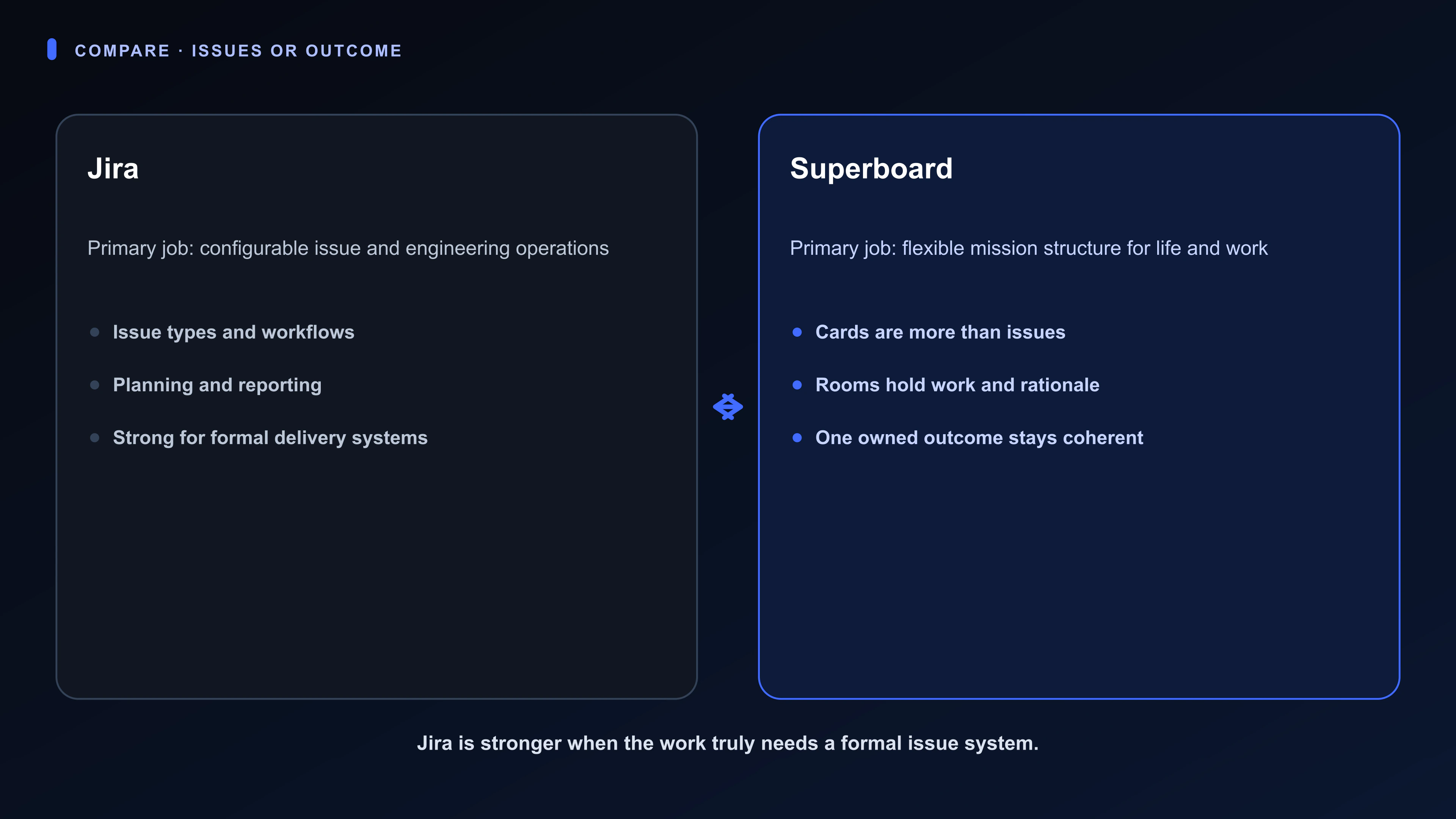
Choose Jira for mature issue tracking, configurable workflows, and established team delivery processes.
The Owner keeps the mission, constraints, consequential decisions, and authority outside current supported actions. Choose You.one for a lighter system that holds the initiative, work, and Ava together.
Superboard is not claiming Jira-scale administration or enterprise workflow maturity today. Next is real-time small-team collaboration. Direction includes direct integration, production multi-agent work, cross-Board decision ranking, and broader point-in-time rollback.
The shortest useful comparison
Swipe or scroll sideways to see every column.
| Dimension | Jira | You.one’s Superboard view |
|---|---|---|
| Primary organizing unit | Work items inside projects or spaces | A Board for the whole initiative; Cards open into Rooms |
| Central job | Jira is especially strong for structured work items, configurable workflows, planning, reporting, permissions, and established software-delivery practices. | Keep the operating picture, work, judgment, Ava, and history together |
| AI role | Rovo agents can be assigned or mentioned on work items and triggered through configured workflows; AI also supports search, updates, and automation | Ava works inside the Board and its Rooms; the broader multi-agent workforce is Direction |
| Human judgment | Configured workflows and approval steps can formalize human review | Notifications bring contextual updates forward; cross-Board decision ranking is Direction |
| Current collaboration | Mature team workflows, permissions, reporting, planning, and administration | Solo-first; real-time small-team collaboration is Next |
| Recovery and history | Work-item history, audit records, and restore options depend on the action and plan | Visible Activity, supported Undo, and restore from Removed Items; broader point-in-time rollback is Direction |
What Jira does especially well
Jira is especially strong for structured work items, configurable workflows, planning, reporting, permissions, and established software-delivery practices.
- Your organization already runs established Jira workflows.
- Detailed issue administration and reporting are required.
- Large-team delivery maturity matters more than a unified creation surface.
What You.one’s Superboard view organizes differently
Jira organizes work through configurable work items, projects, workflows, reports, and administrative rules. Superboard begins with the mission and allows a Card to be a decision, customer, meeting, prompt, reference, artifact, or execution item without first turning the mission into an issue schema.
That flexibility is useful when a solo founder needs customer evidence, a launch decision, and the work itself together, or when a life mission such as a move needs appointments, documents, choices, and logistics in one operating picture. It is not a substitute for Jira's mature delivery controls.
Keep the product boundary clear
The Owner keeps the mission, its constraints, every consequential decision, and authority outside Superboard’s current supported actions. Use this memory aid: people together is Next—real-time small-team collaboration. Systems working more broadly is Direction—direct integration, production multi-agent work, cross-Board decision ranking, and broader point-in-time rollback. Neither is available today.
When to choose Jira
- Your organization already runs established Jira workflows.
- Detailed issue administration and reporting are required.
- Large-team delivery maturity matters more than a unified creation surface.
When You.one’s Superboard view is the better fit
- The work includes decisions, customers, references, prompts, and artifacts that do not fit naturally as software issues.
- One Owner needs a lighter mission map and full Card Rooms more than configurable workflows and reporting.
- You accept that Jira remains stronger for mature team delivery, administration, and issue tracking.
How they can work together
Jira can remain a system of record for software delivery while You.one’s Superboard view holds a higher-level mission and the work around it. Any direct Jira connection is Direction until documented in Help. You.one and Jira are separate products and are not affiliated.
Available today
Current limits of You.one’s Superboard view
Superboard does not match Jira's workflow configuration, reporting, permissions, administration, or large-team delivery maturity. There is no current direct Jira integration documented in Help.
Where this fits in You.one
You.one is the product. Superboard is its Board view and Command Center, and this comparison focuses on that surface. Ava is the continuous relationship. A guided conversational entry into the same system is Direction and has not shipped as a customer mode. The other product remains separate and unaffiliated.
What to do next
Continue with the related guide or example for the next concrete operating picture. If the current boundary fits work that matters to you, request early access; joining the waitlist does not create an account or guarantee an invitation.
Official sources
Material claims about the other product were checked against these first-party sources on August 23, 2026.