
Example
How to finish an animated short when polish is consuming the story
Every background can improve while the emotional beat and sound window disappear. Keiko must choose whether to simplify two scenes, cut one, or stop background polish and finish both at the level the story needs.
Finish a four-minute short whose story, sound, and essential animation work at the promised level
Why this mission matters and what it must not consume
Hold the mission and boundary: finish a four-minute short whose story, sound, and essential animation work at the promised level
The small set of work that can change this mission now
Hold the live choice—whether to simplify the two unfinished scenes, cut one, or stop background polish and finish both—so Keiko can decide from the evidence in this Room
Write the remaining-frame count and story function for each unfinished scene after labeling its shots
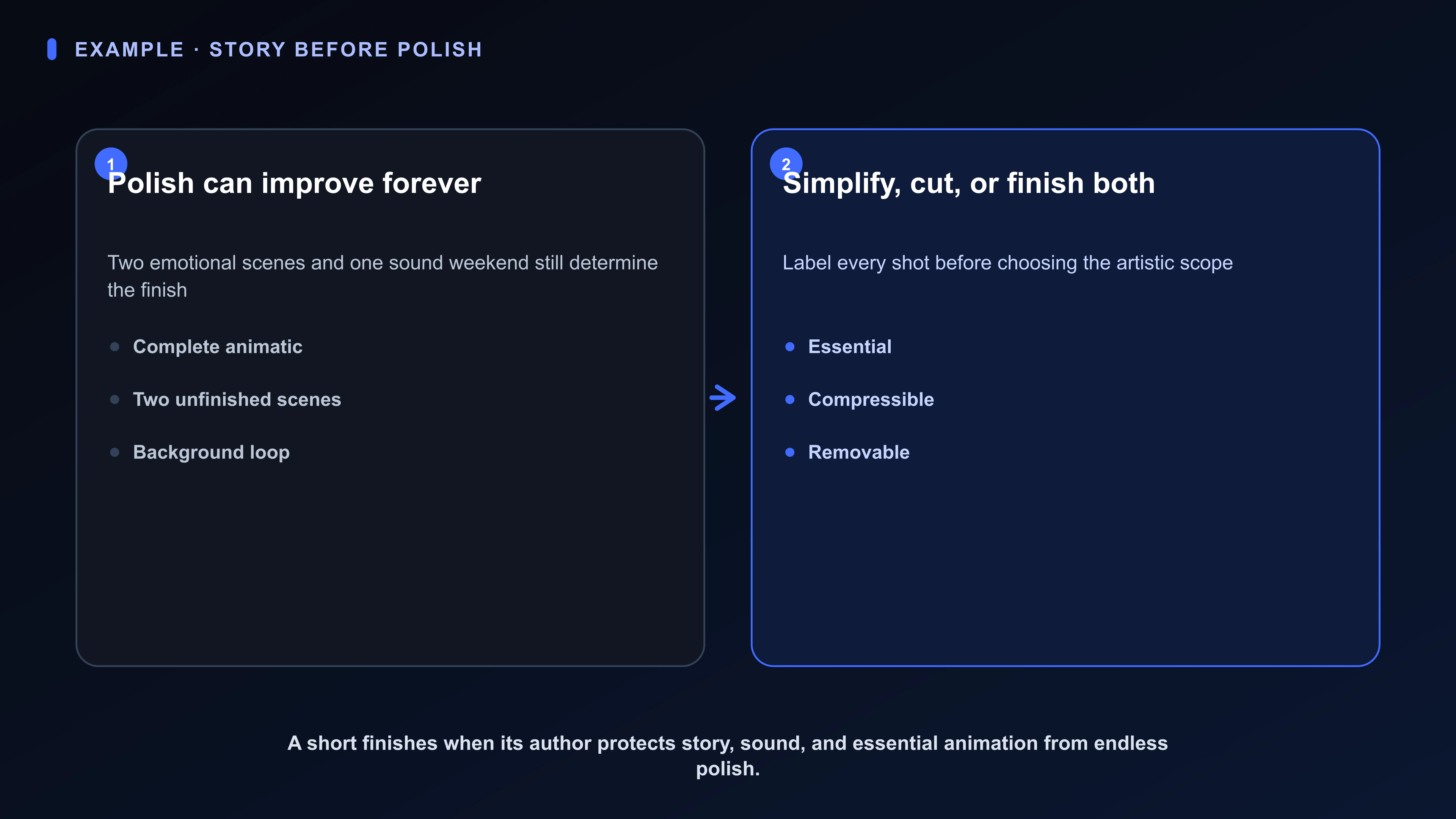
Label every remaining shot before deciding to simplify, cut, or finish both scenes
What Keiko knows, where it came from, and what remains uncertain
Hold the complete animatic as current story evidence without treating polish as the finish line
Keep both unfinished scenes and their story functions visible in the simplify, cut, or finish-both decision
Show the polish work competing with essential animation and the borrowed sound weekend
A separate place for sound window without pretending an outside reply is already in motion
Keep the sound collaborator's final weekend as a dated constraint, not a generic outside-reply item
In You.one's Superboard view, the Four-minute finish Board separates the story promise, shots Keiko can animate now, finish evidence, the collaborator's dated sound weekend, and work she has actually locked.
Open Simplify, cut, or finish both as the consequential Card Room. Start by labeling every remaining shot essential, compressible, or removable, then record each unfinished scene's frame count and story function.
After an explicit request, Ava can compare visible shot labels, story notes, frame counts, and the dated sound window or structure a finish note Keiko reviews. Ava cannot make the artistic choice, direct the collaborator, clear rights, edit, publish, or declare the film finished; Keiko owns the work and decision.
Four-minute finish has one live choice: Simplify, cut, or finish both
This Board has one job: Finish a four-minute short whose story, sound, and essential animation work at the promised level.
The decision still belongs to Keiko: Whether to simplify the two unfinished scenes, cut one, or stop background polish and finish both.
You.one can keep the work, several kinds of evidence, and “Simplify, cut, or finish both” decision visible through its Superboard view. The organized facts support Keiko; they do not replace Keiko's judgment: Keiko, as the independent animator finishing a four-minute short, owns the preparation and the decision about whether to simplify the two unfinished scenes, cut one, or stop background polish and finish both.
Available today
Four-minute finish: one place for the mission
The Four-minute finish Board gives this mission one durable operating picture. Keiko can use familiar language instead of translating the situation into project-management jargon. Its four Lists separate the kinds of attention this situation actually requires.
The Board is not a master task list. It keeps the live choice, the facts that could change it, and any reply or outside event already in motion visible without pretending every uncertainty is work in progress.
Swipe or scroll sideways to see every column.
| List | What belongs here |
|---|---|
| Story promise | Why this mission matters and what it must not consume |
| Animate next | The small set of work that can change this mission now |
| Finish evidence | What Keiko knows, where it came from, and what remains uncertain |
| Sound collaborator's final weekend | A separate place for sound window without pretending an outside reply is already in motion |
Available today
Cards that sound like the real work
These Card titles come directly from Keiko's situation: “Simplify, cut, or finish both” is the live choice, while “Complete animatic” and “Borrowed sound weekend” hold different facts that can change it. The point is recognition, not a perfect taxonomy.
Swipe or scroll sideways to see every column.
| Card | List | Job |
|---|---|---|
| Four-minute finish | Story promise | Hold the mission and boundary: finish a four-minute short whose story, sound, and essential animation work at the promised level |
| Simplify, cut, or finish both | Animate next | Hold the live choice—whether to simplify the two unfinished scenes, cut one, or stop background polish and finish both—so Keiko can decide from the evidence in this Room |
| Complete animatic | Finish evidence | Hold the complete animatic as current story evidence without treating polish as the finish line |
| Write one finish note for each unfinished scene after labeling | Animate next | Write the remaining-frame count and story function for each unfinished scene after labeling its shots |
| Borrowed sound weekend | Sound collaborator's final weekend | Keep the sound collaborator's final weekend as a dated constraint, not a generic outside-reply item |
| Label every remaining shot essential, compressible, or removable | Animate next | Label every remaining shot before deciding to simplify, cut, or finish both scenes |
| Two unfinished scenes | Finish evidence | Keep both unfinished scenes and their story functions visible in the simplify, cut, or finish-both decision |
| Background polish still in motion | Finish evidence | Show the polish work competing with essential animation and the borrowed sound weekend |
Available today
Keep the evidence with “Simplify, cut, or finish both”
Opening the Card gives the visible item durable depth. Stage can hold Finish-scope brief: Place story function, remaining frames, the sound collaborator's final available weekend, and polish value together. Live choice: Whether to simplify the two unfinished scenes, cut one, or stop background polish and finish both. Chat keeps the request and response beside that artifact instead of in a detached thread. Notifications can bring this update forward: “Open decision: Keiko will decide whether to simplify the two unfinished scenes, cut one, or stop background polish and finish both.”
A Card Chat request can ask Ava to prepare the specific comparison or extraction in “Simplify, cut, or finish both” from the visible evidence. Ava can work from the context Keiko deliberately brings into this Card, List, or Board; she cannot monitor the rest of life, contact anyone, or inherit the decision.
Keiko's call remains explicit: Keiko, as the independent animator finishing a four-minute short, owns the preparation and the decision about whether to simplify the two unfinished scenes, cut one, or stop background polish and finish both.
Swipe or scroll sideways to see every column.
| Surface | Job in this example |
|---|---|
| Stage | Finish-scope brief: Place story function, remaining frames, the sound collaborator's final available weekend, and polish value together. Live choice: Whether to simplify the two unfinished scenes, cut one, or stop background polish and finish both |
| Chat | Keep Keiko's request and Ava's attributed response with the work |
| Notifications | Open decision: Keiko will decide whether to simplify the two unfinished scenes, cut one, or stop background polish and finish both |
Start small and rename what feels artificial
Keiko should rename every List or Card that feels artificial. This recipe succeeds when “Simplify, cut, or finish both” becomes easier to decide and fewer open loops depend on memory—not when the Board looks tidy.
Swipe or scroll sideways to see every column.
| Step | Action |
|---|---|
| 1. Label every remaining shot | Essential, compressible, or removable |
| 2. Count the two scenes from those labels | Record frames and story function together |
| 3. Keep the sound weekend visible | The collaborator's final available weekend constrains every path |
| 4. Compare simplify, cut, or finish both | Stop background polish from deciding by default |
| 5. Choose the finish | Open the Simplify, cut, or finish both Room |
An animation shot list can remain part of the system
An animation shot list can be enough while the situation stays simple: both unfinished scenes have a recorded finish path, background polish no longer competes with essential animation, and the borrowed sound weekend fits the chosen path.
It starts to break when the two unfinished scenes, background polish still in motion, and the borrowed sound weekend must inform the same finish choice.
The Four-minute finish Board earns its place only when the familiar tool—an animation shot list—can no longer keep the reason, Finish-scope brief, conversation, current state, decision, and history connected.
Where this example stops
- This is a fictional example, not a customer story.
- This fictional example is not authorship, labor, sound-licensing, delivery, or professional animation advice; the animator and collaborator own the work and commitments.
- It does not show Ava completing external actions or contacting anyone for Keiko.
- It does not report a measured result, and this Board is a starting shape to adapt—not a universal prescription.