
Example
How to organize a community-college transfer without losing requirements between schools
Eli has credits from two colleges and two plausible programs. Before paying another fee, he has to decide whether to keep the reach program, replace it with the clearer fit, or wait for the registrar’s answer.
Submit a small set of transfer applications whose course requirements, evidence, and essays Eli has actually verified
Why Eli is transferring and the programs that genuinely fit
Protect the value of two completed college years
Applications with verified deadlines and next actions
Compare the reach program with a clearer-fit replacement and the option to wait
Turn one generic essay into the specific response each prompt requires
Name the reach program whose fit depends on the unresolved equivalency
Make the replacement path a visible program rather than an abstraction
Official requirements, credit records, and prompt sources
Keep the uncertain course attached to official records and the affected programs
Hold the official source notes behind each program's distinct statement prompt
Keep the source links and verified credit facts behind the three program paths
Ground the Summit and Valley paths in their actual deadlines and costs
Equivalency and registrar answers only schools can provide
Keep the registrar's answer visible as something the student is waiting for, not as a private worry
The Transfer path Board separates applications that are moving from requirement evidence and questions already sent to schools.
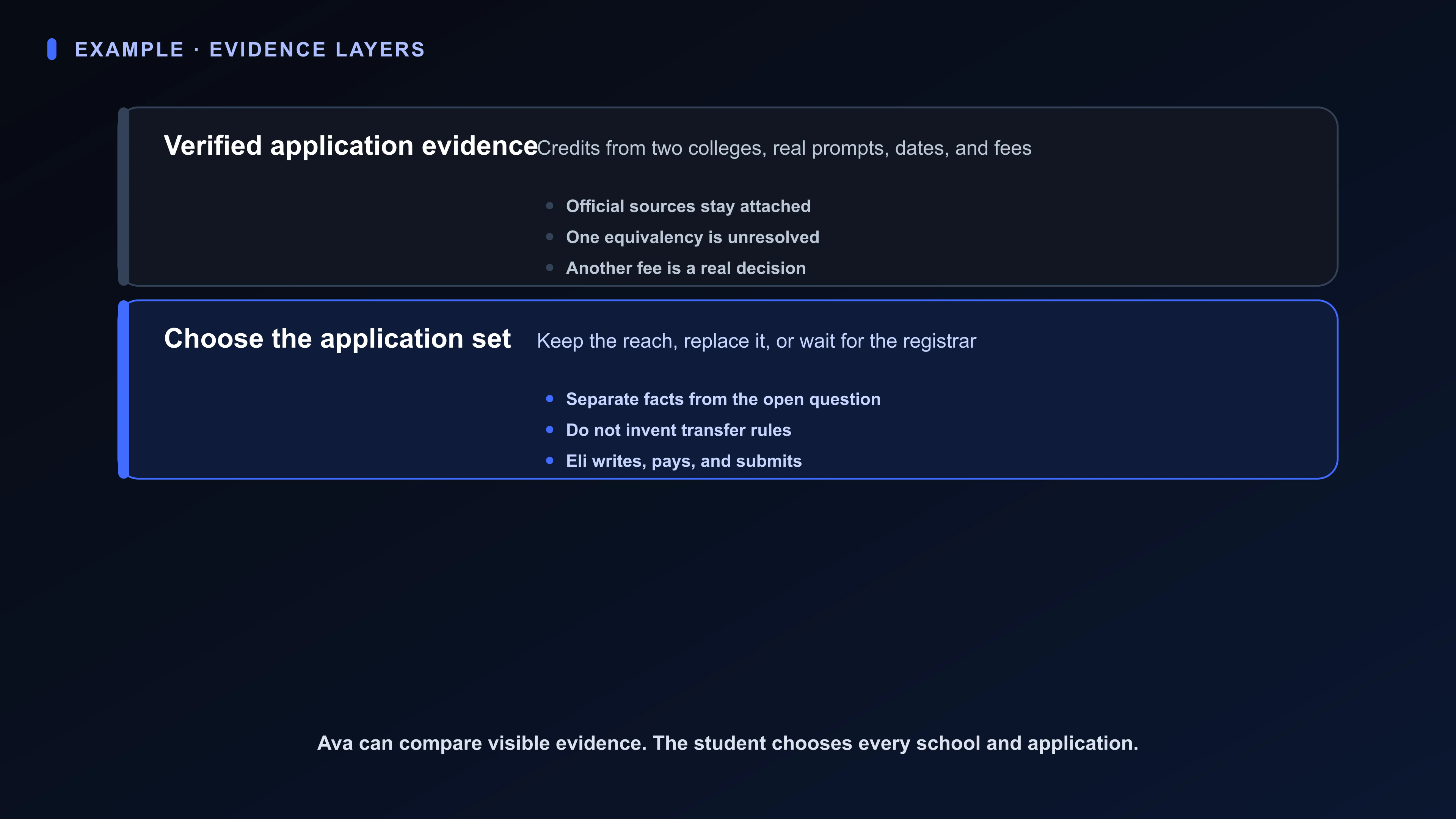
The reach-program Room keeps official sources, dates, fees, essay prompts, and the unresolved equivalency beside one consequential choice.
Ava can compare the visible options and separate verified facts from the open question. Eli chooses the programs, verifies the rules, writes the essays, pays, and submits.
One unclear credit can change the whole application set
The work has a clear center: Submit a small set of transfer applications whose course requirements, evidence, and essays Eli has actually verified.
Organizing the evidence does not authorize the software to decide: Whether to apply to the reach program now, replace it with a clearer-fit option, or wait for the equivalency answer before paying the fee.
You.one can keep the work, evidence, anything already waiting on another person or event, and the “Keep or replace the reach program” decision visible through its Superboard view. Eli still owns the call: Eli chooses the programs, verifies institutional rules, pays fees, writes the statements, and submits every application.
Available today
Name the work in plain language
These Card titles come directly from Eli's situation: “Keep or replace the reach program” is the live choice, “Unclear course equivalency” holds evidence, and “Registrar question sent” names something genuinely in motion outside Eli's control. The point is recognition, not a perfect taxonomy.
Swipe or scroll sideways to see every column.
| Card | List | Job |
|---|---|---|
| Transfer without losing two years of work | Transfer purpose | Protect the value of two completed college years |
| Keep or replace the reach program | Applications moving | Compare the reach program with a clearer-fit replacement and the option to wait |
| Unclear course equivalency | Requirement evidence | Keep the uncertain course attached to official records and the affected programs |
| Adapt the statement prompt | Applications moving | Turn one generic essay into the specific response each prompt requires |
| Registrar question sent | School replies | Keep the registrar's answer visible as something the student is waiting for, not as a private worry |
| Verified statement prompt sources | Requirement evidence | Hold the official source notes behind each program's distinct statement prompt |
| Official requirements and credit records | Requirement evidence | Keep the source links and verified credit facts behind the three program paths |
| Two application dates and fees | Requirement evidence | Ground the Summit and Valley paths in their actual deadlines and costs |
| Summit Environmental Policy — reach | Applications moving | Name the reach program whose fit depends on the unresolved equivalency |
| Valley Public Affairs — clearer fit | Applications moving | Make the replacement path a visible program rather than an abstraction |
Available today
Transfer path: separate the kinds of attention
The Transfer path Board gives this mission one durable operating picture. Eli can use familiar language instead of translating the situation into project-management jargon. Its four Lists separate the kinds of attention this situation actually requires.
The Lists use Eli's own language so actions, evidence, open questions, and decisions do not collapse into one queue. A separate place for replies is useful only after Eli has asked someone or a real outside event must happen first.
Swipe or scroll sideways to see every column.
| List | What belongs here |
|---|---|
| Transfer purpose | Why Eli is transferring and the programs that genuinely fit |
| Applications moving | Applications with verified deadlines and next actions |
| Requirement evidence | Official requirements, credit records, and prompt sources |
| School replies | Equivalency and registrar answers only schools can provide |
Ask Ava to prepare the judgment—not make it
These requests stay with the facts Eli has made visible around “Keep or replace the reach program.” Eli supplies the evidence, checks Ava's work, and decides what belongs in the Room.
Current Ava can prepare help after an explicit request. She cannot make the choice, represent Eli, watch other work on her own, or contact anyone.
Eli chooses programs and submits every application. Ava does not interpret transfer policy as authority or contact schools.
Eli can explain why each application is in the set and which uncertainty is still waiting on a school.
- Request idea: using “Summit Environmental Policy — reach,” “Valley Public Affairs — clearer fit,” “Unclear course equivalency,” “Official requirements and credit records,” “Two application dates and fees,” and “Registrar question sent,” compare the reach, replacement, and wait options. Separate verified facts from the unresolved equivalency. Do not interpret policy as authority or submit anything.
- Request idea: use only the Reach-program brief and notes the Owner has placed in this Card Room to separate facts, assumptions, and unanswered questions
- Request idea: in “Keep or replace the reach program,” group the visible evidence by option and leave the decision open
Available today
One Card Room for the consequential choice
Opening the Card gives the visible item durable depth. Stage can hold Reach-program brief: Place “Summit Environmental Policy — reach,” “Valley Public Affairs — clearer fit,” “Unclear course equivalency,” “Official requirements and credit records,” “Two application dates and fees,” and “Registrar question sent” on one page. Chat keeps the request and response beside that artifact instead of in a detached thread. Notifications can bring this update forward: “Open decision: Eli will decide whether to apply to the reach program now, replace it with a clearer-fit option, or wait for the equivalency answer before paying the fee.”
A Card Chat request can ask Ava to prepare the specific comparison or extraction in “Keep or replace the reach program” from the visible evidence. Ava can work from the context Eli deliberately brings into this Card, List, or Board; she cannot monitor the rest of life, contact anyone, or inherit the decision.
Eli's call remains explicit: Eli chooses the programs, verifies institutional rules, pays fees, writes the statements, and submits every application.
Swipe or scroll sideways to see every column.
| Surface | Job in this example |
|---|---|
| Stage | Reach-program brief: Place “Summit Environmental Policy — reach,” “Valley Public Affairs — clearer fit,” “Unclear course equivalency,” “Official requirements and credit records,” “Two application dates and fees,” and “Registrar question sent” on one page |
| Chat | Keep Eli's request and Ava's attributed response with the work |
| Notifications | Open decision: Eli will decide whether to apply to the reach program now, replace it with a clearer-fit option, or wait for the equivalency answer before paying the fee |
Build only enough Board to make the next decision
Eli should rename every List or Card that feels artificial. This recipe succeeds when “Keep or replace the reach program” becomes easier to decide and fewer open loops depend on memory—not when the Board looks tidy.
Swipe or scroll sideways to see every column.
| Step | Action |
|---|---|
| 1. Choose the transfer purpose | Write what a program must offer to belong on the Board |
| 2. Link every requirement | Use official pages rather than remembered rules |
| 3. Card the uncertain credit | Connect it to each program it can change |
| 4. Record one application-set call | Open the Room and record apply to Summit, replace with Valley, or wait for equivalency |
| 5. Keep or replace the reach program | Eli verifies official details, writes, pays, and submits only the applications that survive the recorded choice |
Where this example stops
- This is a fictional example, not a customer story.
- This is not admissions, financial-aid, or credit-equivalency advice.
- It does not show Ava completing external actions or contacting anyone for Eli.
- It does not report a measured result, and this Board is a starting shape to adapt—not a universal prescription.