
Example
How to produce a community conference without losing speakers, rooms, and a lunch count
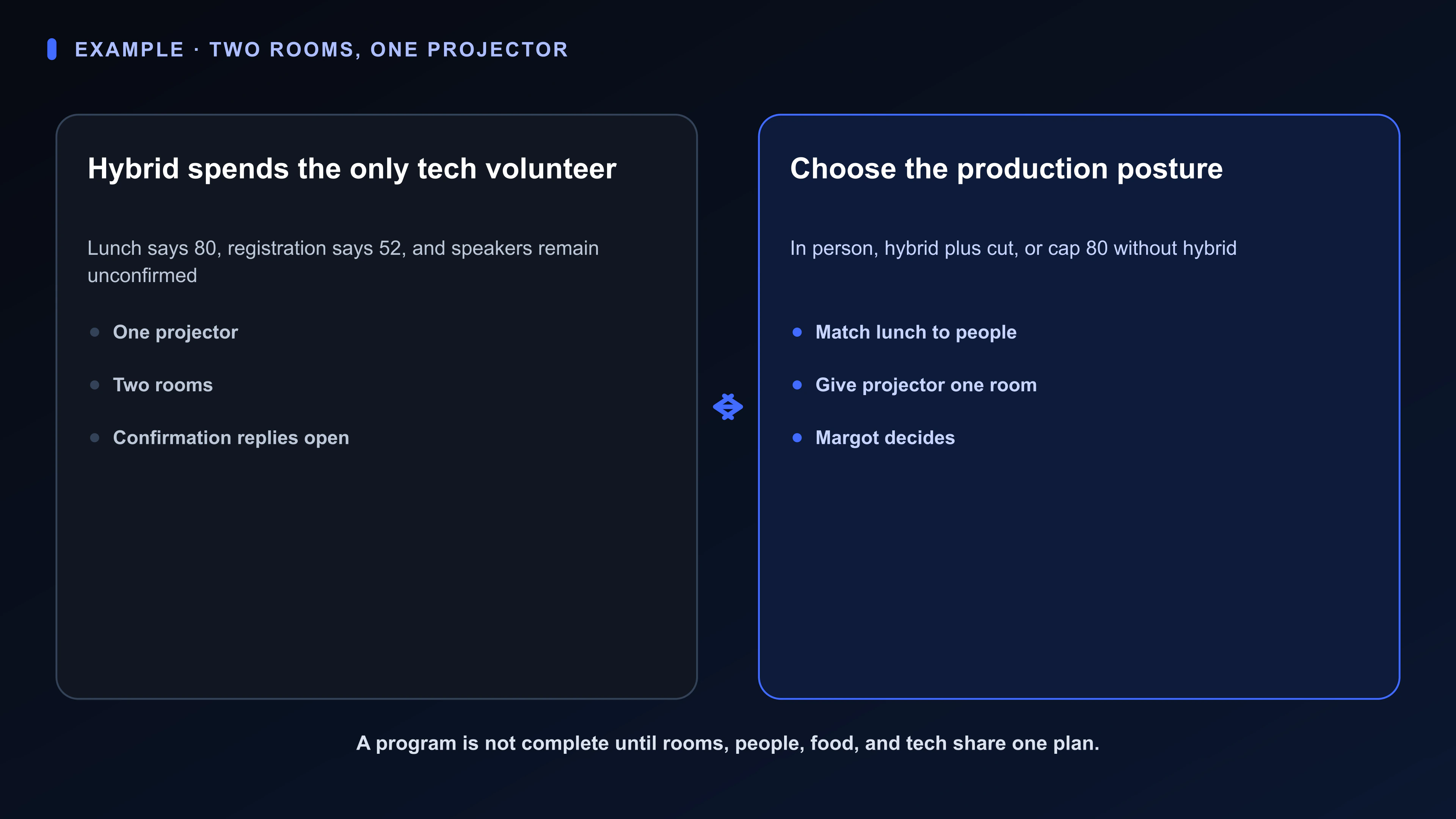
Margot’s keynote wants hybrid, but the hall has never run it and the only tech volunteer would leave registration. She must stay in person, run hybrid in one room and cut a breakout, or cap at 80 and decline hybrid.
Run one day with a program that fits two rooms, a lunch number that matches registration, and a hybrid yes only if tech coverage remains
Rooms, lunch, and tech coverage
Keep tech coverage beside the hybrid ask
Speakers and sessions
Hold the selected session while its confirmation reply remains open and the hybrid request remains a production choice
Hall, projector, hybrid ask
Compare in-person-only, hybrid-plus-cut, and cap-80-decline-hybrid
Hold a request that needs the only tech volunteer
Name the constraint two rooms both want
Lunch count and registration
Show a lunch number that is not yet true
Replies to the speaker confirmation requests Margot already sent
Keep the sent confirmation requests visible and unconfirmed names off the public program
The One-day conference Board keeps program, place, hospitality, speaker confirmations, and tech capacity in one production picture.
Open Choose hybrid, cut a breakout, or cap as a Room with the Scale-and-tech brief.
Ava can compare the facts Margot enters. Margot owns accessibility, AV, catering, registration, spending, hall and speaker conversations, and the program; Ava does not email, register, run tech, or decide.
A program is rooms plus lunch, not a PDF of names
What belongs together is specific: Run one day with a program that fits two rooms, a lunch number that matches registration, and a hybrid yes only if tech coverage remains.
The consequential judgment remains human: Whether to keep in-person only, run hybrid in one room and cut a breakout, or cap registration at 80 and decline hybrid.
You.one can keep the work, evidence, anything already waiting on another person or event, and the “Choose hybrid, cut a breakout, or cap” decision visible through its Superboard view. Margot still owns the call: Margot chooses the program, talks to speakers and the hall, and owns spending.
What changes after a submissions spreadsheet plus a hall diagram
A submissions spreadsheet plus a hall diagram can be enough while the situation stays simple: one room and lunch already matches registration.
It starts to break when one projector, a hybrid ask, and an 80-person quote share a 52-person list.
The One-day conference Board earns its place only when the familiar tool—a submissions spreadsheet plus a hall diagram—can no longer keep the reason, Scale-and-tech brief, conversation, current state, decision, and history connected.
Available today
A focused One-day conference Board
The One-day conference Board gives this mission one durable operating picture. Margot can use familiar language instead of translating the situation into project-management jargon. Its five Lists separate the kinds of attention this situation actually requires.
The point is a fast scan: what is moving, what is known, what is unresolved, and what Margot must choose. Questions not yet asked stay with Margot; they do not move to a list for outside replies.
Swipe or scroll sideways to see every column.
| List | What belongs here |
|---|---|
| Mission | Rooms, lunch, and tech coverage |
| Program | Speakers and sessions |
| Place | Hall, projector, hybrid ask |
| Hospitality | Lunch count and registration |
| Replies and outside conditions | Replies to the speaker confirmation requests Margot already sent |
Available today
Inside the “Choose hybrid, cut a breakout, or cap” Room
Opening the Card gives the visible item durable depth. Stage can hold Scale-and-tech brief: Place projector, lunch quote, hybrid ask, and in-person / hybrid-cut / cap options on one page. Chat keeps the request and response beside that artifact instead of in a detached thread. Notifications can bring this update forward: “Open decision: Margot will choose a tech-and-lunch posture.”
A Card Chat request can ask Ava to prepare the specific comparison or extraction in “Choose hybrid, cut a breakout, or cap” from the visible evidence. Ava can work from the context Margot deliberately brings into this Card, List, or Board; she cannot monitor the rest of life, contact anyone, or inherit the decision.
Margot's call remains explicit: Margot chooses the program, talks to speakers and the hall, and owns spending.
Swipe or scroll sideways to see every column.
| Surface | Job in this example |
|---|---|
| Stage | Scale-and-tech brief: Place projector, lunch quote, hybrid ask, and in-person / hybrid-cut / cap options on one page |
| Chat | Keep Margot's request and Ava's attributed response with the work |
| Notifications | Open decision: Margot will choose a tech-and-lunch posture |
What Ava can prepare from visible context
These requests stay with the facts Margot has made visible around “Choose hybrid, cut a breakout, or cap.” Margot supplies the evidence, checks Ava's work, and decides what belongs in the Room.
Current Ava can prepare help after an explicit request. She cannot make the choice, represent Margot, watch other work on her own, or contact anyone.
Margot owns speakers, hall, and money. Ava does not email presenters, run AV, or take registration.
A day that fits: lunch matches a chosen cap, the projector has a room, and hybrid is a yes only with coverage.
- Request idea: using only the context visible in this Card Room, compare in-person only, hybrid in one room with a cut, and capping at 80 without hybrid. Do not email speakers or choose for me.
- Request idea: use only the Scale-and-tech brief and notes the Owner has placed in this Card Room to separate facts, assumptions, and unanswered questions
- Request idea: from “Choose hybrid, cut a breakout, or cap,” draft a short decision note and name Margot as the decider
A starter shape, not a prescribed workflow
Margot should rename every List or Card that feels artificial. This recipe succeeds when “Choose hybrid, cut a breakout, or cap” becomes easier to decide and fewer open loops depend on memory—not when the Board looks tidy.
Swipe or scroll sideways to see every column.
| Step | Action |
|---|---|
| 1. Count rooms and the projector | Tech is a constraint |
| 2. Match lunch to registration | Quotes are not heads |
| 3. Card the hybrid ask | It costs a volunteer |
| 4. Park unconfirmed speakers | Off the public PDF |
| 5. Choose hybrid, cut a breakout, or cap | Open a Room before hybrid becomes a surprise |
Where this example stops
- This is a fictional example, not a customer story.
- This is not AV, catering, or accessibility-legal advice.
- It does not show Ava contacting speakers or taking registration.
- It is not a measured attendance result.