
Example
How to coordinate community-theater volunteers when opening night needs more than actors
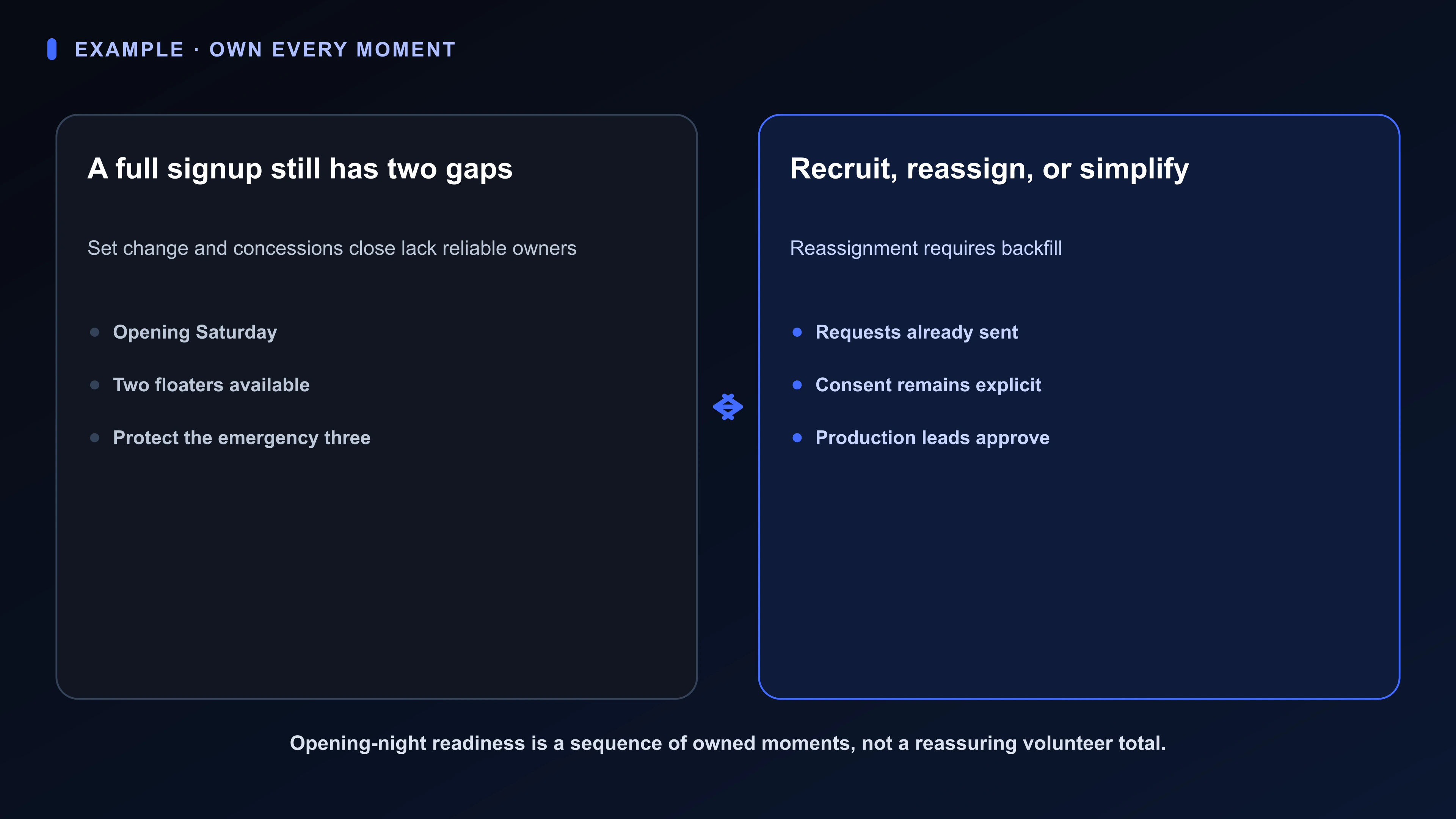
A full signup total hides two unowned moments. Mina must recruit both gaps, request reassignment and backfill, or ask production leaders to simplify both roles for the confirmed floaters.
Open with every audience, backstage, and closing responsibility owned without burning out the reliable three
The promise and limits Mina is protecting
Hold the mission and boundary: open with every audience, backstage, and closing responsibility owned without burning out the reliable three
Put the hard event date beside every staffing option
Choices and actions Mina can move without pretending every fact or outside wait is owned work
Hold the live choice—whether to recruit a skilled set-change volunteer and a closer, request approval to move two experienced ushers into those gaps and recruit two easier usher spots, or request approval to simplify both gap roles so the two confirmed floaters can cover them—so Mina can decide from the evidence in this Room
Prepare the next owned move without treating a draft, check, or test as evidence that anyone has agreed
Use the result of the first owned action to update the Crew-choice brief; record the finding, not merely the effort
Source facts, observations, and artifacts that can change “Recruit both gaps, reassign and backfill, or simplify both for floaters”
Keep the full usher list beside the thin set-change and missing closer so a full signup is not mistaken for a covered Saturday
Name the backstage moment that needs skill
Keep the end-of-night gap visible
Show burnout risk before reassigning anyone
Ground the reassign-and-backfill posture
Ground the simplify-both posture without using the emergency three
Replies, dates, and conditions owned somewhere else
Record who owns the answer, what was asked, and that role-specific volunteer replies is still unconfirmed
In You.one’s Superboard view, the Opening-night crew Board separates the audience-and-backstage promise, roles to fill, coverage evidence, replies to requests already sent, and moments with a confirmed owner.
Open Recruit, reassign-and-backfill, or simplify as the consequential Card Room. Start by mapping Saturday by moment rather than by volunteer count.
After an explicit request, Ava can compare visible coverage without messaging volunteers or treating availability as consent. Mina owns asks; production leadership owns reassignment, simplification, safeguards, building safety, and the opening-night plan.
Opening-night crew has one live choice: Recruit both gaps, reassign and backfill, or simplify both for floaters
This Board has one job: Open with every audience, backstage, and closing responsibility owned without burning out the reliable three.
The decision still belongs to Mina: Whether to recruit a skilled set-change volunteer and a closer, request approval to move two experienced ushers into those gaps and recruit two easier usher spots, or request approval to simplify both gap roles so the two confirmed floaters can cover them.
You.one can keep the work, evidence, anything already waiting on another person or event, and the “Recruit both gaps, reassign and backfill, or simplify both for floaters” decision visible through its Superboard view. Mina still owns the call: Mina owns the role asks and Saturday coverage picture. Production leadership owns reassignment and simplification; Ava cannot message volunteers or approve the opening-night plan.
Available today
Opening-night crew: one place for the mission
The Opening-night crew Board gives this mission one durable operating picture. Mina can use familiar language instead of translating the situation into project-management jargon. Its four Lists separate the kinds of attention this situation actually requires.
The Board is not a master task list. It keeps the live choice, the facts that could change it, and any reply or outside event already in motion visible without pretending every uncertainty is work in progress.
Swipe or scroll sideways to see every column.
| List | What belongs here |
|---|---|
| Show promise | The promise and limits Mina is protecting |
| Roles to fill | Choices and actions Mina can move without pretending every fact or outside wait is owned work |
| Coverage evidence | Source facts, observations, and artifacts that can change “Recruit both gaps, reassign and backfill, or simplify both for floaters” |
| Replies or arrivals from people | Replies, dates, and conditions owned somewhere else |
Available today
Cards that sound like the real work
These Card titles come directly from Mina's situation: “Recruit both gaps, reassign and backfill, or simplify both for floaters” is the live choice, “Ushers are full and two are experienced backstage” holds evidence, and “Role-specific volunteer replies” names something genuinely in motion outside Mina's control. The point is recognition, not a perfect taxonomy.
Swipe or scroll sideways to see every column.
| Card | List | Job |
|---|---|---|
| Own every opening-night moment without making the reliable three the emergency plan | Show promise | Hold the mission and boundary: open with every audience, backstage, and closing responsibility owned without burning out the reliable three |
| Recruit both gaps, reassign and backfill, or simplify both for floaters | Roles to fill | Hold the live choice—whether to recruit a skilled set-change volunteer and a closer, request approval to move two experienced ushers into those gaps and recruit two easier usher spots, or request approval to simplify both gap roles so the two confirmed floaters can cover them—so Mina can decide from the evidence in this Room |
| Ushers are full and two are experienced backstage | Coverage evidence | Keep the full usher list beside the thin set-change and missing closer so a full signup is not mistaken for a covered Saturday |
| Track the role-specific confirmation requests already sent | Roles to fill | Prepare the next owned move without treating a draft, check, or test as evidence that anyone has agreed |
| Role-specific volunteer replies | Replies or arrivals from people | Record who owns the answer, what was asked, and that role-specific volunteer replies is still unconfirmed |
| Map the night by moment, not volunteer count | Roles to fill | Use the result of the first owned action to update the Crew-choice brief; record the finding, not merely the effort |
| Opening night: Saturday | Show promise | Put the hard event date beside every staffing option |
| Set-change coverage is thin | Coverage evidence | Name the backstage moment that needs skill |
| Concessions has no closer | Coverage evidence | Keep the end-of-night gap visible |
| Same three people on every emergency list | Coverage evidence | Show burnout risk before reassigning anyone |
| Two experienced ushers: neither is in the emergency three | Coverage evidence | Ground the reassign-and-backfill posture |
| Two confirmed floaters can cover simplified roles | Coverage evidence | Ground the simplify-both posture without using the emergency three |
Available today
Keep the evidence with “Recruit both gaps, reassign and backfill, or simplify both for floaters”
Opening the Card gives the visible item durable depth. Stage can hold Crew-choice brief: Place Saturday opening-night timing, skill, reliability, audience impact, and all three complete coverage postures together. Live choice: Whether to recruit a skilled set-change volunteer and a closer, request approval to move two experienced ushers into those gaps and recruit two easier usher spots, or request approval to simplify both gap roles so the two confirmed floaters can cover them. Chat keeps the request and response beside that artifact instead of in a detached thread. Notifications can bring this update forward: “Open decision: Mina will decide whether to recruit a skilled set-change volunteer and a closer, request approval to move two experienced ushers into those gaps and recruit two easier usher spots, or request approval to simplify both gap roles so the two confirmed floaters can cover them.”
A Card Chat request can ask Ava to prepare the specific comparison or extraction in “Recruit both gaps, reassign and backfill, or simplify both for floaters” from the visible evidence. Ava can work from the context Mina deliberately brings into this Card, List, or Board; she cannot monitor the rest of life, contact anyone, or inherit the decision.
Mina's call remains explicit: Mina owns the role asks and Saturday coverage picture. Production leadership owns reassignment and simplification; Ava cannot message volunteers or approve the opening-night plan.
Swipe or scroll sideways to see every column.
| Surface | Job in this example |
|---|---|
| Stage | Crew-choice brief: Place Saturday opening-night timing, skill, reliability, audience impact, and all three complete coverage postures together. Live choice: Whether to recruit a skilled set-change volunteer and a closer, request approval to move two experienced ushers into those gaps and recruit two easier usher spots, or request approval to simplify both gap roles so the two confirmed floaters can cover them |
| Chat | Keep Mina's request and Ava's attributed response with the work |
| Notifications | Open decision: Mina will decide whether to recruit a skilled set-change volunteer and a closer, request approval to move two experienced ushers into those gaps and recruit two easier usher spots, or request approval to simplify both gap roles so the two confirmed floaters can cover them |
Start small and rename what feels artificial
Mina should rename every List or Card that feels artificial. This recipe succeeds when “Recruit both gaps, reassign and backfill, or simplify both for floaters” becomes easier to decide and fewer open loops depend on memory—not when the Board looks tidy.
Swipe or scroll sideways to see every column.
| Step | Action |
|---|---|
| 1. Write the mission | Open with every audience, backstage, and closing responsibility owned without burning out the reliable three |
| 2. Open the live choice | Put “Recruit both gaps, reassign and backfill, or simplify both for floaters” in a Room of its own |
| 3. Attach the evidence | Crew-choice brief: Place Saturday opening-night timing, skill, reliability, audience impact, and all three complete coverage postures together. Live choice: Whether to recruit a skilled set-change volunteer and a closer, request approval to move two experienced ushers into those gaps and recruit two easier usher spots, or request approval to simplify both gap roles so the two confirmed floaters can cover them. |
| 4. Name what is already waiting | Keep “Role-specific volunteer replies” visibly waiting |
| 5. Take the first owned action | Map the night by moment, not volunteer count |
An opening-night call sheet can remain part of the system
An opening-night call sheet can be enough while the situation stays simple: every Saturday moment already has an owner who is not one of the emergency three.
It starts to break when “Ushers are full and two are experienced backstage” and “Role-specific volunteer replies” must inform the same choice.
The Opening-night crew Board earns its place only when the familiar tool—an opening-night call sheet—can no longer keep the reason, Crew-choice brief, conversation, current state, decision, and history connected.
Where this example stops
- This is a fictional example, not a customer story.
- This fictional example is not performer, volunteer, employment, child-safeguarding, accessibility, building, or event-safety advice; the theater owns every role and opening-night boundary.
- It does not show Ava completing external actions or contacting anyone for Mina.
- It does not report a measured result, and this Board is a starting shape to adapt—not a universal prescription.