
Example
How to prepare for a craft fair without making a second collection the night before
Corinne's booth needs work that is dry, priced, and safe to sell—not a second collection started under deadline pressure. She must choose to stop making, run one isolated test batch, or skip Sunday so glazing can happen honestly.
Pack a 6-foot table with finished, priced work that exists, and park new shapes that cannot dry or be tested in time
6-foot table, finished work only
Keep the 6-foot table beside the urge to start a new shape
What is dry, priced, and packed
Count the work that can actually sit on the table
Table, cloth, cash/square, bags
Hold a packing job that new making is crowding out
Kiln loads, untested glaze, and new shapes Corinne still controls
Compare stop-now, isolated-test-batch, and skip-Sunday-to-glaze
Keep an untested surface as owned test work and off the mug stack
Name wet work that is stealing packing time
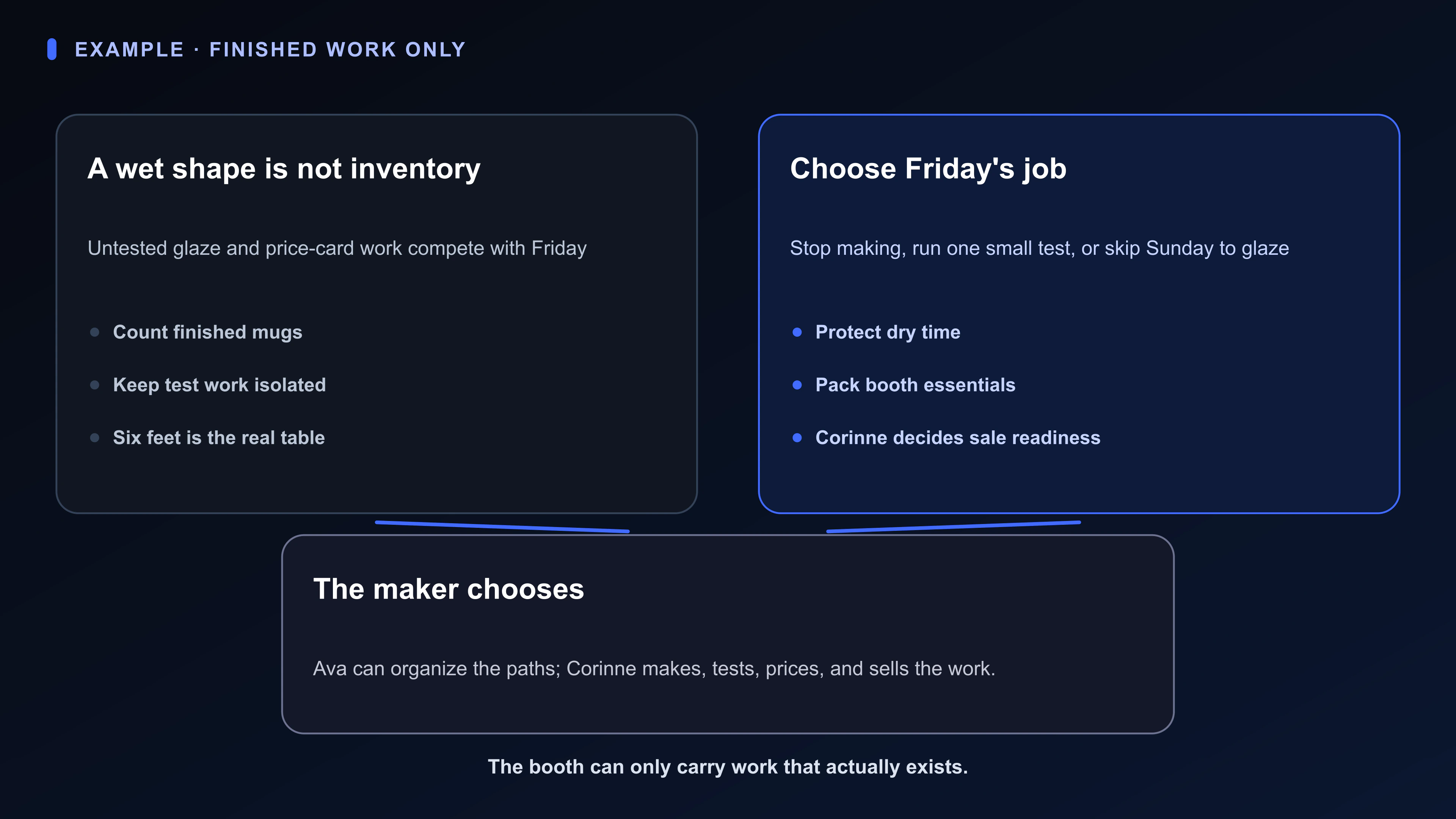
The Fair weekend pack Board separates finished inventory, booth work, and making evidence so a wet shape cannot count as a mug headed to the table.
The Make-or-pack Room compares stop, small test, and skip-Sunday paths with dry time, glaze status, price cards, and the transport clock.
Ava can organize the evidence Corinne supplies. Corinne makes the art, follows material and equipment guidance, chooses what is sale-ready, prices it, and runs the booth.
A booth fee is not inventory, and a wet shape is not a mug
The work has a clear center: Pack a 6-foot table with finished, priced work that exists, and park new shapes that cannot dry or be tested in time.
Organizing the evidence does not authorize the software to decide: Whether to stop new making now, fire one small test batch without mixing it into drinkware, or skip the fair’s second day to glaze later.
You.one can keep the work, evidence, and “Choose stop, small test, or skip day two” decision visible through its Superboard view. Authority does not move to the software: Corinne chooses what to fire, pack, and sell, and owns safety around food-contact surfaces.
Available today
Name the work in plain language
These Card titles come directly from Corinne's situation: “Choose stop, small test, or skip day two” is the live choice, “Mugs already finished” holds evidence, and “Shape that will not dry by Friday” is still work Corinne controls—not something already awaiting another person. The point is recognition, not a perfect taxonomy.
Swipe or scroll sideways to see every column.
| Card | List | Job |
|---|---|---|
| Pack what exists | Mission | Keep the 6-foot table beside the urge to start a new shape |
| Choose stop, small test, or skip day two | Making | Compare stop-now, isolated-test-batch, and skip-Sunday-to-glaze |
| Mugs already finished | Inventory | Count the work that can actually sit on the table |
| New glaze not tested for drinkware | Making | Keep an untested surface as owned test work and off the mug stack |
| Shape that will not dry by Friday | Making | Name wet work that is stealing packing time |
| Price cards unprinted | Booth | Hold a packing job that new making is crowding out |
Available today
Fair weekend pack: separate the kinds of attention
The Fair weekend pack Board gives this mission one durable operating picture. Corinne can use familiar language instead of translating the situation into project-management jargon. Its four Lists separate the kinds of attention this situation actually requires.
The Lists use Corinne's own language so actions, evidence, open questions, and decisions do not collapse into one queue. A separate place for replies is useful only after Corinne has asked someone or a real outside event must happen first.
Swipe or scroll sideways to see every column.
| List | What belongs here |
|---|---|
| Mission | 6-foot table, finished work only |
| Inventory | What is dry, priced, and packed |
| Booth | Table, cloth, cash/square, bags |
| Making | Kiln loads, untested glaze, and new shapes Corinne still controls |
Ask Ava to prepare the judgment—not make it
These requests stay with the facts Corinne has made visible around “Choose stop, small test, or skip day two.” Corinne supplies the evidence, checks Ava's work, and decides what belongs in the Room.
Current Ava can prepare help after an explicit request. She cannot make the choice, represent Corinne, watch other work on her own, or contact anyone.
Corinne owns making, safety, and sales. Ava does not fire a kiln, print prices, or take payment.
A table of work that exists: mugs are counted, a wet shape is parked, and an untested glaze is not on drinkware.
- Request idea: using only the context visible in this Card Room, compare stopping new making, firing an isolated test, and skipping Sunday. Do not change the booth or choose for me.
- Request idea: use only the Make-or-pack brief and notes the Owner has placed in this Card Room to separate facts, assumptions, and unanswered questions
- Request idea: in “Choose stop, small test, or skip day two,” group the visible evidence by option and leave the decision open
Available today
One Card Room for the consequential choice
Opening the Card gives the visible item durable depth. Stage can hold Make-or-pack brief: Place dry inventory, untested glaze, Friday, and stop / test / skip-Sunday options on one page. Chat keeps the request and response beside that artifact instead of in a detached thread. Notifications can bring this update forward: “Open decision: Corinne will choose whether Friday is for packing or for wet clay.”
A Card Chat request can ask Ava to prepare the specific comparison or extraction in “Choose stop, small test, or skip day two” from the visible evidence. Ava can work from the context Corinne deliberately brings into this Card, List, or Board; she cannot monitor the rest of life, contact anyone, or inherit the decision.
Corinne's call remains explicit: Corinne chooses what to fire, pack, and sell, and owns safety around food-contact surfaces.
Swipe or scroll sideways to see every column.
| Surface | Job in this example |
|---|---|
| Stage | Make-or-pack brief: Place dry inventory, untested glaze, Friday, and stop / test / skip-Sunday options on one page |
| Chat | Keep Corinne's request and Ava's attributed response with the work |
| Notifications | Open decision: Corinne will choose whether Friday is for packing or for wet clay |
Build only enough Board to make the next decision
Corinne should rename every List or Card that feels artificial. This recipe succeeds when “Choose stop, small test, or skip day two” becomes easier to decide and fewer open loops depend on memory—not when the Board looks tidy.
Swipe or scroll sideways to see every column.
| Step | Action |
|---|---|
| 1. Count finished work | What can sit on 6 feet |
| 2. List booth jobs | Price cards and bags |
| 3. Park wet shapes | Dry time is a clock |
| 4. Isolate untested surfaces | Off drinkware |
| 5. Choose stop, small test, or skip day two | Open a Room before a new shape misses the truck |
Where this example stops
- This is a fictional example, not a customer story.
- This is not food-safety, sales, or craft-business advice.
- It does not show Ava firing a kiln or taking payment.
- It is not a measured sales result.