
Example
How to run a customer-success renewal plan without confusing activity with a yes
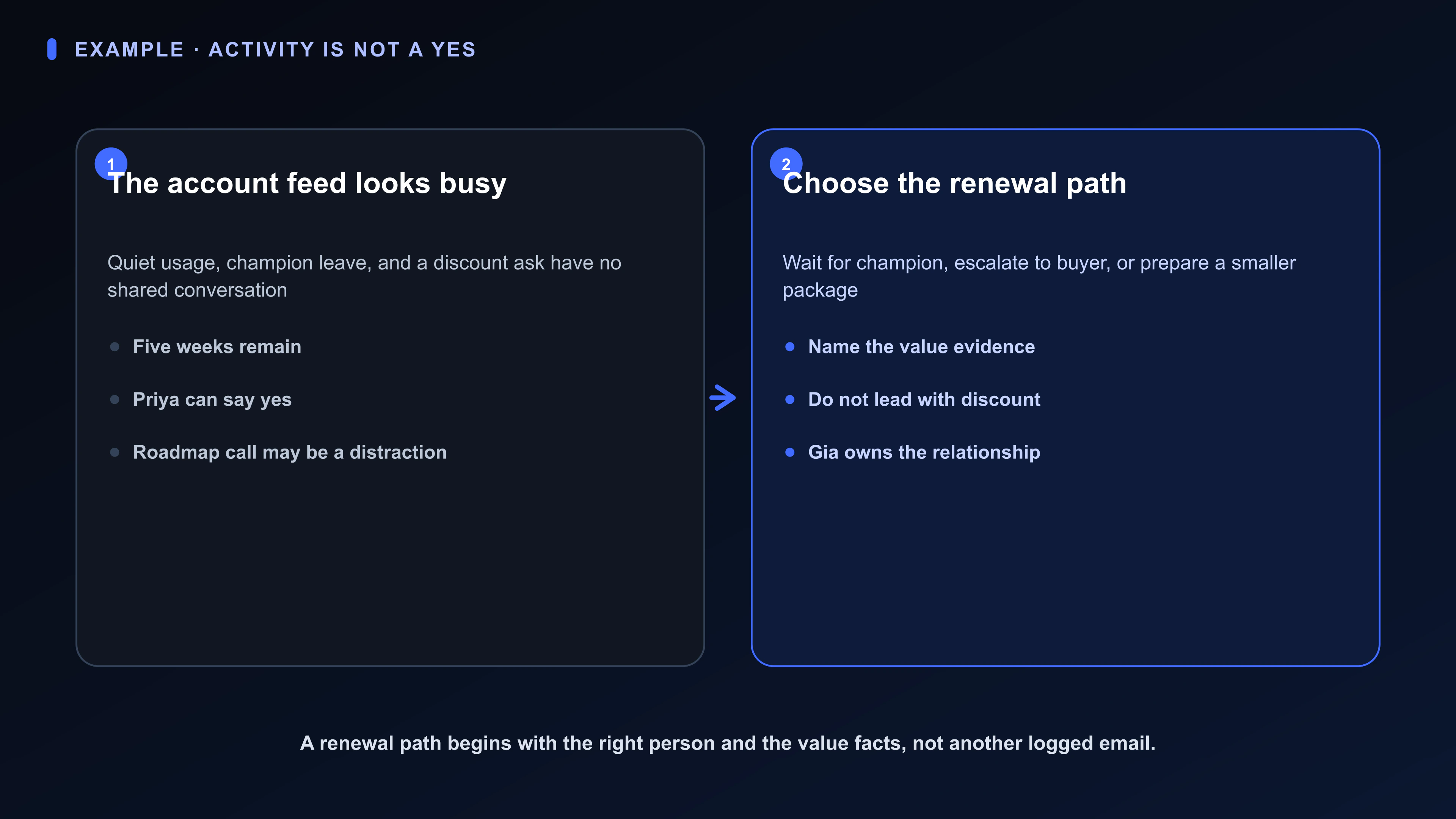
Gia’s CRM feed looks busy but nobody has named the value conversation. She must wait for the champion, escalate to the economic buyer, or prepare a smaller package while keeping price from substituting for a customer decision.
Reach a named renewal conversation with the right people, using usage facts and open risks, without substituting a discount for a decision
Date, people who can actually say yes, and the no-discount-first rule
Keep the date beside the people who can actually renew
Captured usage evidence
Hold a dashboard fact on the same Board as cheerful activity logs
The named economic buyer who can renew
Name the person Gia could escalate to instead of hiding the path in a sentence
Path choice, discount ask, and roadmap extra
Compare champion-return, economic-buyer-now, and smaller-package options
Keep price from substituting for a value conversation
Park a maybe-helpful extra so it cannot become the plan
Customer conditions outside Gia’s control that determine when a path can move
Keep the champion’s return visible as an outside condition, not a requested reply or a promise Gia controls
The Renewal in five weeks Board separates usage facts, people with authority, risks, and customer conditions outside Gia’s control.
Open Choose wait, escalate, or smaller package as a Room with six quiet weeks, the absent champion, procurement’s ask, and the three conversation paths.
Ava can compare the visible account facts. Gia owns the relationship, pricing, contract, forecast, promises, and every customer message; Ava does not contact anyone or predict a renewal.
Logged activity is not a renewal conversation
This Board has one job: Reach a named renewal conversation with the right people, using usage facts and open risks, without substituting a discount for a decision.
The decision still belongs to Gia: Whether to wait for the champion’s return, escalate to the economic buyer now, or prepare a smaller package and let the discount ask wait.
You.one can keep the work, evidence, anything already waiting on another person or event, and the “Choose wait, escalate, or smaller package” decision visible through its Superboard view. Gia still owns the call: Gia chooses the path, talks to the customer, and owns pricing and the relationship.
Available today
Renewal in five weeks: one place for the mission
The Renewal in five weeks Board gives this mission one durable operating picture. Gia can use familiar language instead of translating the situation into project-management jargon. Its five Lists separate the kinds of attention this situation actually requires.
The Board is not a master task list. It keeps the live choice, the facts that could change it, and any reply or outside event already in motion visible without pretending every uncertainty is work in progress.
Swipe or scroll sideways to see every column.
| List | What belongs here |
|---|---|
| Mission | Date, people who can actually say yes, and the no-discount-first rule |
| Facts | Captured usage evidence |
| People and commitments | The named economic buyer who can renew |
| Risks | Path choice, discount ask, and roadmap extra |
| Replies and outside conditions | Customer conditions outside Gia’s control that determine when a path can move |
Available today
Cards that sound like the real work
These Card titles come directly from Gia's situation: “Choose wait, escalate, or smaller package” is the live choice, “Usage quiet for six weeks” holds evidence, and “Champion return from leave” names something genuinely in motion outside Gia's control. The point is recognition, not a perfect taxonomy.
Swipe or scroll sideways to see every column.
| Card | List | Job |
|---|---|---|
| A named yes from someone who can give it | Mission | Keep the date beside the people who can actually renew |
| Choose wait, escalate, or smaller package | Risks | Compare champion-return, economic-buyer-now, and smaller-package options |
| Usage quiet for six weeks | Facts | Hold a dashboard fact on the same Board as cheerful activity logs |
| Economic buyer: Priya Shah | People and commitments | Name the person Gia could escalate to instead of hiding the path in a sentence |
| Champion return from leave | Replies and outside conditions | Keep the champion’s return visible as an outside condition, not a requested reply or a promise Gia controls |
| Procurement discount ask | Risks | Keep price from substituting for a value conversation |
| Roadmap call offer from product | Risks | Park a maybe-helpful extra so it cannot become the plan |
Available today
Keep the evidence with “Choose wait, escalate, or smaller package”
Opening the Card gives the visible item durable depth. Stage can hold Renewal-path brief: Place usage, missing champion, discount ask, and the three paths on one page. Chat keeps the request and response beside that artifact instead of in a detached thread. Notifications can bring this update forward: “Open decision: Gia will choose the renewal conversation path.”
A Card Chat request can ask Ava to prepare the specific comparison or extraction in “Choose wait, escalate, or smaller package” from the visible evidence. Ava can work from the context Gia deliberately brings into this Card, List, or Board; she cannot monitor the rest of life, contact anyone, or inherit the decision.
Gia's call remains explicit: Gia chooses the path, talks to the customer, and owns pricing and the relationship.
Swipe or scroll sideways to see every column.
| Surface | Job in this example |
|---|---|
| Stage | Renewal-path brief: Place usage, missing champion, discount ask, and the three paths on one page |
| Chat | Keep Gia's request and Ava's attributed response with the work |
| Notifications | Open decision: Gia will choose the renewal conversation path |
Start small and rename what feels artificial
Gia should rename every List or Card that feels artificial. This recipe succeeds when “Choose wait, escalate, or smaller package” becomes easier to decide and fewer open loops depend on memory—not when the Board looks tidy.
Swipe or scroll sideways to see every column.
| Step | Action |
|---|---|
| 1. Name who can say yes | Logged work is not a person |
| 2. Put usage on the Board | Facts beside the feed |
| 3. Separate risks from Replies and outside conditions | Put champion return on Replies and outside conditions as an outside condition, not Gia’s next email |
| 4. Park extras | Roadmap calls wait until a path is chosen |
| 5. Choose wait, escalate, or smaller package | Open a Room before sending another check-in |
A CRM activity feed can remain part of the system
A CRM activity feed can be enough while the situation stays simple: the champion is present and usage is healthy.
It starts to break when leave, quiet usage, and a discount ask all hide under logged emails.
The Renewal in five weeks Board earns its place only when the familiar tool—a CRM activity feed—can no longer keep the reason, Renewal-path brief, conversation, current state, decision, and history connected.
Where this example stops
- This is a fictional example, not a customer story.
- This is not a revenue forecast or a customer testimonial.
- It does not show Ava emailing a customer or changing a contract.
- It is not a measured retention result.