
Example
Keep rides, forms and family promises clear
Put the next ride, the missing form, and each confirmed family promise in one place—without letting software make care decisions.
Your situation
In this fictional example, rides, office forms, printed dates and family promises are scattered across texts and paper. Helen needs to know who is covering Thursday—not ask software to decide care.
How Ava can help
Ava can organize the dates, open questions and confirmed commitments Helen provides, then help compare three ride plans.
What stays together
Thursday and Friday ride details, the office form, its printed date, her brother’s reply and Helen’s chosen plan.
Available today and limits
Current Cards, Documents, Checklists, files and Card Chat can keep that record together. Helen and her family make every care, medical, legal, financial and family decision. Ava does not contact anyone in this example.
Keep this week’s rides, printed dates, household tasks, and office forms visible in one Board Helen maintains and uses in conversation with her siblings—without implying they access the Board or that it is in charge of care
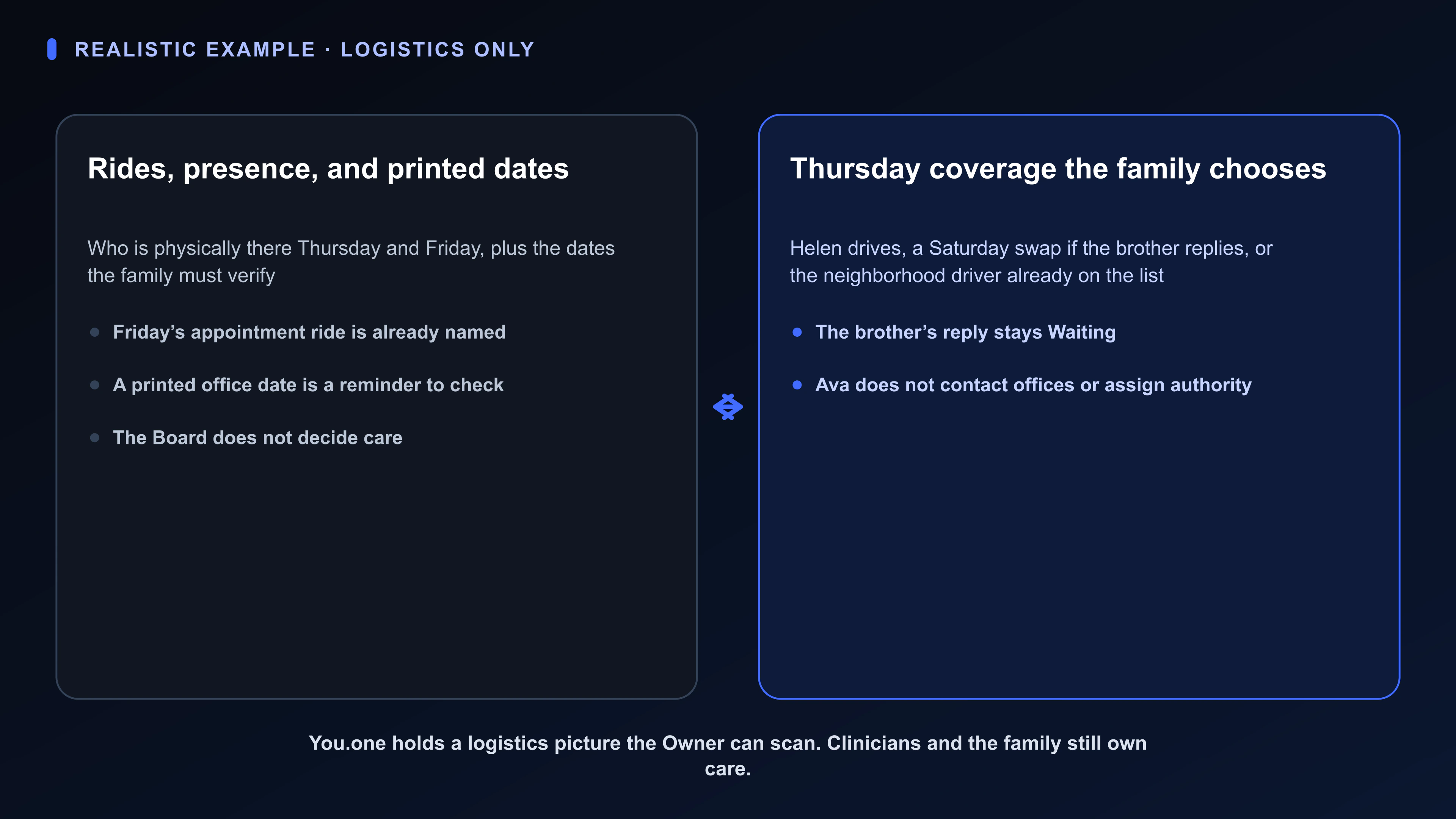
This week’s picture and the line that the Board does not decide care
Give Helen a picture she can scan and use in sibling conversations; clinicians and the family still own care
Who is physically there, and when
Compare Helen driving, a Saturday swap, and hiring the neighborhood driver already on the contact list
Hold the time, address as written, and who is currently named
Food, mail, and house tasks
Keep the household mail work visible without treating it as a care decision
Forms and dates as printed, with owners
Track the stated date as a reminder to check, not as a confirmed appointment or instruction
Give the dated form an owner without filling it as advice
The brother’s reply to Helen’s Saturday-swap request
Keep an unconfirmed sibling maybe from being the plan
See the detailed walkthrough
Why This week’s care logistics needs an operating picture
Helen is a fictional 54-year-old adult child coordinating household logistics with a parent and two siblings in Raleigh, North Carolina. Helen’s father still lives in his house. Appointment times, sibling driving days, printed office dates, and a stack of mail currently live in texts. Nobody is asking Superboard to decide care; Helen needs one Owner-maintained picture she can use while coordinating the week.
A group text, a paper calendar on the fridge at her father’s house, and her own work calendar disagree about Thursday.
A form from an office is in a pile of mail. It is not medical advice to notice that the form has a date and no owner.
In You.one's Superboard view, Helen can give “Keep this week’s rides, printed dates, household tasks, and office forms visible in one Board Helen maintains and uses in conversation with her siblings—without implying they access the Board or that it is in charge of care” a Board of its own. That Board connects shared promises, physical constraints, time, and the household's own decisions; opening “Choose Thursday coverage” creates a Room for its evidence, discussion, state, and decision.
The work is coordination, not a diagnosis
The mission is specific: Keep this week’s rides, printed dates, household tasks, and office forms visible in one Board Helen maintains and uses in conversation with her siblings—without implying they access the Board or that it is in charge of care.
The consequential choice is not something a board or an AI should quietly make: Whether Helen covers Thursday’s ride, her brother swaps his Saturday, or they hire the neighborhood driver already on the contact list.
You.one can keep the work, evidence, anything already waiting on another person or event, and the “Choose Thursday coverage” decision visible through its Superboard view. Helen still owns the call: Helen and her siblings choose coverage, talk to offices, and own every care and spending decision. The Board does not.
Available today
This week’s care logistics: one Board shape to adapt
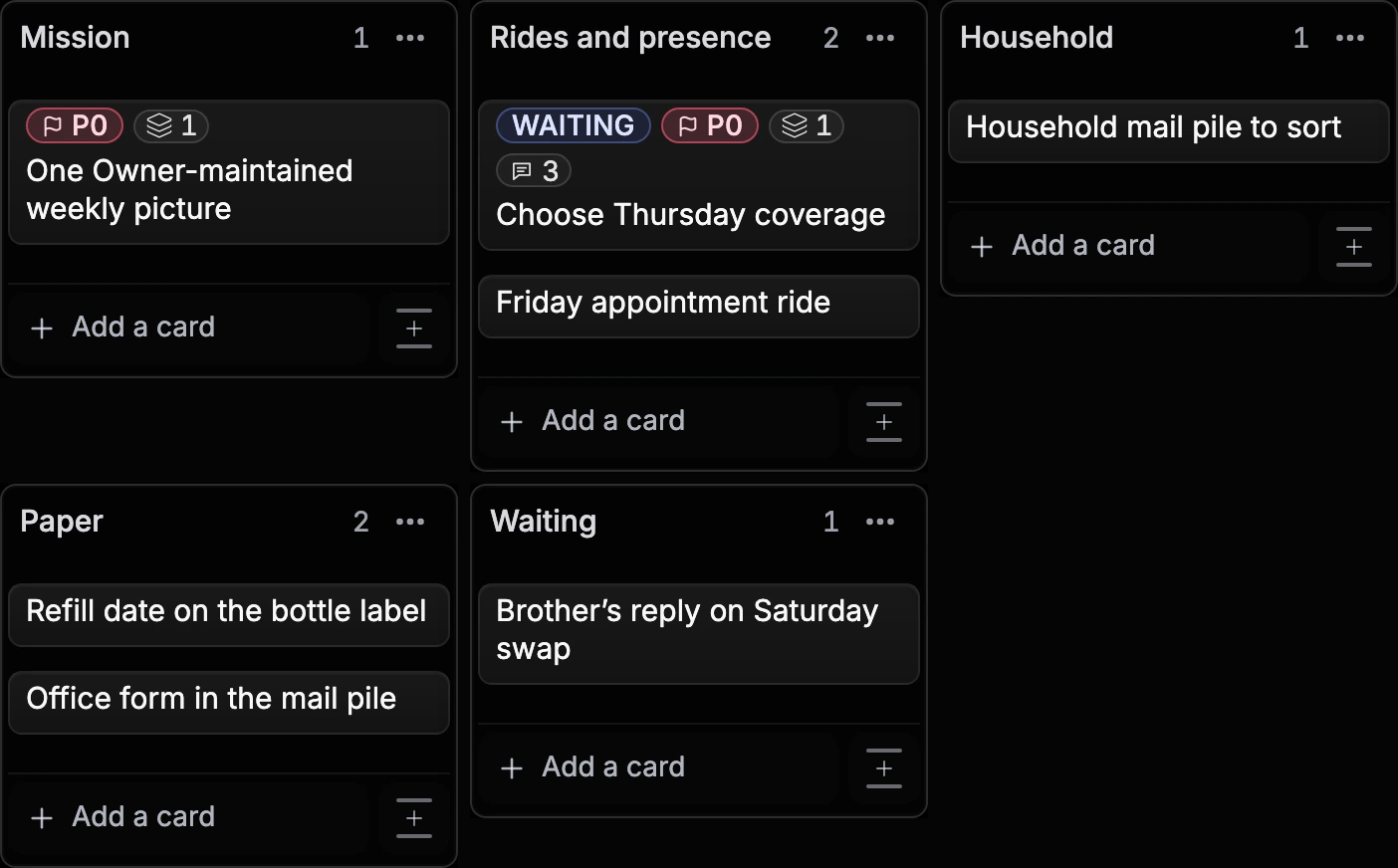
The This week’s care logistics Board gives this mission one durable operating picture. Helen can use familiar language instead of translating the situation into project-management jargon. Its five Lists separate the kinds of attention this situation actually requires.
Its Cards deliberately distinguish actions, evidence, something already waiting on another person or event, and decisions. A Waiting List is useful here only because a named request or outside condition is already in motion. That separation makes the current choice, evidence, and next move easier to scan.
Swipe or scroll sideways to see every column.
| List | What belongs here |
|---|---|
| Mission | This week’s picture and the line that the Board does not decide care |
| Rides and presence | Who is physically there, and when |
| Household | Food, mail, and house tasks |
| Paper | Forms and dates as printed, with owners |
| Waiting | The brother’s reply to Helen’s Saturday-swap request |
Available today
The Cards make the operating picture concrete
These Card titles come directly from Helen's situation: “Choose Thursday coverage” is the live choice, “Friday appointment ride” holds evidence, and “Brother’s reply on Saturday swap” names something genuinely in motion outside Helen's control. The point is recognition, not a perfect taxonomy.
Swipe or scroll sideways to see every column.
| Card | List | Job |
|---|---|---|
| One Owner-maintained weekly picture | Mission | Give Helen a picture she can scan and use in sibling conversations; clinicians and the family still own care |
| Choose Thursday coverage | Rides and presence | Compare Helen driving, a Saturday swap, and hiring the neighborhood driver already on the contact list |
| Friday appointment ride | Rides and presence | Hold the time, address as written, and who is currently named |
| Printed office date to confirm | Paper | Track the stated date as a reminder to check, not as a confirmed appointment or instruction |
| Office form in the mail pile | Paper | Give the dated form an owner without filling it as advice |
| Household mail pile to sort | Household | Keep the household mail work visible without treating it as a care decision |
| Brother’s reply on Saturday swap | Waiting | Keep an unconfirmed sibling maybe from being the plan |
Available today
Available today: Choose Thursday coverage becomes a Room
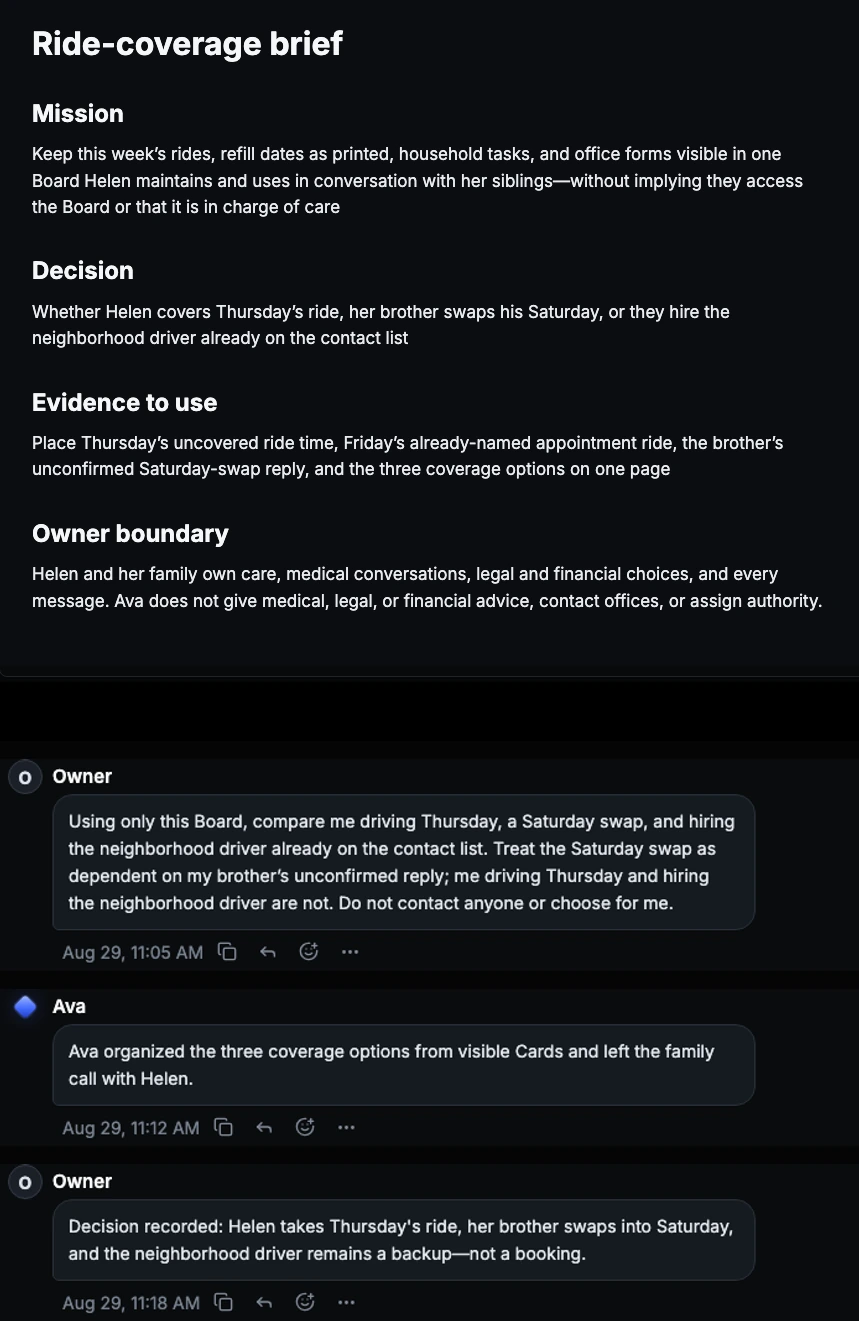
Opening the Card gives the visible item durable depth. Stage can hold Ride-coverage brief: Place Thursday’s uncovered ride time, Friday’s already-named appointment ride, the brother’s unconfirmed Saturday-swap reply, and the three coverage options on one page. Chat keeps the request and response beside that artifact instead of in a detached thread. Notifications can bring this update forward: “Open decision: Helen will choose Thursday coverage with her siblings.”
A Card Chat request can ask Ava to prepare the specific comparison or extraction in “Choose Thursday coverage” from the visible evidence. Ava can work from the context Helen deliberately brings into this Card, List, or Board; she cannot monitor the rest of life, contact anyone, or inherit the decision.
Helen's call remains explicit: Helen and her siblings choose coverage, talk to offices, and own every care and spending decision. The Board does not.
Swipe or scroll sideways to see every column.
| Surface | Job in this example |
|---|---|
| Stage | Ride-coverage brief: Place Thursday’s uncovered ride time, Friday’s already-named appointment ride, the brother’s unconfirmed Saturday-swap reply, and the three coverage options on one page |
| Chat | Keep Helen's request and Ava's attributed response with the work |
| Notifications | Open decision: Helen will choose Thursday coverage with her siblings |
What to ask Ava—and what not to assume
These requests stay with the facts Helen has made visible around “Choose Thursday coverage.” Helen supplies the evidence, checks Ava's work, and decides what belongs in the Room.
Current Ava can prepare help after an explicit request. She cannot make the choice, represent Helen, watch other work on her own, or contact anyone.
Helen and her family own care, medical conversations, legal and financial choices, and every message. Ava does not give medical, legal, or financial advice, contact offices, or assign authority.
A week Helen can scan and explain: Thursday has a chosen coverage path, the form has an owner, and the Board has not been asked to be a clinician or a shared family workspace.
- Request idea: using only the context visible in this Card Room, compare me driving Thursday, a Saturday swap, and hiring the neighborhood driver already on the contact list. Treat the Saturday swap as dependent on my brother’s unconfirmed reply; me driving Thursday and hiring the neighborhood driver are not. Do not contact anyone or choose for me.
- Request idea: use only the Ride-coverage brief and notes the Owner has placed in this Card Room to separate facts, assumptions, and unanswered questions
- Request idea: name which visible Room note could most change the comparison; do not watch other Lists or follow up autonomously
What A sibling group text can still handle
A sibling group text can be enough while the situation stays simple: one person is always free and mail is empty.
It starts to break when a Thursday ride, a form date, and a maybe-swap all live in different places.
The This week’s care logistics Board earns its place only when the familiar tool—a sibling group text—can no longer keep the reason, Ride-coverage brief, conversation, current state, decision, and history connected.
A starter recipe to adapt, not obey
Helen should rename every List or Card that feels artificial. This recipe succeeds when “Choose Thursday coverage” becomes easier to decide and fewer open loops depend on memory—not when the Board looks tidy.
Swipe or scroll sideways to see every column.
| Step | Action |
|---|---|
| 1. State the line | The Board coordinates logistics; it does not decide care |
| 2. Card this week’s presence | Rides and who is physically there |
| 3. Capture printed dates | Appointment cards and form dates as written, with owners |
| 4. Park maybes | Sibling replies stay in Waiting until they are real |
| 5. Choose Thursday coverage | Open a Room for the first uncovered ride |
Direction
Direction, not a current promise
Later, Ava may help this Board notice when a ride Card has no named person, still leaving every care decision with the family.
A future unified You.one experience could carry relevant context from “Choose Thursday coverage” across guidance and the Superboard view. Broad proactive coordination, cross-surface personalized memory, realtime shared editing, and general external execution are not available today. Any future action would still require the applicable capability, connection, grant, and human authority.
What this realistic example does not claim
- Helen is fictional and is not a customer, testimonial, research participant, or disguised real person.
- This is not medical, legal, financial, or care-planning advice, and it is not a substitute for clinicians or authorized decision-makers.
- It does not show Ava contacting offices, changing appointments, or choosing care.
- It is not a measured health outcome or a claim about any real family.