
Example
How to build a graphic-novel first issue without explaining the whole world
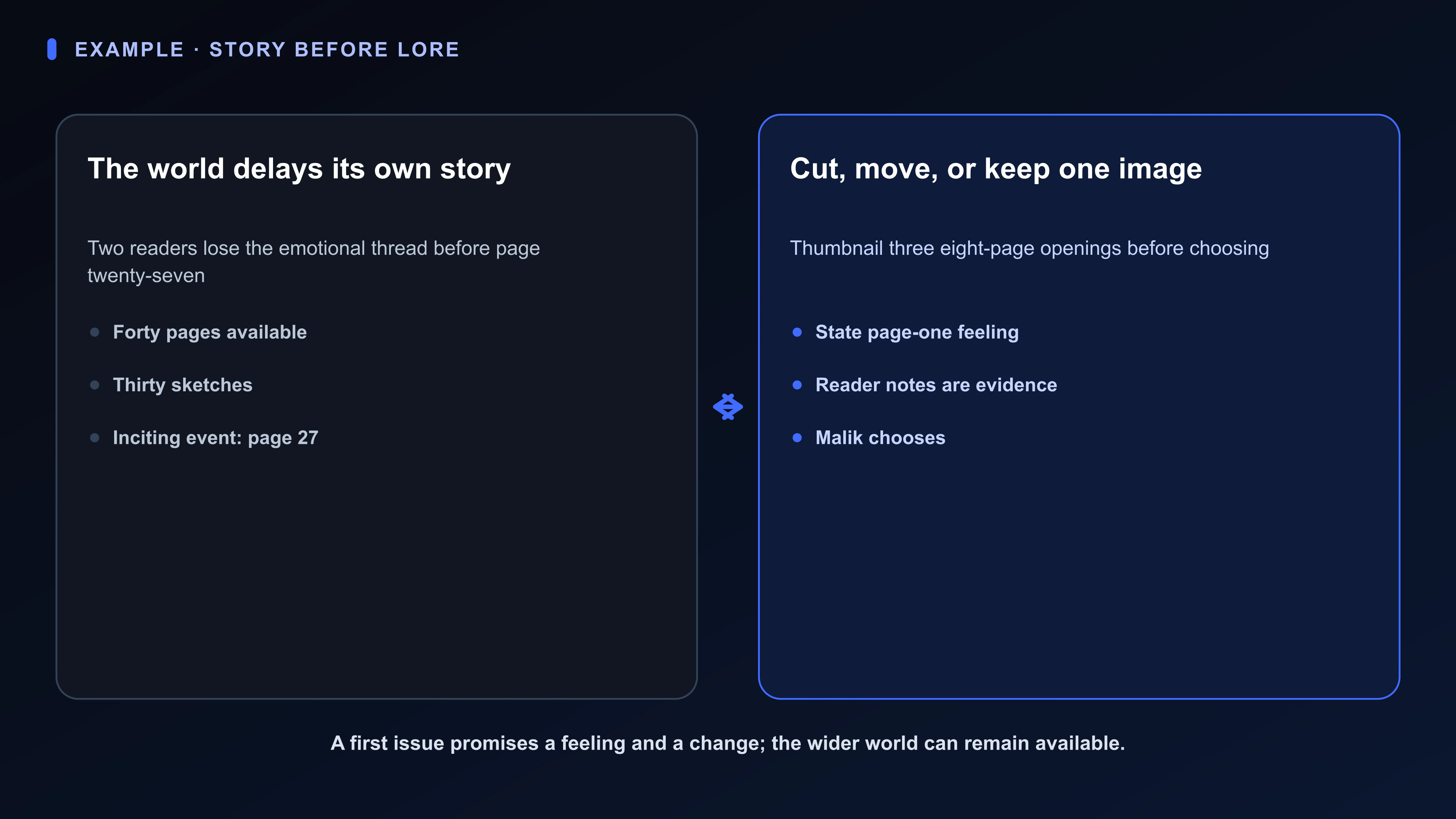
The world is rich enough to delay the story readers need first. Malik must cut the historical prologue, move it later, or retain only the one image that changes the protagonist’s choice after comparing three eight-page openings.
Finish a first issue that creates one emotional promise and leaves the wider world available rather than summarized
The result Malik is trying to create—not every possible task
Hold the mission and boundary: finish a first issue that creates one emotional promise and leaves the wider world available rather than summarized
The current choice, preparation, and other owned next moves
Hold the live choice—whether to cut the historical prologue, move it later, or keep only the image that changes the protagonist's choice—so Malik can decide from the evidence in this Room
State what page one must make the reader feel after comparing the three thumbnails
Thumbnail three eight-page openings that cut, move, or reduce the prologue
Evidence for the live choice, drawn from the situation's actual sources
Supply the evidence for the Opening-structure brief: place reader promise, page count, necessary context, thumbnails, and two early-reader notes together. Live choice: Whether to cut the historical prologue, move it later, or keep only the image that changes the protagonist's choice.
Keep the two readers' lost-thread evidence separate from Malik's interpretation
In You.one’s Superboard view, the Issue one Board separates the reader promise, pages in motion, story evidence, reader evidence, and what is truly print-ready.
Open Cut, move, or keep one image as the Room with the Opening-structure brief, three thumbnails, page count, and both readers’ lost-thread notes.
After an explicit request, Ava can group only the visible evidence but cannot turn reader notes into votes, write or draw the issue, clear rights, publish, or choose the story. Malik owns every creative and release decision.
Issue one has one live choice: Cut, move, or keep one image
The work has a clear center: Finish a first issue that creates one emotional promise and leaves the wider world available rather than summarized.
Organizing the evidence does not authorize the software to decide: Whether to cut the historical prologue, move it later, or keep only the image that changes the protagonist's choice.
You.one can keep the work, several kinds of evidence, and “Cut, move, or keep one image” decision visible through its Superboard view. The organized facts support Malik; they do not replace Malik's judgment: Malik, as the writer-illustrator creating a first serialized comic, owns the preparation and the decision about whether to cut the historical prologue, move it later, or keep only the image that changes the protagonist's choice.
Available today
Name the work in plain language
These Card titles come directly from Malik's situation: “Cut, move, or keep one image” is the live choice, while “Page twenty-seven inciting event” and “Two early readers lose the thread” hold different facts that can change it. The point is recognition, not a perfect taxonomy.
Swipe or scroll sideways to see every column.
| Card | List | Job |
|---|---|---|
| Issue one | Reader promise | Hold the mission and boundary: finish a first issue that creates one emotional promise and leaves the wider world available rather than summarized |
| Cut, move, or keep one image | Pages moving | Hold the live choice—whether to cut the historical prologue, move it later, or keep only the image that changes the protagonist's choice—so Malik can decide from the evidence in this Room |
| Page twenty-seven inciting event | Story evidence | Supply the evidence for the Opening-structure brief: place reader promise, page count, necessary context, thumbnails, and two early-reader notes together. Live choice: Whether to cut the historical prologue, move it later, or keep only the image that changes the protagonist's choice. |
| Page-one promise | Pages moving | State what page one must make the reader feel after comparing the three thumbnails |
| Two early readers lose the thread | Story evidence | Keep the two readers' lost-thread evidence separate from Malik's interpretation |
| Thumbnail three eight-page openings: cut the prologue, move it later, and keep only the one consequential image | Pages moving | Thumbnail three eight-page openings that cut, move, or reduce the prologue |
Available today
Issue one: separate the kinds of attention
The Issue one Board gives this mission one durable operating picture. Malik can use familiar language instead of translating the situation into project-management jargon. Its three Lists separate the kinds of attention this situation actually requires.
The Lists use Malik's own language so actions, evidence, open questions, and decisions do not collapse into one queue. A separate place for replies is useful only after Malik has asked someone or a real outside event must happen first.
Swipe or scroll sideways to see every column.
| List | What belongs here |
|---|---|
| Reader promise | The result Malik is trying to create—not every possible task |
| Pages moving | The current choice, preparation, and other owned next moves |
| Story evidence | Evidence for the live choice, drawn from the situation's actual sources |
Ask Ava to prepare the judgment—not make it
These requests stay with the facts Malik has made visible around “Cut, move, or keep one image.” Malik supplies the evidence, checks Ava's work, and decides what belongs in the Room.
Current Ava can prepare help after an explicit request. She cannot make the choice, represent Malik, watch other work on her own, or contact anyone.
Malik, as the writer-illustrator creating a first serialized comic, owns the preparation and the decision about whether to cut the historical prologue, move it later, or keep only the image that changes the protagonist's choice. Ava may help only inside this Card Room; she cannot decide, represent anyone, contact people, or act elsewhere.
Malik finishes “Thumbnail three eight-page openings: cut the prologue, move it later, and keep only the one consequential image,” keeps “Page twenty-seven inciting event” beside “Cut, move, or keep one image,” and uses “Two early readers lose the thread” only as visible decision evidence.
- Request idea: help me prepare for Cut, move, or keep one image using only this Card Room and the Opening-structure brief. Separate facts, assumptions, and unanswered questions; stop before the final call.
- Request idea: use only the Opening-structure brief and notes the Owner has placed in this Card Room to name the missing evidence for each option
- Request idea: in “Cut, move, or keep one image,” group the visible evidence by option and leave the decision open
Available today
One Card Room for the consequential choice
Opening the Card gives the visible item durable depth. Stage can hold Opening-structure brief: Place reader promise, page count, necessary context, thumbnails, and two early-reader notes together. Live choice: Whether to cut the historical prologue, move it later, or keep only the image that changes the protagonist's choice. Chat keeps the request and response beside that artifact instead of in a detached thread. Notifications can bring this update forward: “Open decision: Malik will decide whether to cut the historical prologue, move it later, or keep only the image that changes the protagonist's choice.”
A Card Chat request can ask Ava to prepare the specific comparison or extraction in “Cut, move, or keep one image” from the visible evidence. Ava can work from the context Malik deliberately brings into this Card, List, or Board; she cannot monitor the rest of life, contact anyone, or inherit the decision.
Malik's call remains explicit: Malik, as the writer-illustrator creating a first serialized comic, owns the preparation and the decision about whether to cut the historical prologue, move it later, or keep only the image that changes the protagonist's choice.
Swipe or scroll sideways to see every column.
| Surface | Job in this example |
|---|---|
| Stage | Opening-structure brief: Place reader promise, page count, necessary context, thumbnails, and two early-reader notes together. Live choice: Whether to cut the historical prologue, move it later, or keep only the image that changes the protagonist's choice |
| Chat | Keep Malik's request and Ava's attributed response with the work |
| Notifications | Open decision: Malik will decide whether to cut the historical prologue, move it later, or keep only the image that changes the protagonist's choice |
Build only enough Board to make the next decision
Malik should rename every List or Card that feels artificial. This recipe succeeds when “Cut, move, or keep one image” becomes easier to decide and fewer open loops depend on memory—not when the Board looks tidy.
Swipe or scroll sideways to see every column.
| Step | Action |
|---|---|
| 1. Thumbnail three eight-page openings | Cut the prologue, move it later, and keep only the consequential image |
| 2. State the page-one promise | Name what the strongest thumbnail makes the reader feel before explanation |
| 3. Keep page twenty-seven visible | The current inciting event shows how long the opening delays the story |
| 4. Compare reader evidence | Use the two lost-thread notes without turning them into votes |
| 5. Choose the prologue posture | Open the Cut, move, or keep one image Room |
Where this example stops
- This is a fictional example, not a customer story.
- This fictional example is not authorship, publishing, copyright, or professional story advice; the artist owns the work and decides what reader feedback means.
- It does not show Ava completing external actions or contacting anyone for Malik.
- It does not report a measured result, and this Board is a starting shape to adapt—not a universal prescription.