
Example
How to host a holiday week without losing beds, meals, and a quiet morning
Neil and his partner need one hosting shape that resolves both sleeping capacity and mornings. The honest options are six guests with later presents, nine using the basement with later presents, or six guests with the adults trading protected mornings.
Host a week with honest beds, an oven schedule, and one quiet morning that is actually quiet
Beds, oven, and one quiet morning
Keep capacity beside the 6 a.m. ask
Who sleeps where
Compare three complete paths that each resolve beds and the quiet-morning promise
Keep the conditional headcount visible as owned planning evidence rather than inventing an unanswered RSVP
Oven slots and what must come from elsewhere
Schedule sides so they are not all at noon
Quiet hours versus 6 a.m. tradition
Hold a household constraint so tradition cannot overwrite it
Name the colliding tradition
The Holiday four days Board keeps people, real beds, oven slots, and morning promises visible before a conditional headcount hardens into a plan.
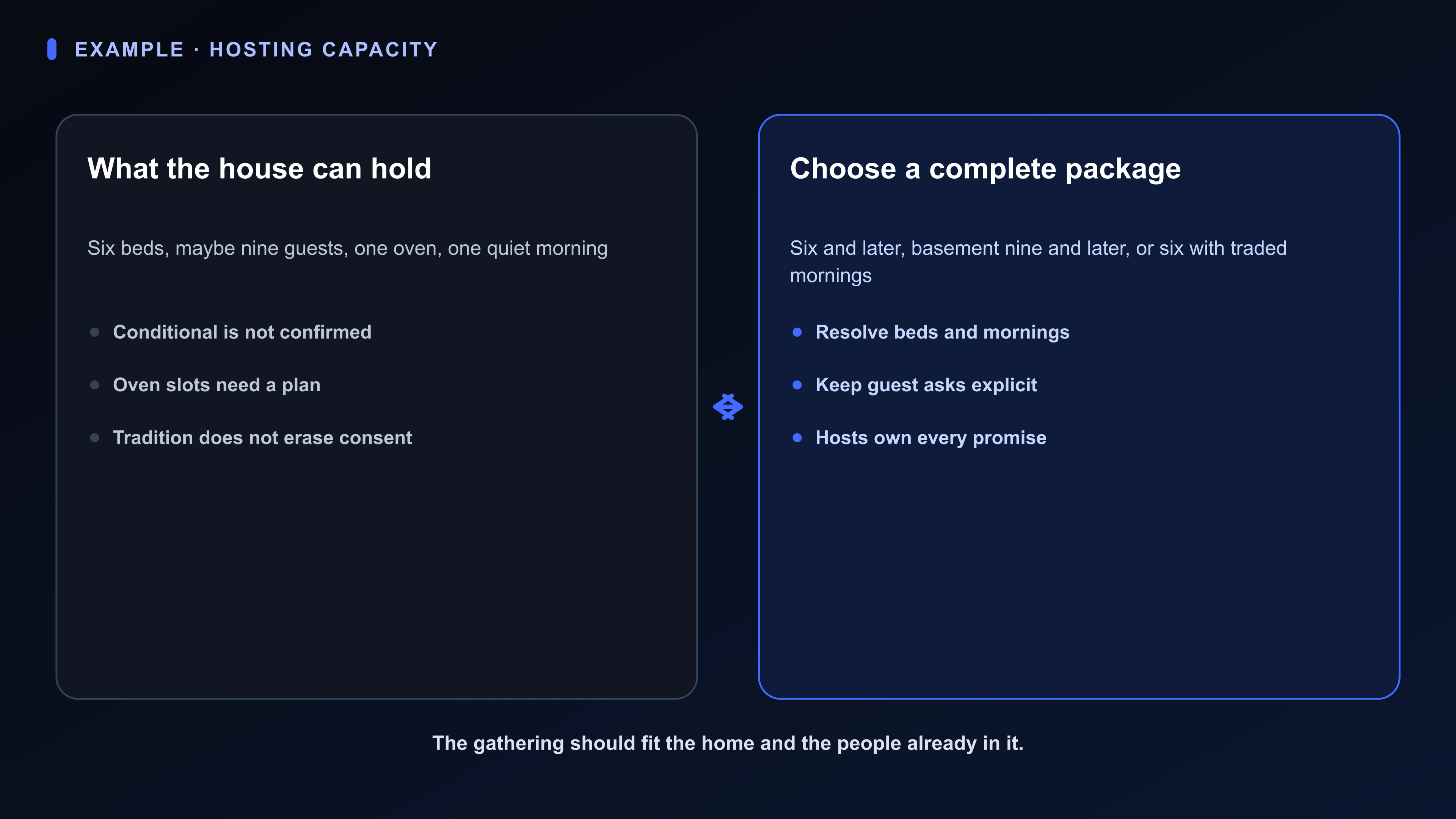
The hosting-path Room compares three complete packages instead of treating overflow beds and quiet hours as separate errands.
Ava can prepare the comparison from the Room. Neil and his partner choose what their home can hold, then make every invitation, food, and guest conversation themselves.
Nine people is not six beds, and 6 a.m. is not a quiet morning
The mission is specific: Host a week with honest beds, an oven schedule, and one quiet morning that is actually quiet.
The consequential choice is not something a board or an AI should quietly make: Whether to house six and help three people with a motel with presents after breakfast, house nine using the basement with presents after breakfast and the next morning quiet, or house six with motel help and trade a 6 a.m. present morning for a protected quiet morning the next day.
You.one can keep the work, evidence, and “Choose six-and-later, basement-nine-and-later, or six-and-trade-mornings” decision visible through its Superboard view. Authority does not move to the software: Neil and his partner choose beds and mornings, talk to relatives, and own the household.
Available today
Holiday four days: the working map
The Holiday four days Board gives this mission one durable operating picture. Neil can use familiar language instead of translating the situation into project-management jargon. Its four Lists separate the kinds of attention this situation actually requires.
The Lists separate what Neil can move now, what is evidence, what is already waiting on a named person or event, and what still needs a decision.
Swipe or scroll sideways to see every column.
| List | What belongs here |
|---|---|
| Mission | Beds, oven, and one quiet morning |
| People and beds | Who sleeps where |
| Kitchen | Oven slots and what must come from elsewhere |
| Mornings | Quiet hours versus 6 a.m. tradition |
Available today
Open one decision: Choose six-and-later, basement-nine-and-later, or six-and-trade-mornings
Opening the Card gives the visible item durable depth. Stage can hold Hosting-path brief: Place bed count, conditional cousin headcount, quiet-morning promise, and the three complete beds-and-mornings packages on one page. Chat keeps the request and response beside that artifact instead of in a detached thread. Notifications can bring this update forward: “Open decision: Neil and his partner will choose a hosting path.”
A Card Chat request can ask Ava to prepare the specific comparison or extraction in “Choose six-and-later, basement-nine-and-later, or six-and-trade-mornings” from the visible evidence. Ava can work from the context Neil deliberately brings into this Card, List, or Board; she cannot monitor the rest of life, contact anyone, or inherit the decision.
Neil's call remains explicit: Neil and his partner choose beds and mornings, talk to relatives, and own the household.
Swipe or scroll sideways to see every column.
| Surface | Job in this example |
|---|---|
| Stage | Hosting-path brief: Place bed count, conditional cousin headcount, quiet-morning promise, and the three complete beds-and-mornings packages on one page |
| Chat | Keep Neil's request and Ava's attributed response with the work |
| Notifications | Open decision: Neil and his partner will choose a hosting path |
Useful Ava requests, with the boundary intact
These requests stay with the facts Neil has made visible around “Choose six-and-later, basement-nine-and-later, or six-and-trade-mornings.” Neil supplies the evidence, checks Ava's work, and decides what belongs in the Room.
Current Ava can prepare help after an explicit request. She cannot make the choice, represent Neil, watch other work on her own, or contact anyone.
Neil owns the household, invitations, and food. Ava does not message relatives, cook, or mediate tradition.
A week that fits the house: beds are honest, the oven has slots, and a quiet morning is a decision rather than a hope.
- Request idea: using only the context visible in this Card Room, compare six in the house with motel help and later presents, nine using the basement with later presents and the next morning quiet, and six with motel help plus one 6 a.m. present morning traded for a protected quiet morning the next day. Do not message relatives, move Cards, watch other Lists, or choose for us.
- Request idea: use only the Hosting-path brief and notes the Owner has placed in this Card Room to separate facts, assumptions, and unanswered questions
- Request idea: in “Choose six-and-later, basement-nine-and-later, or six-and-trade-mornings,” show which visible fact could reverse the current choice
The limit of a group text plus a fold-out couch
A group text plus a fold-out couch can be enough while the situation stays simple: the guest count fits and mornings agree.
It starts to break when maybe-nine, one oven, and a 6 a.m. tradition share a quiet-morning ask.
The Holiday four days Board earns its place only when the familiar tool—a group text plus a fold-out couch—can no longer keep the reason, Hosting-path brief, conversation, current state, decision, and history connected.
A practical way to start the Holiday four days Board
Neil should rename every List or Card that feels artificial. This recipe succeeds when “Choose six-and-later, basement-nine-and-later, or six-and-trade-mornings” becomes easier to decide and fewer open loops depend on memory—not when the Board looks tidy.
Swipe or scroll sideways to see every column.
| Step | Action |
|---|---|
| 1. Count real beds | Comfortable, not theoretical |
| 2. Schedule the oven | One heat source |
| 3. Put quiet hours on the Board | As a constraint |
| 4. Keep conditional headcounts with beds | A maybe is planning evidence until Neil asks |
| 5. Choose six-and-later, basement-nine-and-later, or six-and-trade-mornings | Open a Room before 6 a.m. writes the week |
Where this example stops
- This is a fictional example, not a customer story.
- This is not hosting, dietary, or family-therapy advice.
- It does not show Ava contacting guests or cooking.
- It is not a measured gathering result.