
Example
How a new-parent household can keep the first months visible without a second full-time job
Nora and her partner do not need software to tell them how to parent. They need one quiet place to see which nights are covered, which visitor would truly help on Friday, and which dated form is still unopened.
Keep a visible week of coverage, mail dates, and visitor timing so the household is not run by whoever is least asleep—without treating the Board as a clinician
Coverage picture and the line that the Board does not give care advice
Keep who-is-home beside the rule that the Board organizes logistics, not care
Who is actually home which hours
Show actual night coverage rather than a vague we-will-figure-it-out
Mail, food, and dishes that still happen
Track the printed times and printed change line as logistics, not as medical instruction
Pull dated envelopes off the changing table
Visitors and offers with specific jobs
Compare delay, dated-mail-only, and keep-and-move-appointment options
Turn an open-ended offer into a yes, a job, or a delay
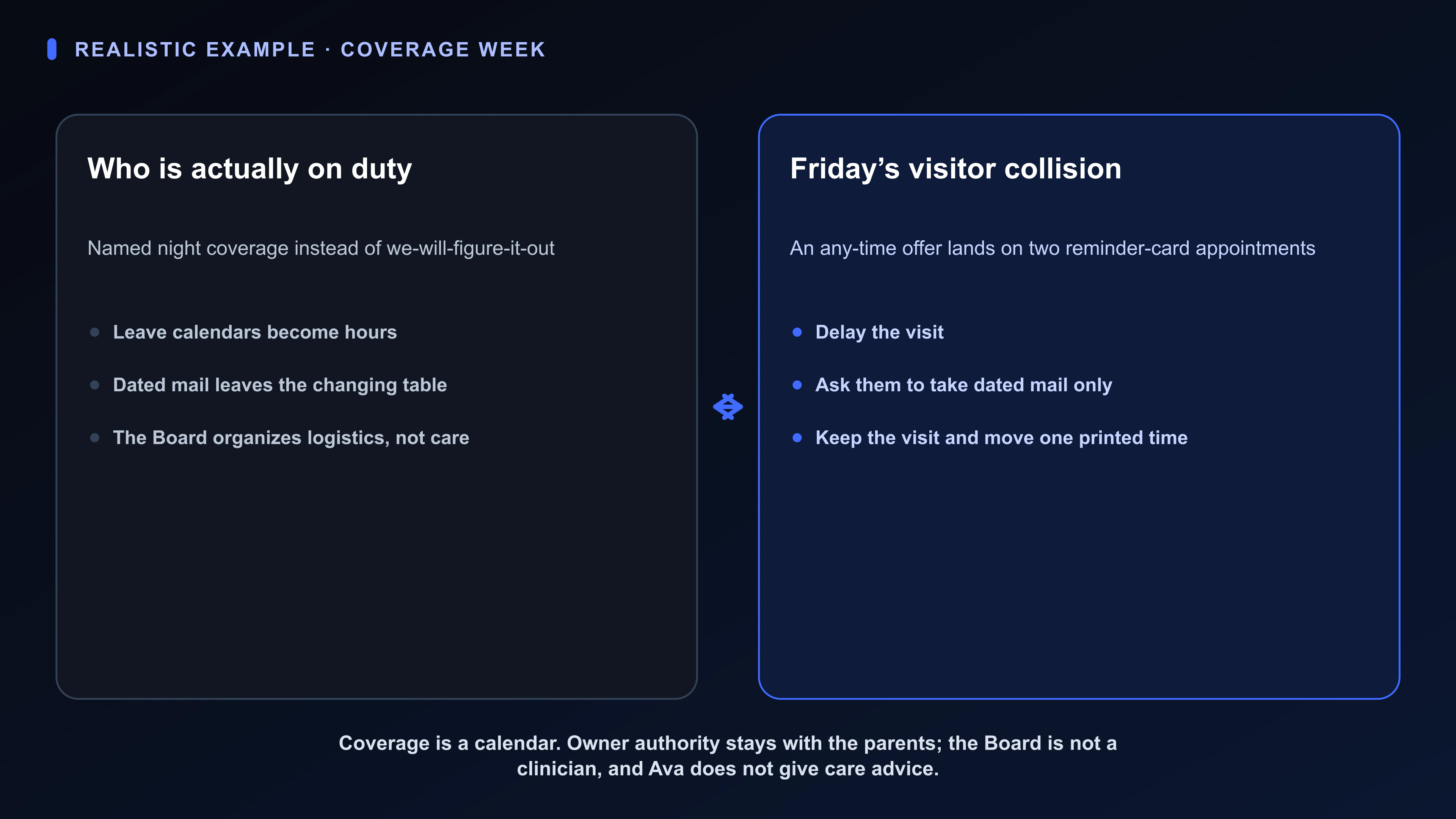
Organize the household transition around coverage and commitments, not an idealized routine.
Use a Room for Friday’s visitor decision so timing, boundaries, offered help, and the parents’ call stay together.
Ava can sort logistics the household shares. She cannot give medical advice, assess a baby or parent, choose care, or contact people.
Why Fourth-trimester week needs an operating picture
Nora is a fictional 32-year-old new parent sharing a small apartment with a partner in Providence, Rhode Island. Nora is home with a six-week-old. Leave calendars, a visitor who offered “any time,” and a pile of unopened mail currently compete with sleep. Nobody is asking Superboard to parent; they need one picture of who is on duty.
A leave calendar, a group text of offers, and a changing table covered in unopened envelopes do not share a week.
A visitor who said any time is currently penciled in for Friday, which is the first day both adults have medical-follow-up appointments listed on reminder cards.
In You.one's Superboard view, Nora can give “Keep a visible week of coverage, mail dates, and visitor timing so the household is not run by whoever is least asleep—without treating the Board as a clinician” a Board of its own. That Board connects what matters, practical constraints, open questions, and personal agency; opening “Choose Friday’s visitor” creates a Room for its evidence, discussion, state, and decision.
Coverage is a calendar; advice threads are not a night shift
The mission is specific: Keep a visible week of coverage, mail dates, and visitor timing so the household is not run by whoever is least asleep—without treating the Board as a clinician.
The consequential choice is not something a board or an AI should quietly make: Whether to delay Friday’s visitor, ask them to take the dated mail only, or keep the visit and move one reminder-card appointment using the printed change line.
You.one can keep the work, evidence, and “Choose Friday’s visitor” decision visible through its Superboard view. Authority does not move to the software: Nora and her partner choose visitors, coverage, and any appointment changes. The Board does not give medical advice.
Available today
Fourth-trimester week: one Board shape to adapt
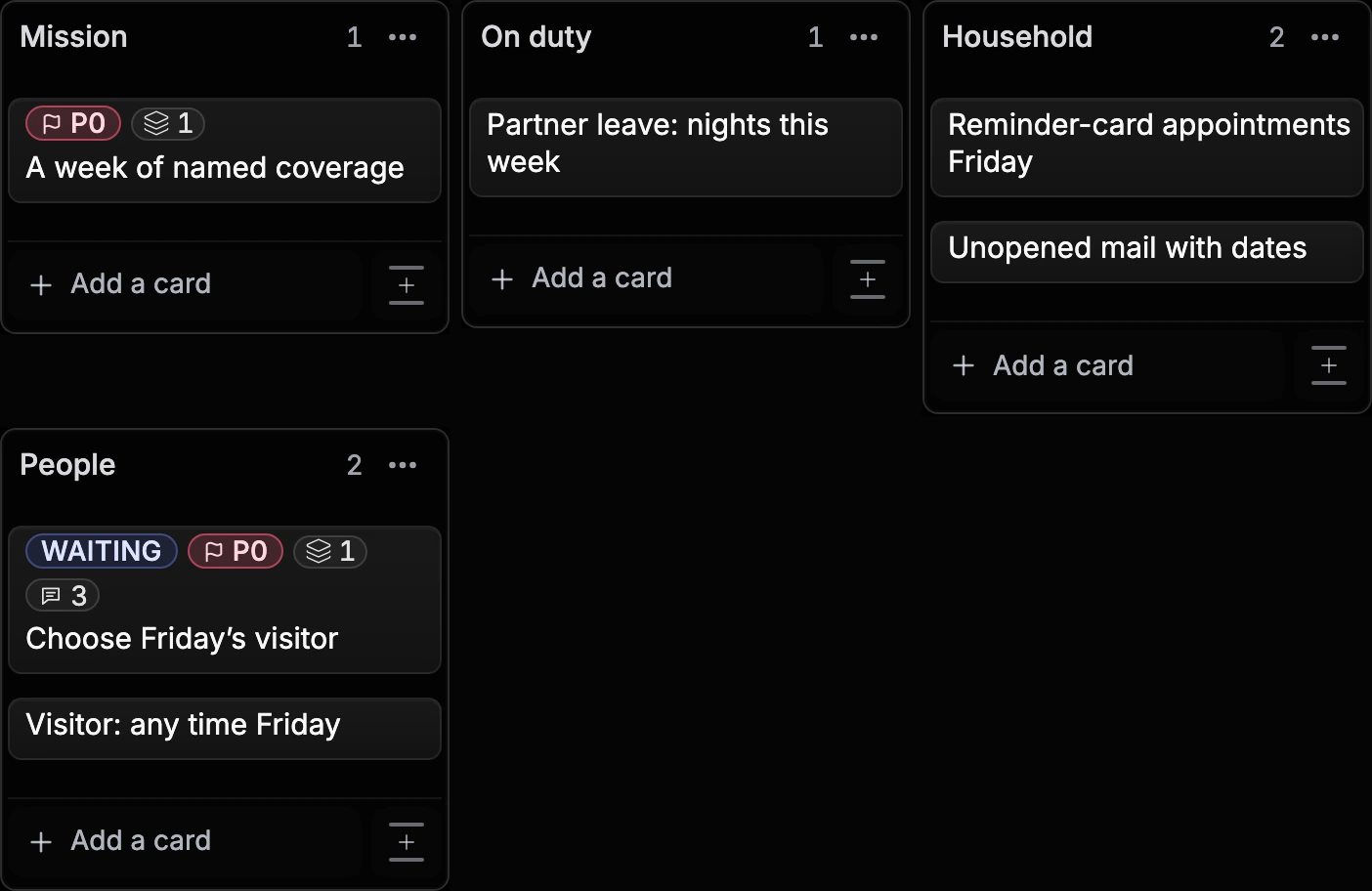
The Fourth-trimester week Board gives this mission one durable operating picture. Nora can use familiar language instead of translating the situation into project-management jargon. Its four Lists separate the kinds of attention this situation actually requires.
Its Cards deliberately distinguish actions, evidence, and decisions while keeping unsent questions in owned work. A Waiting List would be premature until a named request or outside condition is actually in motion. That separation makes the current choice, evidence, and next move easier to scan.
Swipe or scroll sideways to see every column.
| List | What belongs here |
|---|---|
| Mission | Coverage picture and the line that the Board does not give care advice |
| On duty | Who is actually home which hours |
| Household | Mail, food, and dishes that still happen |
| People | Visitors and offers with specific jobs |
Available today
The Cards make the operating picture concrete
These Card titles come directly from Nora's situation: “Choose Friday’s visitor” is the live choice, “Partner leave: nights this week” holds evidence, and “Unopened mail with dates” is still work Nora controls—not something already awaiting another person. The point is recognition, not a perfect taxonomy.
Swipe or scroll sideways to see every column.
| Card | List | Job |
|---|---|---|
| A week of named coverage | Mission | Keep who-is-home beside the rule that the Board organizes logistics, not care |
| Choose Friday’s visitor | People | Compare delay, dated-mail-only, and keep-and-move-appointment options |
| Partner leave: nights this week | On duty | Show actual night coverage rather than a vague we-will-figure-it-out |
| Reminder-card appointments Friday | Household | Track the printed times and printed change line as logistics, not as medical instruction |
| Unopened mail with dates | Household | Pull dated envelopes off the changing table |
| Visitor: any time Friday | People | Turn an open-ended offer into a yes, a job, or a delay |
Available today
Available today: Choose Friday’s visitor becomes a Room
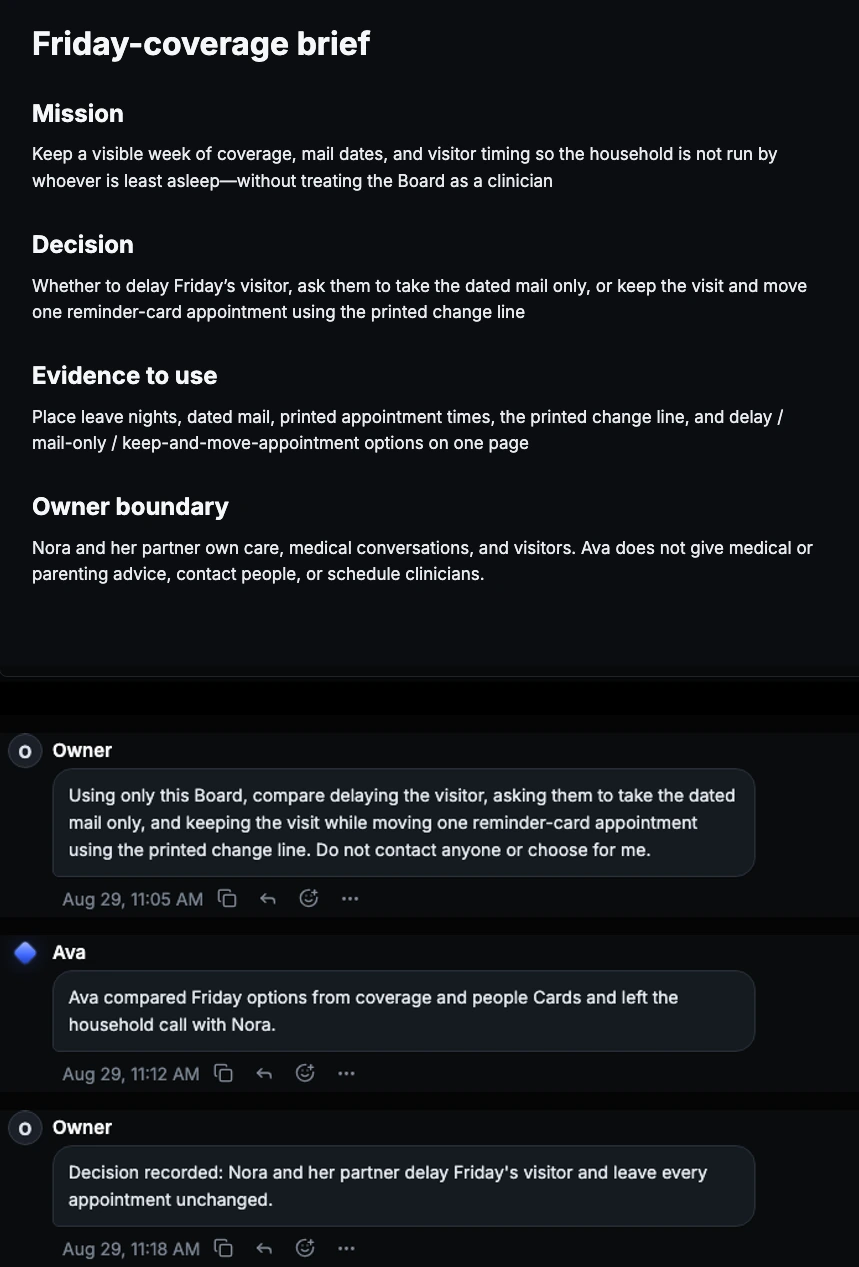
Opening the Card gives the visible item durable depth. Stage can hold Friday-coverage brief: Place leave nights, dated mail, printed appointment times, the printed change line, and delay / mail-only / keep-and-move-appointment options on one page. Chat keeps the request and response beside that artifact instead of in a detached thread. Notifications can bring this update forward: “Open decision: Nora and her partner will choose Friday’s coverage.”
A Card Chat request can ask Ava to prepare the specific comparison or extraction in “Choose Friday’s visitor” from the visible evidence. Ava can work from the context Nora deliberately brings into this Card, List, or Board; she cannot monitor the rest of life, contact anyone, or inherit the decision.
Nora's call remains explicit: Nora and her partner choose visitors, coverage, and any appointment changes. The Board does not give medical advice.
Swipe or scroll sideways to see every column.
| Surface | Job in this example |
|---|---|
| Stage | Friday-coverage brief: Place leave nights, dated mail, printed appointment times, the printed change line, and delay / mail-only / keep-and-move-appointment options on one page |
| Chat | Keep Nora's request and Ava's attributed response with the work |
| Notifications | Open decision: Nora and her partner will choose Friday’s coverage |
What to ask Ava—and what not to assume
These requests stay with the facts Nora has made visible around “Choose Friday’s visitor.” Nora supplies the evidence, checks Ava's work, and decides what belongs in the Room.
Current Ava can prepare help after an explicit request. She cannot make the choice, represent Nora, watch other work on her own, or contact anyone.
Nora and her partner own care, medical conversations, and visitors. Ava does not give medical or parenting advice, contact people, or schedule clinicians.
A week with named coverage: Friday’s visitor is a decision, dated mail is off the changing table, and the Board has not been asked to parent.
- Request idea: using only the context visible in this Card Room, compare delaying the visitor, asking them to take the dated mail only, and keeping the visit while moving one reminder-card appointment using the printed change line. Do not contact anyone or choose for me.
- Request idea: use only the Friday-coverage brief and notes the Owner has placed in this Card Room to separate facts, assumptions, and unanswered questions
- Request idea: name which visible Room note could most change the comparison; do not watch other Lists or follow up autonomously
What A group text of offers plus reminder cards can still handle
A group text of offers plus reminder cards can be enough while the situation stays simple: one adult is always off duty.
It starts to break when a Friday visitor and two reminder-card times land on the same morning.
The Fourth-trimester week Board earns its place only when the familiar tool—a group text of offers plus reminder cards—can no longer keep the reason, Friday-coverage brief, conversation, current state, decision, and history connected.
A starter recipe to adapt, not obey
Nora should rename every List or Card that feels artificial. This recipe succeeds when “Choose Friday’s visitor” becomes easier to decide and fewer open loops depend on memory—not when the Board looks tidy.
Swipe or scroll sideways to see every column.
| Step | Action |
|---|---|
| 1. Name who is on duty | Hours, not vibes |
| 2. Put printed appointment times on the Board | Logistics only |
| 3. Pull dated mail | Envelopes are not changing-table decor |
| 4. Give visitors jobs or dates | Any time is not a plan |
| 5. Choose Friday’s visitor | Open a Room before Friday becomes a hallway |
Direction
Direction, not a current promise
Later, Ava may help this Board notice when a day has no on-duty Card, still leaving every care decision with the parents.
A future unified You.one experience could carry relevant context from “Choose Friday’s visitor” across guidance and the Superboard view. Broad proactive coordination, cross-surface personalized memory, realtime shared editing, and general external execution are not available today. Any future action would still require the applicable capability, connection, grant, and human authority.
What this realistic example does not claim
- Nora is fictional and is not a customer, testimonial, research participant, or disguised real person.
- This is not medical, lactation, or parenting advice, and it is not a substitute for clinicians.
- It does not show Ava contacting visitors or changing appointments.
- It is not a measured infant or family outcome.