
Example
How to make room for the puppy you actually wanted
Jules wanted a puppy and the life that comes with one—not a second job held together by texts, fridge notes, and conflicting advice. Noon coverage is incomplete, hallway barking is affecting a neighbor, the vet visit is booked, and a group-class seat is not. The next eight weeks need one shared routine and one honest training choice.
Get through the next eight weeks with a shared routine, the booked vet visit honored, and hallway barking treated as a household problem rather than a surprise
Eight-week picture and household constraints
Keep who-is-home and the hallway problem on the same mission as cute photos
Who is home, crate, walks, and meals
Show which days someone is actually in the apartment
Partner, neighbor, and building rules as written
Show the partner's own availability without assigning care they did not accept
Treat the note as a household fact, not as a forum argument
Booked visits, training decisions, and supply runs
Compare Saturday group, private sessions, and wait-until-vet options
Keep the existing appointment from being rescheduled by accident
The unconfirmed Saturday class seat
Hold an unconfirmed seat so it is not already in the routine
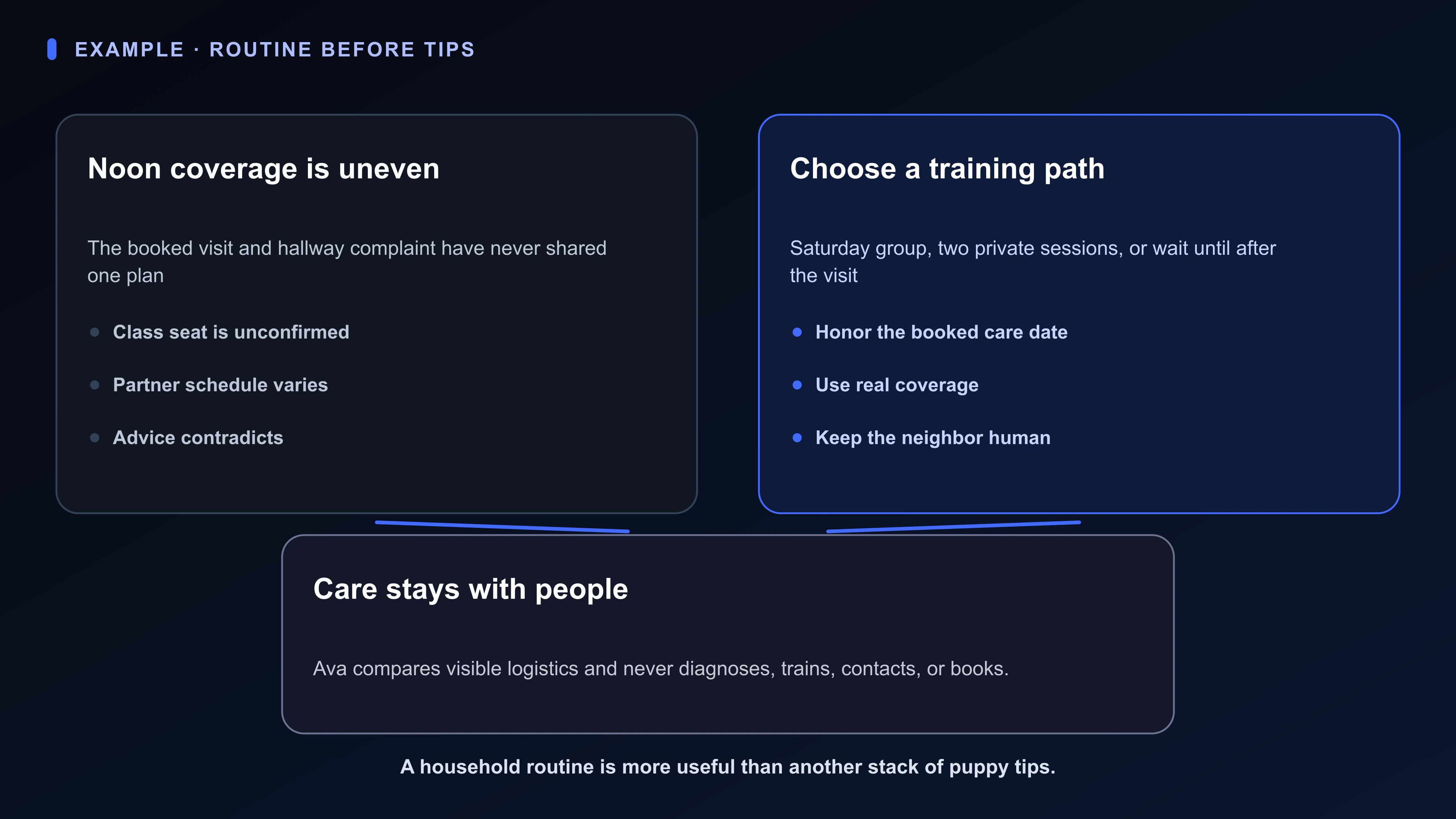
You.one can hold a separate Board for the puppy just as it can for work, a household project, or another part of life. This one keeps the shared routine, noon coverage, care dates, neighbor concern, and unconfirmed class together.
Open Choose a training path as a Room so the household can see who is home, what is booked, and what each option would require. The conversation, evidence, and final choice remain with the Card through the next eight weeks.
Ava can organize what Jules and their partner provide and help compare the visible options. They own care, spending, the neighbor conversation, and the choice; Ava does not train, diagnose, contact, or book.
A routine is a picture of who is home, not a stack of tips
This Board has one job: Get through the next eight weeks with a shared routine, the booked vet visit honored, and hallway barking treated as a household problem rather than a surprise.
The decision still belongs to Jules: Whether to start a Saturday group class, book two private sessions, or wait until after the vet visit already on the calendar.
You.one can keep the work, evidence, anything already waiting on another person or event, and the “Choose a training path” decision visible through its Superboard view. Jules still owns the call: Jules and their partner choose classes, spending, and how they respond to the neighbor. Ava does not train the dog.
Available today
Puppy first months: one place for the mission
The Puppy first months Board gives this mission one durable operating picture. Jules can use familiar language instead of translating the situation into project-management jargon. Its five Lists separate the kinds of attention this situation actually requires.
The Board is not a master task list. It keeps the live choice, the facts that could change it, and any reply or outside event already in motion visible without pretending every uncertainty is work in progress.
Swipe or scroll sideways to see every column.
| List | What belongs here |
|---|---|
| Mission | Eight-week picture and household constraints |
| Routine | Who is home, crate, walks, and meals |
| People and place | Partner, neighbor, and building rules as written |
| Care dates | Booked visits, training decisions, and supply runs |
| Replies and outside conditions | The unconfirmed Saturday class seat |
Available today
Cards that sound like the real work
These Card titles come directly from Jules's situation: “Choose a training path” is the live choice, “Noon coverage on workdays” holds evidence, and “Saturday class waitlist” names something genuinely in motion outside Jules's control. The point is recognition, not a perfect taxonomy.
Swipe or scroll sideways to see every column.
| Card | List | Job |
|---|---|---|
| Eight weeks of a shared routine | Mission | Keep who-is-home and the hallway problem on the same mission as cute photos |
| Choose a training path | Care dates | Compare Saturday group, private sessions, and wait-until-vet options |
| Noon coverage on workdays | Routine | Show which days someone is actually in the apartment |
| Partner work schedule: noon coverage by day | People and place | Show the partner's own availability without assigning care they did not accept |
| Vet visit already booked | Care dates | Keep the existing appointment from being rescheduled by accident |
| Neighbor note about hallway barking | People and place | Treat the note as a household fact, not as a forum argument |
| Saturday class waitlist | Replies and outside conditions | Hold an unconfirmed seat so it is not already in the routine |
Available today
Keep the evidence with “Choose a training path”
Opening the Card gives the visible item durable depth. Stage can hold Training-path brief: Place vet date, noon coverage, “Saturday class waitlist,” and group / private / wait options on one page. Chat keeps the request and response beside that artifact instead of in a detached thread. Notifications can bring this update forward: “Open decision: Jules will choose a training path with their partner.”
A Card Chat request can ask Ava to prepare the specific comparison or extraction in “Choose a training path” from the visible evidence. Ava can work from the context Jules deliberately brings into this Card, List, or Board; she cannot monitor the rest of life, contact anyone, or inherit the decision.
Jules's call remains explicit: Jules and their partner choose classes, spending, and how they respond to the neighbor. Ava does not train the dog.
Swipe or scroll sideways to see every column.
| Surface | Job in this example |
|---|---|
| Stage | Training-path brief: Place vet date, noon coverage, “Saturday class waitlist,” and group / private / wait options on one page |
| Chat | Keep Jules's request and Ava's attributed response with the work |
| Notifications | Open decision: Jules will choose a training path with their partner |
Start small and rename what feels artificial
Jules should rename every List or Card that feels artificial. This recipe succeeds when “Choose a training path” becomes easier to decide and fewer open loops depend on memory—not when the Board looks tidy.
Swipe or scroll sideways to see every column.
| Step | Action |
|---|---|
| 1. Map who is home | Routine fails if noon is imaginary |
| 2. Put booked care on the Board | Existing vet dates are constraints |
| 3. Capture place facts | Neighbor notes and building rules as written |
| 4. Park class maybes | Waitlists are not already the plan |
| 5. Choose a training path | Open a Room instead of collecting more videos |
A group chat of advice plus a fridge note can remain part of the system
A group chat of advice plus a fridge note can be enough while the situation stays simple: someone is always home and nothing is booked.
It starts to break when a vet date, a neighbor note, and noon coverage all need one picture.
The Puppy first months Board earns its place only when the familiar tool—a group chat of advice plus a fridge note—can no longer keep the reason, Training-path brief, conversation, current state, decision, and history connected.
Where this example stops
- This is a fictional example, not a customer story.
- This is not veterinary, training, or landlord-tenant advice.
- It does not show Ava booking a class, contacting a neighbor, or diagnosing an animal.
- It is not a measured training outcome.