
Example
How to revise a novel without drowning in notes from three earlier selves
Wallace keeps restarting chapter one while a lakeside subplot remains unresolved. He must revise an opening sample, use a cleaner middle section, or delay the residency application to finish the structural pass honestly.
Run one structural pass, then one line pass, and extract a residency sample without restarting the book to avoid a cut
Pass order and the six-week sample date
Keep pass order beside the sample date so chapter one cannot restart forever
Keep page count and deadline from hiding in an email
Cuts, moves, missing scenes, and the residency-sample decision
Compare revised opening, middle section, and delay-application options
Hold the unresolved subplot as structural evidence that changes which sample can honestly represent the book
Each chapter’s current job in the book
Hold the habit visible so it can be refused
Friend comments, earlier outlines, and the notebook of later ideas sorted by kind
Sort a comment as structure, not as a sentence-level chore
Keep an earlier-self plan visible as a note to evaluate, not the current book's authority
Keep line-level ideas from masquerading as the structural pass or the residency sample
The Revision passes Board gives structural questions, chapter jobs, notes from earlier selves, and packet requirements different homes.
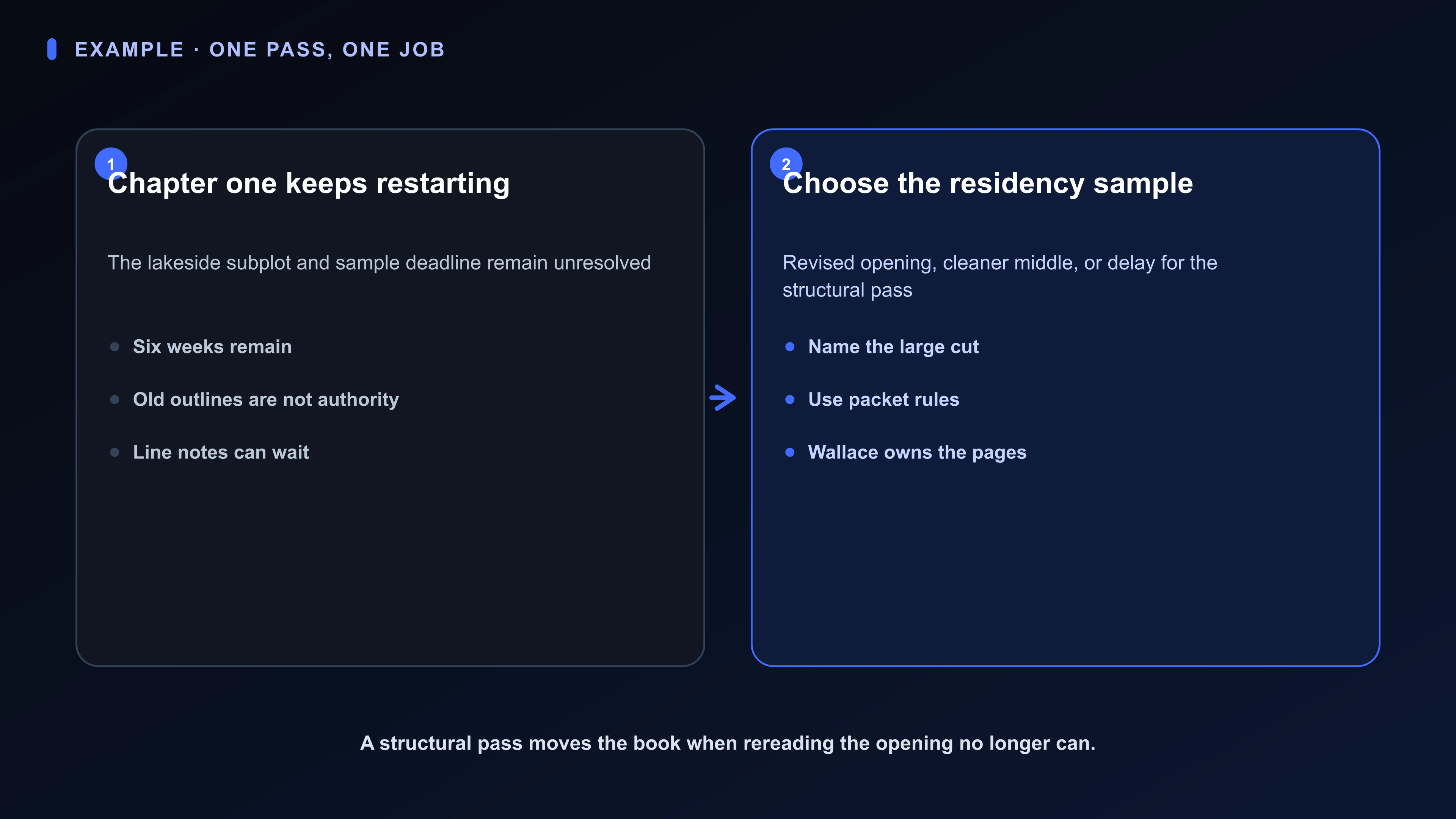
Open Choose the residency sample as a Room with the sample rules, six-week date, unresolved cut, and opening, middle, or delay paths.
Ava can sort and compare the visible material. Wallace owns the art, every sentence and cut, the sample, and the application; Ava does not write the novel or submit the application.
A pass has a job; rereading chapter one is not a pass
This Board has one job: Run one structural pass, then one line pass, and extract a residency sample without restarting the book to avoid a cut.
The decision still belongs to Wallace: Whether the sample is a revised opening, a middle section already closer, or a delay of the application to finish the structural pass.
You.one can keep the work, several kinds of evidence, and “Choose the residency sample” decision visible through its Superboard view. The organized facts support Wallace; they do not replace Wallace's judgment: Wallace chooses the sample, makes the cuts, and owns the application and the sentences.
Available today
Revision passes: one place for the mission
The Revision passes Board gives this mission one durable operating picture. Wallace can use familiar language instead of translating the situation into project-management jargon. Its four Lists separate the kinds of attention this situation actually requires.
The Board is not a master task list. It keeps the live choice, the facts that could change it, and any reply or outside event already in motion visible without pretending every uncertainty is work in progress.
Swipe or scroll sideways to see every column.
| List | What belongs here |
|---|---|
| Mission | Pass order and the six-week sample date |
| Structure | Cuts, moves, missing scenes, and the residency-sample decision |
| Chapters | Each chapter’s current job in the book |
| Notes | Friend comments, earlier outlines, and the notebook of later ideas sorted by kind |
Available today
Cards that sound like the real work
These Card titles come directly from Wallace's situation: “Choose the residency sample” is the live choice, while “Lakeside subplot still uncut” and “Old outline still claiming to be the plan” hold different facts that can change it. The point is recognition, not a perfect taxonomy.
Swipe or scroll sideways to see every column.
| Card | List | Job |
|---|---|---|
| One structural pass first | Mission | Keep pass order beside the sample date so chapter one cannot restart forever |
| Choose the residency sample | Structure | Compare revised opening, middle section, and delay-application options |
| Lakeside subplot still uncut | Structure | Hold the unresolved subplot as structural evidence that changes which sample can honestly represent the book |
| Friend note: pacing in chapter 4 | Notes | Sort a comment as structure, not as a sentence-level chore |
| Old outline still claiming to be the plan | Notes | Keep an earlier-self plan visible as a note to evaluate, not the current book's authority |
| Notebook of later: line-level extras | Notes | Keep line-level ideas from masquerading as the structural pass or the residency sample |
| Chapter 1 restart urge | Chapters | Hold the habit visible so it can be refused |
| Residency packet requirements | Mission | Keep page count and deadline from hiding in an email |
Available today
Keep the evidence with “Choose the residency sample”
Opening the Card gives the visible item durable depth. Stage can hold Sample-path brief: Place six-week date, structural cuts, and opening / middle / delay options on one page. Chat keeps the request and response beside that artifact instead of in a detached thread. Notifications can bring this update forward: “Open decision: Wallace will choose which pages represent the book.”
A Card Chat request can ask Ava to prepare the specific comparison or extraction in “Choose the residency sample” from the visible evidence. Ava can work from the context Wallace deliberately brings into this Card, List, or Board; she cannot monitor the rest of life, contact anyone, or inherit the decision.
Wallace's call remains explicit: Wallace chooses the sample, makes the cuts, and owns the application and the sentences.
Swipe or scroll sideways to see every column.
| Surface | Job in this example |
|---|---|
| Stage | Sample-path brief: Place six-week date, structural cuts, and opening / middle / delay options on one page |
| Chat | Keep Wallace's request and Ava's attributed response with the work |
| Notifications | Open decision: Wallace will choose which pages represent the book |
Start small and rename what feels artificial
Wallace should rename every List or Card that feels artificial. This recipe succeeds when “Choose the residency sample” becomes easier to decide and fewer open loops depend on memory—not when the Board looks tidy.
Swipe or scroll sideways to see every column.
| Step | Action |
|---|---|
| 1. Name the pass | Structure first, lines later |
| 2. Card the large cuts | Subplots as decisions |
| 3. Sort notes by kind | Separate the pacing note, old-outline claim, and Notebook of later: line-level extras |
| 4. Put the sample rules on the Board | Page count and deadline stay on Mission |
| 5. Choose the residency sample | Open a Room instead of restarting chapter one |
Friend comments in the document, a notebook of later, and an old outline can remain part of the system
Friend comments in the document, a notebook of later, and an old outline can be enough while the situation stays simple: the only work left is proofreading.
It starts to break when structure, line notes, and a sample deadline all restart at chapter one.
The Revision passes Board earns its place only when the familiar tool—friend comments in the document, a notebook of later, and an old outline—can no longer keep the reason, Sample-path brief, conversation, current state, decision, and history connected.
Where this example stops
- This is a fictional example, not a customer story.
- This is not literary-agent advice or a publication claim.
- It does not show Ava writing chapters or submitting applications.
- It is not a measured craft or acceptance result.