
Example
How a pet sitter can handle holiday bookings without promising overlapping houses
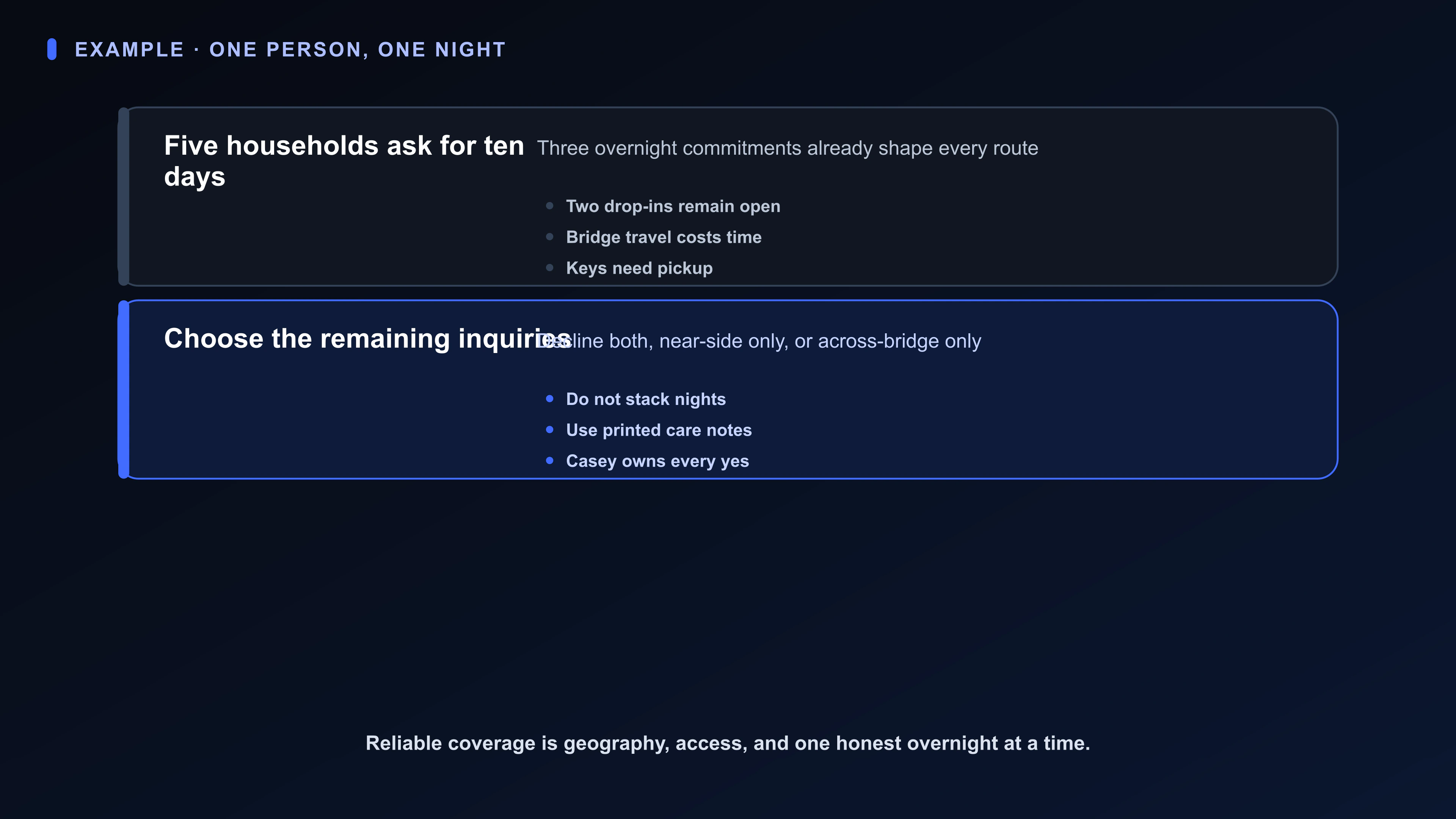
Casey already owes three households reliable coverage. The remaining choice is decline both drop-ins, accept only the near-side request, or accept only the higher-rate trip across the bridge without stacking nights.
Cover holiday bookings that one person can actually reach, with keys and printed care notes attached, without stacking two overnights
Ten-day capacity and the no-two-overnights rule
Keep geography and overnight limits beside booking appetite
Each home with nights versus drop-ins
Hold a true overnight so a drop-in cannot pretend to fit those nights
Keep the second accepted house-sit visible in the ten-day route
Keep the third and farthest accepted house-sit visible in the ten-day route
Printed times, feeding, and vet contacts as written
Keep label times visible without turning them into veterinary advice
Keys, codes, and parking
Make access a job, not a notes-app title
Requests Casey has not accepted or declined
Compare decline-both, near-side-only, and across-bridge-only options against the same three house-sits
Hold the higher-rate far request as one open option, not accepted work
Hold the near-side request as the other open option, not accepted work
The Holiday coverage Board keeps houses, care notes as written, access jobs, travel, and unaccepted requests in one operational picture.
Open Choose the remaining inquiries as a Room with all three accepted overnights and the decline-both, near-only, and bridge-only paths.
Ava can compare Casey’s schedule and geography. Casey owns animal care, keys, access, and client messages; Ava gives no veterinary advice and accepts no booking.
Ten days cannot hold five households if two of them need nights
The work has a clear center: Cover holiday bookings that one person can actually reach, with keys and printed care notes attached, without stacking two overnights.
Organizing the evidence does not authorize the software to decide: Whether to keep the three house-sits and decline both drop-ins, accept only the near-side drop-in, or accept only the higher-rate across-bridge drop-in.
You.one can keep the work, several kinds of evidence, and “Choose the remaining inquiries” decision visible through its Superboard view. The organized facts support Casey; they do not replace Casey's judgment: Casey chooses bookings, picks up keys, and owns animal care and client messages.
Available today
Name the work in plain language
These Card titles come directly from Casey's situation: “Choose the remaining inquiries” is the live choice, while “Overnight: Davis house Dec 22–26 morning handoff” and “Overnight: Ortiz house Dec 29 afternoon–31” hold different facts that can change it. The point is recognition, not a perfect taxonomy.
Swipe or scroll sideways to see every column.
| Card | List | Job |
|---|---|---|
| Ten days, one person, no stacked nights | Mission | Keep geography and overnight limits beside booking appetite |
| Choose the remaining inquiries | Requests not yet accepted | Compare decline-both, near-side-only, and across-bridge-only options against the same three house-sits |
| Overnight: Davis house Dec 22–26 morning handoff | Houses | Hold a true overnight so a drop-in cannot pretend to fit those nights |
| Overnight: Lee house Dec 26 afternoon–29 morning | Houses | Keep the second accepted house-sit visible in the ten-day route |
| Overnight: Ortiz house Dec 29 afternoon–31 | Houses | Keep the third and farthest accepted house-sit visible in the ten-day route |
| Medication times as printed | Care notes | Keep label times visible without turning them into veterinary advice |
| Spare key pickup Thursday | Keys and access | Make access a job, not a notes-app title |
| Drop-in inquiry across the bridge | Requests not yet accepted | Hold the higher-rate far request as one open option, not accepted work |
| Drop-in inquiry near the Davis route | Requests not yet accepted | Hold the near-side request as the other open option, not accepted work |
Available today
Holiday coverage: separate the kinds of attention
The Holiday coverage Board gives this mission one durable operating picture. Casey can use familiar language instead of translating the situation into project-management jargon. Its five Lists separate the kinds of attention this situation actually requires.
The Lists use Casey's own language so actions, evidence, open questions, and decisions do not collapse into one queue. A separate place for replies is useful only after Casey has asked someone or a real outside event must happen first.
Swipe or scroll sideways to see every column.
| List | What belongs here |
|---|---|
| Mission | Ten-day capacity and the no-two-overnights rule |
| Houses | Each home with nights versus drop-ins |
| Care notes | Printed times, feeding, and vet contacts as written |
| Keys and access | Keys, codes, and parking |
| Requests not yet accepted | Requests Casey has not accepted or declined |
Ask Ava to prepare the judgment—not make it
These requests stay with the facts Casey has made visible around “Choose the remaining inquiries.” Casey supplies the evidence, checks Ava's work, and decides what belongs in the Room.
Current Ava can prepare help after an explicit request. She cannot make the choice, represent Casey, watch other work on her own, or contact anyone.
Casey owns animal care, keys, and client conversations. Ava does not give veterinary advice, message clients, or hold keys.
A ten-day map one person can walk: overnights are exclusive, keys have pickup jobs, and extra drop-ins are a chosen yes or no.
- Request idea: using only the context visible in this Card Room, compare declining both drop-ins, accepting only the near-side inquiry, and accepting only the higher-rate across-bridge inquiry. Do not message clients or choose for me.
- Request idea: use only the Capacity map brief and notes the Owner has placed in this Card Room to separate facts, assumptions, and unanswered questions
- Request idea: in “Choose the remaining inquiries,” group the visible evidence by option and leave the decision open
Available today
One Card Room for the consequential choice
Opening the Card gives the visible item durable depth. Stage can hold Capacity map brief: Place all three accepted overnights, both drop-in inquiries, travel, and decline-both / near-only / bridge-only options on one page. Chat keeps the request and response beside that artifact instead of in a detached thread. Notifications can bring this update forward: “Open decision: Casey will choose holiday capacity.”
A Card Chat request can ask Ava to prepare the specific comparison or extraction in “Choose the remaining inquiries” from the visible evidence. Ava can work from the context Casey deliberately brings into this Card, List, or Board; she cannot monitor the rest of life, contact anyone, or inherit the decision.
Casey's call remains explicit: Casey chooses bookings, picks up keys, and owns animal care and client messages.
Swipe or scroll sideways to see every column.
| Surface | Job in this example |
|---|---|
| Stage | Capacity map brief: Place all three accepted overnights, both drop-in inquiries, travel, and decline-both / near-only / bridge-only options on one page |
| Chat | Keep Casey's request and Ava's attributed response with the work |
| Notifications | Open decision: Casey will choose holiday capacity |
Build only enough Board to make the next decision
Casey should rename every List or Card that feels artificial. This recipe succeeds when “Choose the remaining inquiries” becomes easier to decide and fewer open loops depend on memory—not when the Board looks tidy.
Swipe or scroll sideways to see every column.
| Step | Action |
|---|---|
| 1. Write the overnight rule | Two nights in two houses is not coverage |
| 2. Card each house | Nights versus drop-ins, with travel |
| 3. Attach printed care notes | Times as written, contacts as written |
| 4. Make keys a job | Pickup dates, not a folder named don’t lose |
| 5. Choose the remaining inquiries | Open a Room before a text yes stacks the map |
Where this example stops
- This is a fictional example, not a customer story.
- This is not veterinary, legal, or insurance advice.
- It does not show Ava messaging clients or providing animal care.
- It is not a measured booking result.