
Example
How to run product-design discovery without turning interviews into a pitch
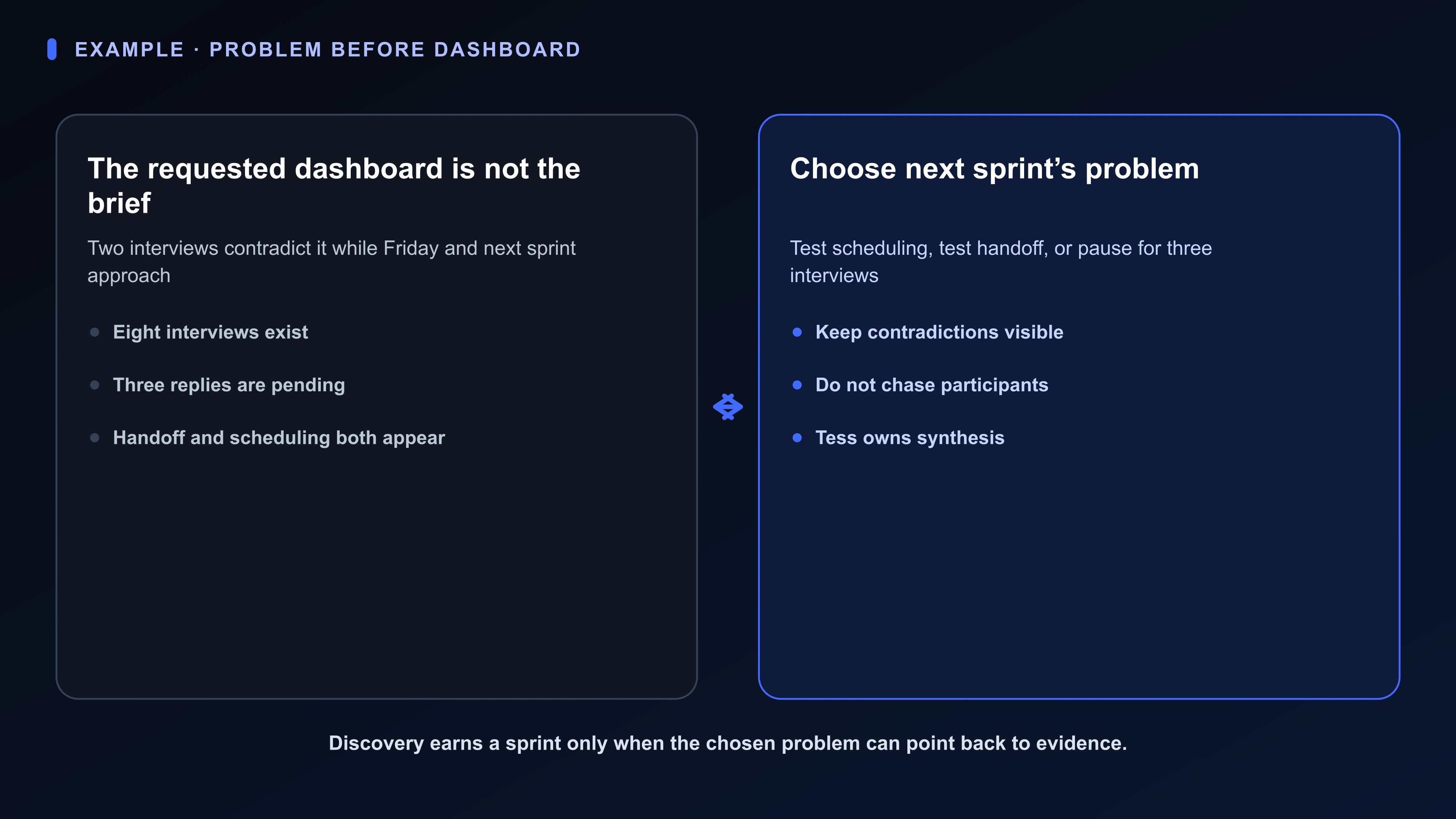
Tess already invited three more people, while an engineer needs a direction and two interviews contradict the stakeholder’s requested dashboard. She must test scheduling pain, test handoff pain, or pause build for more evidence.
Leave discovery with either one chosen problem and a next-sprint ask, or an explicit decision to pause build for three more interviews, while contradictory evidence stays visible
Four weeks and the no-solution-first rule
Keep the stakeholder request visible as a request, not as the brief
Keep Friday’s stakeholder delivery visible as work Tess still owns
Interviews and clips with sources
Attach a clip to a person and a date
Hold a sourced scheduling example beside the handoff clip
Contradictions that must stay visible
Keep inconvenient evidence on the same Board as the pretty slide
Keep an in-hand solution request visible without turning it into the brief
Problems, not features
Compare scheduling pain, handoff pain, and more-interviews options
Translate a sprint question into a problem choice, not a feature list
Replies from the three invited interviewees Tess already asked
Keep the additional-research path tied to invitations Tess already sent
The Discovery month Board keeps sourced evidence, contradictions, solution requests, problem candidates, and invited replies visible together.
Open Choose next sprint’s problem as a Room with both pain patterns, the dashboard tension, Friday’s review, and the pause-for-interviews path.
Ava can compare visible research without becoming a participant. Tess owns synthesis, stakeholder and engineer conversations, design judgment, and the choice; Ava does not interview participants or write the product specification.
A requested dashboard is not the problem statement
The mission is specific: Leave discovery with either one chosen problem and a next-sprint ask, or an explicit decision to pause build for three more interviews, while contradictory evidence stays visible.
The consequential choice is not something a board or an AI should quietly make: Whether the next sprint tests a scheduling pain, a handoff pain, or pauses build to run three more interviews.
You.one can keep the work, evidence, anything already waiting on another person or event, and the “Choose next sprint’s problem” decision visible through its Superboard view. Tess still owns the call: Tess chooses the problem, talks to stakeholders and engineers, and owns what gets designed.
Available today
Discovery month: the working map
The Discovery month Board gives this mission one durable operating picture. Tess can use familiar language instead of translating the situation into project-management jargon. Its five Lists separate the kinds of attention this situation actually requires.
The Lists separate what Tess can move now, what is evidence, what is already waiting on a named person or event, and what still needs a decision.
Swipe or scroll sideways to see every column.
| List | What belongs here |
|---|---|
| Mission | Four weeks and the no-solution-first rule |
| Evidence | Interviews and clips with sources |
| Tensions | Contradictions that must stay visible |
| Problem candidates | Problems, not features |
| Replies and outside conditions | Replies from the three invited interviewees Tess already asked |
Available today
Open one decision: Choose next sprint’s problem
Opening the Card gives the visible item durable depth. Stage can hold Problem-choice brief: Place contradictory interviews, the dashboard request, and the three problem paths on one page. Chat keeps the request and response beside that artifact instead of in a detached thread. Notifications can bring this update forward: “Open decision: Tess will choose scheduling pain, handoff pain, or no build while she runs three more interviews.”
A Card Chat request can ask Ava to prepare the specific comparison or extraction in “Choose next sprint’s problem” from the visible evidence. Ava can work from the context Tess deliberately brings into this Card, List, or Board; she cannot monitor the rest of life, contact anyone, or inherit the decision.
Tess's call remains explicit: Tess chooses the problem, talks to stakeholders and engineers, and owns what gets designed.
Swipe or scroll sideways to see every column.
| Surface | Job in this example |
|---|---|
| Stage | Problem-choice brief: Place contradictory interviews, the dashboard request, and the three problem paths on one page |
| Chat | Keep Tess's request and Ava's attributed response with the work |
| Notifications | Open decision: Tess will choose scheduling pain, handoff pain, or no build while she runs three more interviews |
Useful Ava requests, with the boundary intact
These requests stay with the facts Tess has made visible around “Choose next sprint’s problem.” Tess supplies the evidence, checks Ava's work, and decides what belongs in the Room.
Current Ava can prepare help after an explicit request. She cannot make the choice, represent Tess, watch other work on her own, or contact anyone.
Tess owns synthesis, stakeholder conversations, and design judgment. Ava does not interview users, write specs, or pick the problem.
A defensible next-sprint posture: test scheduling pain, test handoff pain, or pause build for three more interviews. The dashboard remains a request and the contradicting interview stays visible.
- Request idea: using only the context visible in this Card Room, compare scheduling pain, handoff pain, and pausing to interview more. Do not write a spec, contact interviewees, chase the three invited replies, or choose for me.
- Request idea: use only the Problem-choice brief and notes the Owner has placed in this Card Room to separate facts, assumptions, and unanswered questions
- Request idea: in “Choose next sprint’s problem,” show which visible fact could reverse the current choice
The limit of a quotes slide plus a sprint board
A quotes slide plus a sprint board can be enough while the situation stays simple: the problem is already agreed.
It starts to break when contradictory interviews and a requested dashboard both want to be the brief.
The Discovery month Board earns its place only when the familiar tool—a quotes slide plus a sprint board—can no longer keep the reason, Problem-choice brief, conversation, current state, decision, and history connected.
A practical way to start the Discovery month Board
Tess should rename every List or Card that feels artificial. This recipe succeeds when “Choose next sprint’s problem” becomes easier to decide and fewer open loops depend on memory—not when the Board looks tidy.
Swipe or scroll sideways to see every column.
| Step | Action |
|---|---|
| 1. Capture evidence with sources | Clips and notes, dated |
| 2. Put contradictions on the Board | Do not hide them in the other doc |
| 3. Separate requests from problems | A dashboard is a request |
| 4. Keep invited replies on Replies and outside conditions | Tess already sent three invitations; do not chase them from Chat or treat silence as a result |
| 5. Choose next sprint’s problem | Open a Room instead of letting the slide decide |
Where this example stops
- This is a fictional example, not a customer story.
- This is not a user-research finding or a product-market claim.
- It does not show Ava interviewing users or writing a specification.
- It is not a measured product result.