
Example
How to build a promotion case that can survive scrutiny
With six weeks left, Nathan has three plausible lead stories: a vendor recovery, a forecasting program, and coaching a junior colleague. The real decision is which story is both consequential and honestly sourceable.
Build a promotion packet of dated, sourced evidence that distinguishes Nathan’s work from team work without inflating either
The role being sought and the truthfulness line
Keep the target level, the six-week due date, and the rule that unsourced numbers do not ship
Dated artifacts with sources
Preserve the chat as a dated note rather than a vanished compliment
Claims and figures Nathan still has to source
Hold the unlabeled image until a date and source are attached
Keep Nathan's own verification work visible until the figures have a source
Candidate lead narratives still being tested
Compare vendor recovery, forecasting program, and coaching record against available sources
Test the vendor-recovery narrative against sourced figures and shared credit
Test the forecasting narrative against dated artifacts Nathan can cite
Test the coaching narrative against examples Nathan has permission to use
Manager, peers, and the colleague who was coached
Keep the person and coaching relationship visible without claiming her experience for her
People asked for examples and replies that have not arrived
Hold the sent request until Priya replies instead of treating the example as already in the packet
In You.one’s Superboard view, Nathan keeps dated evidence, verification work, story candidates, shared credit, and replies already requested on one Promotion packet Board.
The lead-story Card Room becomes the durable case file: screenshots, figures to re-check, coaching evidence, and the six-week deadline stay beside the choice.
On that Card, Ava can help compare only the evidence Nathan supplies and flag claims that still need a source. Nathan owns every number, claim, peer request, manager conversation, and submission; Ava invents and sends nothing.
A packet needs dated proof, not a personality rewrite
The mission is specific: Build a promotion packet of dated, sourced evidence that distinguishes Nathan’s work from team work without inflating either.
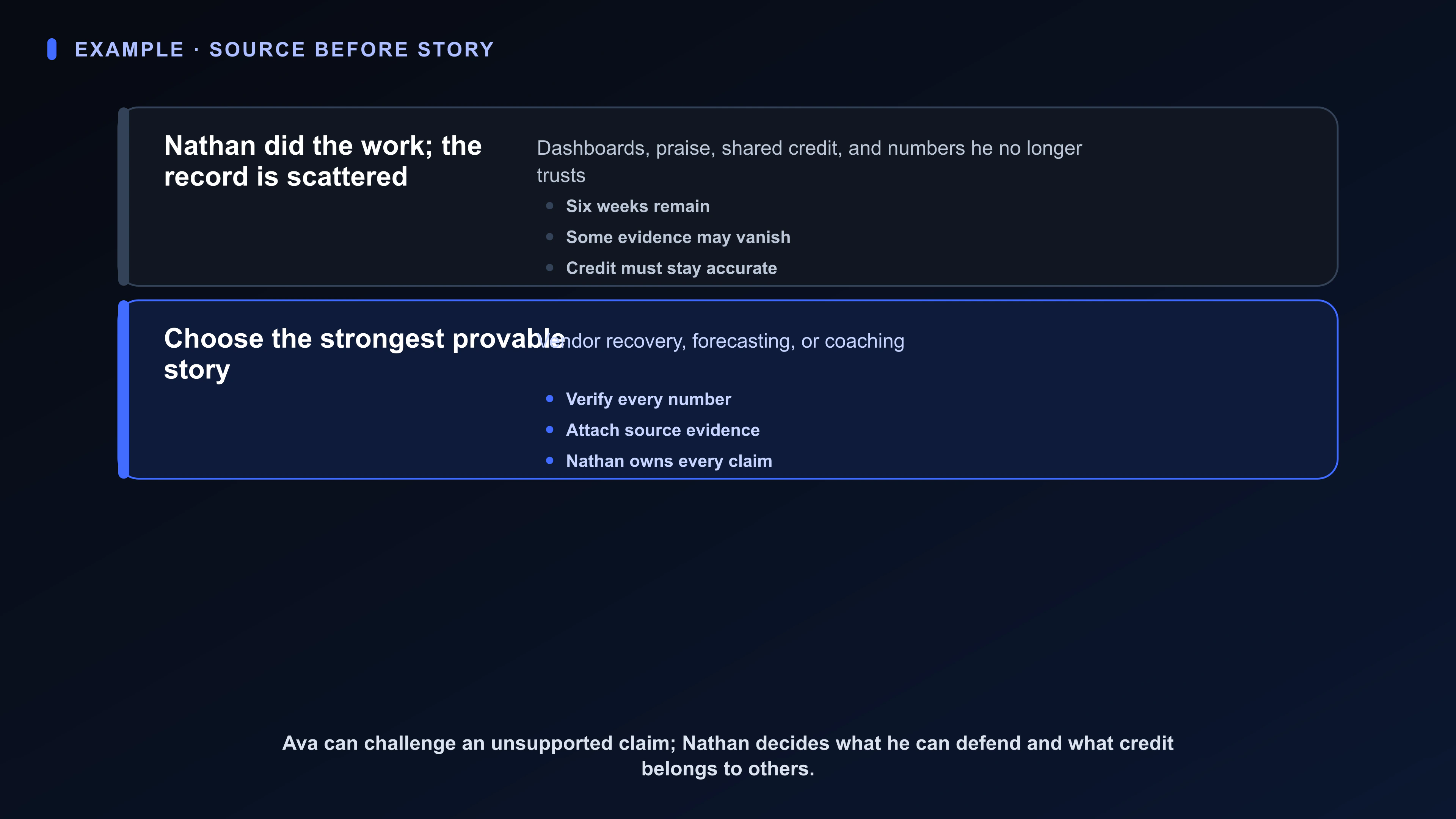
The consequential choice is not something a board or an AI should quietly make: Whether the lead story is the vendor recovery, the forecasting program, or the coaching record, given what can actually be sourced in six weeks.
You.one can keep the work, evidence, anything already waiting on another person or event, and the “Choose the lead story” decision visible through its Superboard view. Nathan still owns the call: Nathan chooses the lead story, verifies numbers, asks people for examples, and owns every sentence in the packet.
Available today
Promotion packet: the working map
The Promotion packet Board gives this mission one durable operating picture. Nathan can use familiar language instead of translating the situation into project-management jargon. Its six Lists separate the kinds of attention this situation actually requires.
The Lists separate what Nathan can move now, what is evidence, what is already waiting on a named person or event, and what still needs a decision.
Swipe or scroll sideways to see every column.
| List | What belongs here |
|---|---|
| Mission | The role being sought and the truthfulness line |
| Evidence | Dated artifacts with sources |
| To verify | Claims and figures Nathan still has to source |
| Stories | Candidate lead narratives still being tested |
| People and replies | Manager, peers, and the colleague who was coached |
| Replies already requested | People asked for examples and replies that have not arrived |
Available today
Open one decision: Choose the lead story
Opening the Card gives the visible item durable depth. Stage can hold Lead-story comparison: Place sourced versus unsourced evidence beside the three candidate stories and the six-week date. Chat keeps the request and response beside that artifact instead of in a detached thread. Notifications can bring this update forward: “Open decision: Nathan will choose which story the packet leads with.”
A Card Chat request can ask Ava to prepare the specific comparison or extraction in “Choose the lead story” from the visible evidence. Ava can work from the context Nathan deliberately brings into this Card, List, or Board; she cannot monitor the rest of life, contact anyone, or inherit the decision.
Nathan's call remains explicit: Nathan chooses the lead story, verifies numbers, asks people for examples, and owns every sentence in the packet.
Swipe or scroll sideways to see every column.
| Surface | Job in this example |
|---|---|
| Stage | Lead-story comparison: Place sourced versus unsourced evidence beside the three candidate stories and the six-week date |
| Chat | Keep Nathan's request and Ava's attributed response with the work |
| Notifications | Open decision: Nathan will choose which story the packet leads with |
Useful Ava requests, with the boundary intact
These requests stay with the facts Nathan has made visible around “Choose the lead story.” Nathan supplies the evidence, checks Ava's work, and decides what belongs in the Room.
Current Ava can prepare help after an explicit request. She cannot make the choice, represent Nathan, watch other work on her own, or contact anyone.
Nathan owns the claims, the numbers, and every conversation with his manager and peers. Ava does not invent impact, contact people, or submit the packet.
A packet with a chosen lead and a source rule: unlabeled screenshots are work, not proof, and team credit stays visible.
- Request idea: using only the context visible in this Card Room, compare the three lead stories on what is already sourced versus still waiting. Do not write the packet or choose for me.
- Request idea: use only the Lead-story comparison and notes the Owner has placed in this Card Room to separate facts, assumptions, and unanswered questions
- Request idea: in “Choose the lead story,” show which visible fact could reverse the current choice
The limit of a folder of old slides
A folder of old slides can be enough while the situation stays simple: there is one project and a manager who already remembers it.
It starts to break when six weeks remain and the strongest memory is still unlabeled.
The Promotion packet Board earns its place only when the familiar tool—a folder of old slides—can no longer keep the reason, Lead-story comparison, conversation, current state, decision, and history connected.
A practical way to start the Promotion packet Board
Nathan should rename every List or Card that feels artificial. This recipe succeeds when “Choose the lead story” becomes easier to decide and fewer open loops depend on memory—not when the Board looks tidy.
Swipe or scroll sideways to see every column.
| Step | Action |
|---|---|
| 1. Write the truth rule | Unsourced numbers do not ship |
| 2. Capture artifacts | One Card per screenshot, note, or deck with a date |
| 3. Separate stories from evidence | Narratives are hypotheses until sources attach |
| 4. Card people, then wait honestly | Name the person and relationship, send the request, then park that request in Replies already requested until they reply |
| 5. Choose the lead story | Open a Room for the story that can actually be sourced in time |
Where this example stops
- This is a fictional example, not a customer story.
- This is not HR advice, a promotion guarantee, or a claim Superboard accessed company systems.
- It does not show Ava writing the packet, verifying payroll, or contacting peers.
- It is not a measured compensation or title result.