
Example
How to reset quarterly priorities when every team has a valid urgent request
Every team can be right about urgency while the portfolio remains impossible. Sophie must choose whether to make room for sales’s requested date, defer one incident repair, or protect both repairs and ask sales to redate.
Reset the quarter around the few outcomes the current team can actually finish and explain what moved
The few outcomes the smaller team can finish and every promise that must move
Keep the smaller team's finishable outcomes and every moved promise as the quarter rule
Original priorities, repair work, and owner-level work that can move this quarter
Compare making room for sales, deferring one repair, and asking sales to redate
Name whose current work would move under each posture
List active work by accountable owner before comparing initiatives
Name one original outcome that could pause
Name one original outcome that could pause
Name one original outcome that could pause
Name one original outcome that could pause
Current staffing, two incident repairs, and the unagreed sales date
Show the capacity the quarter actually has, not the original staffing assumption
Show the unplanned repair load competing for the smaller team
Keep the external ask visible without presenting a date as accepted
The customer-date question Sophie owns as an unsent draft until a posture is chosen
Keep the customer-date question as an unsent draft until Sophie chooses a posture
In You.one’s Superboard view, the Quarter with one center Board separates the outcome promise, priority options, capacity evidence, questions still owned, and changes leaders have actually accepted.
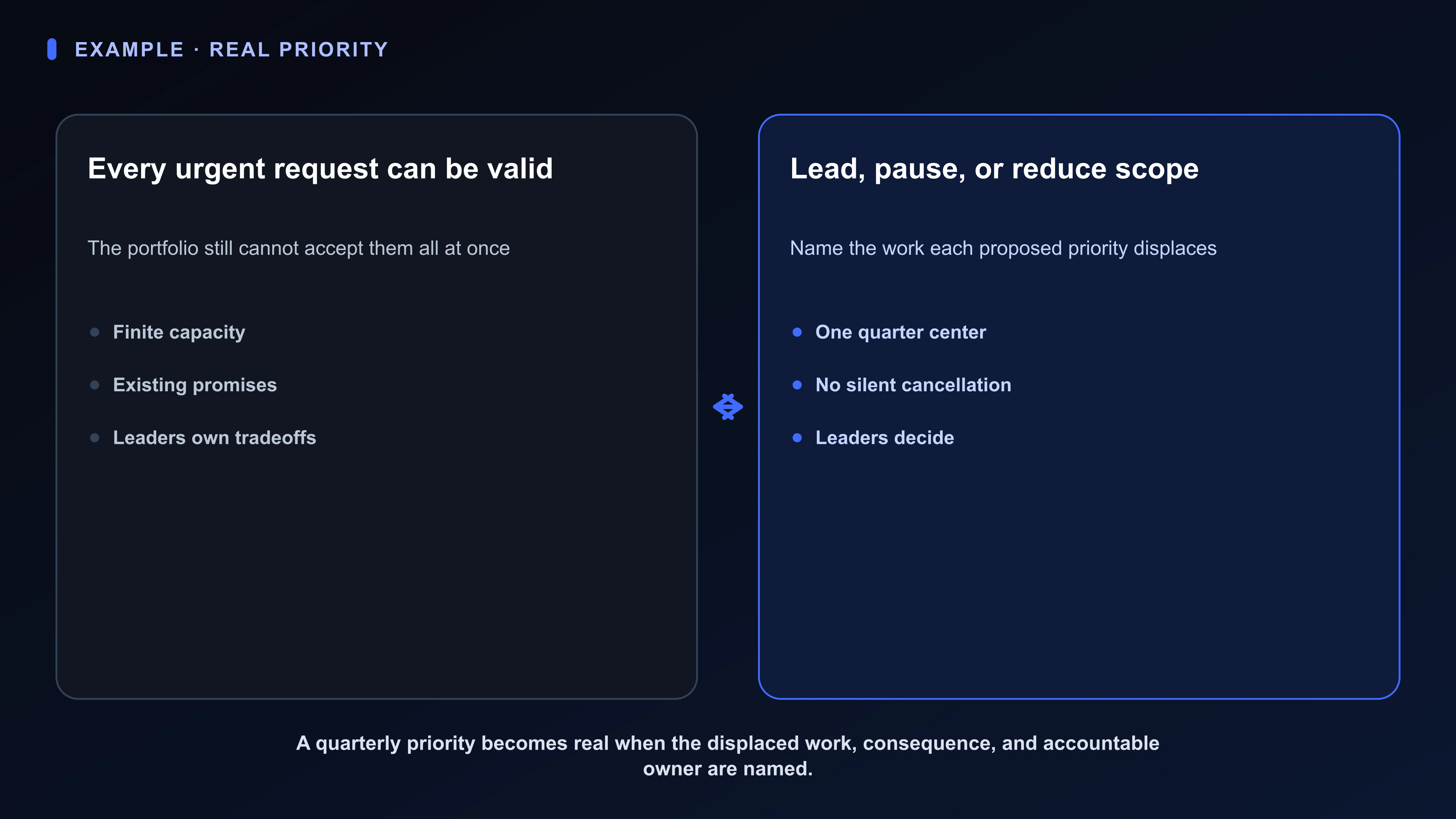
Open Make room, defer a repair, or ask to redate as the consequential Card Room. Start by placing every proposed priority beside the work it displaces and the owner who can accept that consequence.
After an explicit request, Ava can compare visible capacity and commitment evidence or draft a decision note. Ava cannot reprioritize teams, cancel work, speak for leaders, or approve the quarter; Sophie and accountable leaders own the decision.
Every request can be real and the quarter still cannot do all of them
This Board has one job: Reset the quarter around the few outcomes the current team can actually finish and explain what moved.
The decision still belongs to Sophie: Whether to pause one original priority to make room for sales's requested date, keep the original priorities and defer one incident repair, or fund both repairs and ask sales to take a later customer date.
You.one can keep the work, evidence, and “Make room for the date ask, defer a repair, or ask to redate” decision visible through its Superboard view. Authority does not move to the software: Sophie owns the comparison, coordination, and draft customer-date question. Team leaders own staffing and work commitments; sales and the accountable executive own any customer promise.
Available today
Quarter in reality: one place for the mission
The Quarter in reality Board gives this mission one durable operating picture. Sophie can use familiar language instead of translating the situation into project-management jargon. Its four Lists separate the kinds of attention this situation actually requires.
The Board is not a master task list. It keeps the live choice, the facts that could change it, and any reply or outside event already in motion visible without pretending every uncertainty is work in progress.
Swipe or scroll sideways to see every column.
| List | What belongs here |
|---|---|
| Quarter promise | The few outcomes the smaller team can finish and every promise that must move |
| Outcomes moving | Original priorities, repair work, and owner-level work that can move this quarter |
| Capacity evidence | Current staffing, two incident repairs, and the unagreed sales date |
| Questions to send | The customer-date question Sophie owns as an unsent draft until a posture is chosen |
Available today
Cards that sound like the real work
These Card titles come directly from Sophie's situation: “Make room for the date ask, defer a repair, or ask to redate” is the live choice, “Current staffing map” holds evidence, and “Draft the customer-date question” is still work Sophie controls—not something already awaiting another person. The point is recognition, not a perfect taxonomy.
Swipe or scroll sideways to see every column.
| Card | List | Job |
|---|---|---|
| Keep only the outcomes this smaller team can finish, and name what moved | Quarter promise | Keep the smaller team's finishable outcomes and every moved promise as the quarter rule |
| Make room for the date ask, defer a repair, or ask to redate | Outcomes moving | Compare making room for sales, deferring one repair, and asking sales to redate |
| Current staffing map | Capacity evidence | Show the capacity the quarter actually has, not the original staffing assumption |
| Name which owner loses work under each quarter posture | Outcomes moving | Name whose current work would move under each posture |
| Draft the customer-date question | Questions to send | Keep the customer-date question as an unsent draft until Sophie chooses a posture |
| List active work by owner, not by initiative name | Outcomes moving | List active work by accountable owner before comparing initiatives |
| Priority 1: onboarding completion | Outcomes moving | Name one original outcome that could pause |
| Priority 2: billing reliability | Outcomes moving | Name one original outcome that could pause |
| Priority 3: partner launch | Outcomes moving | Name one original outcome that could pause |
| Priority 4: reporting migration | Outcomes moving | Name one original outcome that could pause |
| Two incident repairs | Capacity evidence | Show the unplanned repair load competing for the smaller team |
| Sales wants a customer date (not agreed) | Capacity evidence | Keep the external ask visible without presenting a date as accepted |
Available today
Keep the evidence with “Make room for the date ask, defer a repair, or ask to redate”
Opening the Card gives the visible item durable depth. Stage can hold Quarter-reset brief: Place outcomes, incident impact, staffing, customer consequence, and work already in motion together. Live choice: Whether to pause one original priority to make room for sales's requested date, keep the original priorities and defer one incident repair, or fund both repairs and ask sales to take a later customer date. Chat keeps the request and response beside that artifact instead of in a detached thread. Notifications can bring this update forward: “Open decision: Sophie will decide whether to pause one original priority to make room for sales's requested date, keep the original priorities and defer one incident repair, or fund both repairs and ask sales to take a later customer date.”
A Card Chat request can ask Ava to prepare the specific comparison or extraction in “Make room for the date ask, defer a repair, or ask to redate” from the visible evidence. Ava can work from the context Sophie deliberately brings into this Card, List, or Board; she cannot monitor the rest of life, contact anyone, or inherit the decision.
Sophie's call remains explicit: Sophie owns the comparison, coordination, and draft customer-date question. Team leaders own staffing and work commitments; sales and the accountable executive own any customer promise.
Swipe or scroll sideways to see every column.
| Surface | Job in this example |
|---|---|
| Stage | Quarter-reset brief: Place outcomes, incident impact, staffing, customer consequence, and work already in motion together. Live choice: Whether to pause one original priority to make room for sales's requested date, keep the original priorities and defer one incident repair, or fund both repairs and ask sales to take a later customer date |
| Chat | Keep Sophie's request and Ava's attributed response with the work |
| Notifications | Open decision: Sophie will decide whether to pause one original priority to make room for sales's requested date, keep the original priorities and defer one incident repair, or fund both repairs and ask sales to take a later customer date |
Start small and rename what feels artificial
Sophie should rename every List or Card that feels artificial. This recipe succeeds when “Make room for the date ask, defer a repair, or ask to redate” becomes easier to decide and fewer open loops depend on memory—not when the Board looks tidy.
Swipe or scroll sideways to see every column.
| Step | Action |
|---|---|
| 1. Write the quarter promise | Put finishable outcomes and every moved promise on Quarter promise |
| 2. Card actual capacity | Put staffing, two incident repairs, and the unagreed sales date on Capacity evidence |
| 3. Keep the date question unsent | Draft the customer-date question on Questions to send |
| 4. List active work by owner | Put owner-level work on Outcomes moving before comparing initiatives |
| 5. Choose the quarter posture | Open Make room for the date ask, defer a repair, or ask to redate |
A quarterly planning deck can remain part of the system
A quarterly planning deck can be enough while the situation stays simple: current staffing can still finish the four original priorities, both repairs, and the customer date without hiding moved work.
It starts to break when current staffing and the two incident repairs must inform the same quarter choice as the sales promise.
The Quarter in reality Board earns its place only when the familiar tool—a quarterly planning deck—can no longer keep the reason, Quarter-reset brief, conversation, current state, decision, and history connected.
Where this example stops
- This is a fictional example, not a customer story.
- This fictional example is not employment, financial, customer-contract, incident, or management advice; accountable leaders own the real tradeoffs and promises.
- It does not show Ava completing external actions or contacting anyone for Sophie.
- It does not report a measured result, and this Board is a starting shape to adapt—not a universal prescription.