
Example
How to run a student robotics competition build without letting the parts list become the plan
A parts list makes a missing shipment and a measured mechanism failure look alike. Sofia’s team must cut the raise-and-place motion, rework the current arm, or test a limited-load cycle without pretending arrival of the sensor settles the design.
Arrive at the scrimmage with one reliable scoring cycle, documented failure modes, and safe work ownership
The scoring cycle the team promises to bring to the scrimmage
Define one scoring cycle as the team's finish line
Build and practice work the team can complete safely now
Choose whether to cut the raise-and-place motion after lift, rework the current mechanism, or run a limited-load scoring cycle before drive practice
Protect drive-practice time from endless mechanism changes
Name the motion the team may cut before comparing the three arm-scope paths
Measured failures, working cycles, and safety observations
Record the load and exact point where the current arm slips
Hold the working lift motion as evidence separate from the slipping raise-and-place motion
Attach the safety limit the team must use before comparing arm-scope options
Parts and deliveries the team does not currently have
Track the shipment without pretending the part will solve the design
In You.one’s Superboard view, the One scoring cycle Board separates the scrimmage promise, safe build work, measured test evidence, parts still outside the room, and mechanisms the team has actually proved.
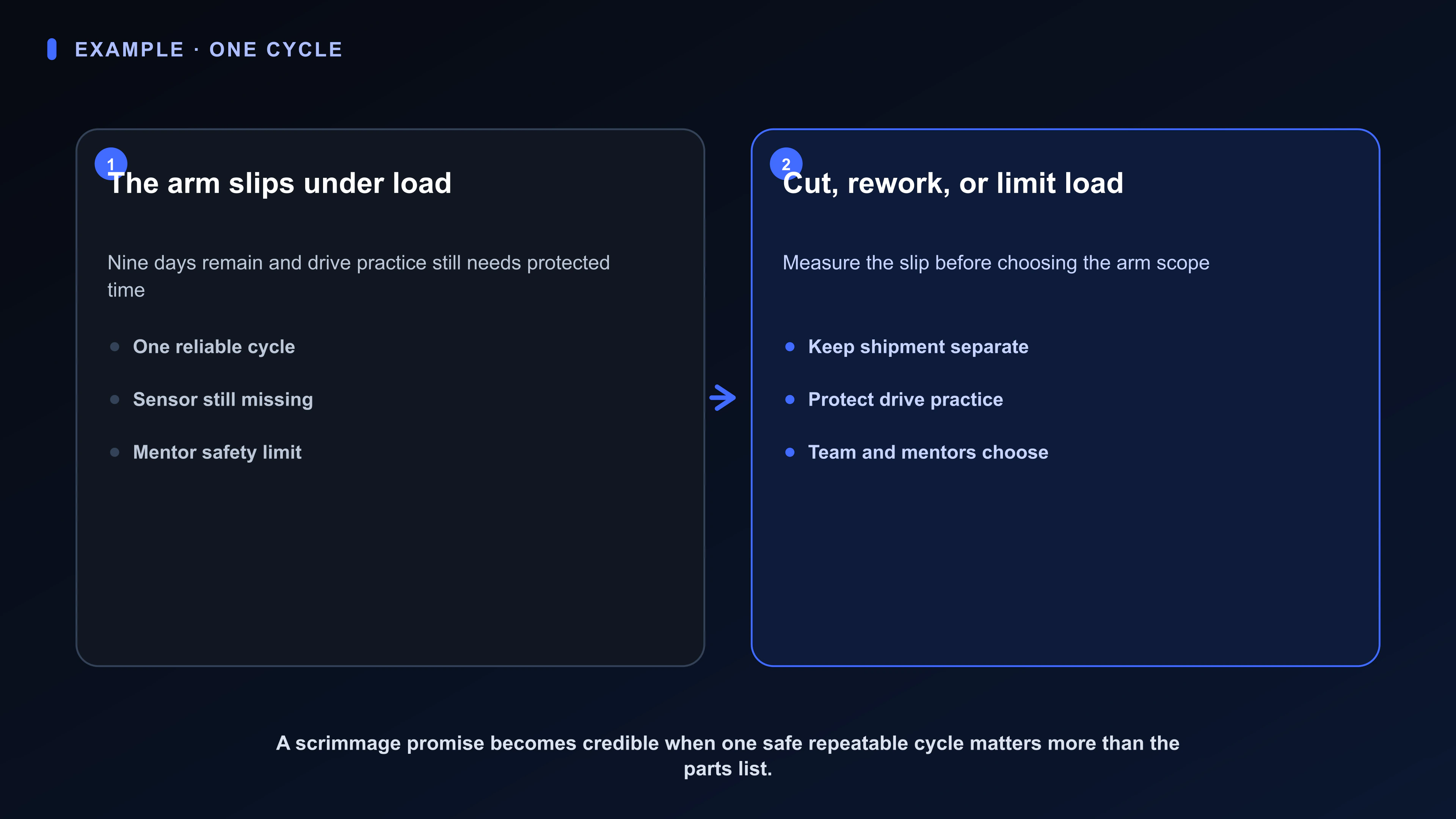
Open Cut, rework, or limited load as the consequential Card Room. Start by recording the exact load and point where the arm slips, then protect the remaining drive-practice blocks.
After an explicit request, Ava can summarize only visible test notes and compare time left. Sofia, her teammates, and adult mentors own design, testing, equipment, and safety; competition officials own the rules.
The scrimmage promise is one reliable scoring cycle
The mission is specific: Arrive at the scrimmage with one reliable scoring cycle, documented failure modes, and safe work ownership.
The consequential choice is not something a board or an AI should quietly make: Whether to cut the raise-and-place motion after lift, rework the current mechanism, or run a limited-load scoring cycle before drive practice; the sensor shipment remains a separate delivery the team is waiting for.
You.one can keep the work, evidence, anything already waiting on another person or event, and the “Choose the arm scope” decision visible through its Superboard view. Sofia still owns the call: Sofia, teammates, and adult mentors own design, testing, equipment, and the robot; adult mentors approve safe work, and competition officials own event rules.
Available today
Scrimmage build: the working map
The Scrimmage build Board gives this mission one durable operating picture. Sofia can use familiar language instead of translating the situation into project-management jargon. Its four Lists separate the kinds of attention this situation actually requires.
The Lists separate what Sofia can move now, what is evidence, what is already waiting on a named person or event, and what still needs a decision.
Swipe or scroll sideways to see every column.
| List | What belongs here |
|---|---|
| Scrimmage promise | The scoring cycle the team promises to bring to the scrimmage |
| Build next | Build and practice work the team can complete safely now |
| Test evidence | Measured failures, working cycles, and safety observations |
| Replies or arrivals from parts | Parts and deliveries the team does not currently have |
Available today
Open one decision: Choose the arm scope
Opening the Card gives the visible item durable depth. Stage can hold Arm decision brief: Place “Second scoring motion: raise and place after lift,” “Lift motion works before raise-and-place,” “Arm slips under load,” “Reserve drive-practice blocks,” “Adult-mentor safety limit,” “Sensor shipment,” and “One scoring cycle nine days from now” together. Chat keeps the request and response beside that artifact instead of in a detached thread. Notifications can bring this update forward: “Open decision: Sofia, her teammates, and adult mentors will choose the arm scope.”
A Card Chat request can ask Ava to prepare the specific comparison or extraction in “Choose the arm scope” from the visible evidence. Ava can work from the context Sofia deliberately brings into this Card, List, or Board; she cannot monitor the rest of life, contact anyone, or inherit the decision.
Sofia's call remains explicit: Sofia, teammates, and adult mentors own design, testing, equipment, and the robot; adult mentors approve safe work, and competition officials own event rules.
Swipe or scroll sideways to see every column.
| Surface | Job in this example |
|---|---|
| Stage | Arm decision brief: Place “Second scoring motion: raise and place after lift,” “Lift motion works before raise-and-place,” “Arm slips under load,” “Reserve drive-practice blocks,” “Adult-mentor safety limit,” “Sensor shipment,” and “One scoring cycle nine days from now” together |
| Chat | Keep Sofia's request and Ava's attributed response with the work |
| Notifications | Open decision: Sofia, her teammates, and adult mentors will choose the arm scope |
Useful Ava requests, with the boundary intact
These requests stay with the facts Sofia has made visible around “Choose the arm scope.” Sofia supplies the evidence, checks Ava's work, and decides what belongs in the Room.
Current Ava can prepare help after an explicit request. She cannot make the choice, represent Sofia, watch other work on her own, or contact anyone.
Sofia, teammates, and adult mentors own design, testing, equipment, and the robot; adult mentors approve safe work, and competition officials own event rules. Ava does not operate equipment or approve safety.
The team knows which scoring cycle it is protecting and what it will not attempt at the scrimmage.
- Request idea: use “Second scoring motion: raise and place after lift,” “Lift motion works before raise-and-place,” “Arm slips under load,” “Reserve drive-practice blocks,” “Adult-mentor safety limit,” “Sensor shipment,” and “One scoring cycle nine days from now” to compare cutting the raise-and-place motion after lift, reworking the mechanism, and running a limited-load scoring cycle before drive practice. Keep the sensor shipment visible as a delivery the team is still waiting for. Do not design or operate the robot, approve safety, or invent test results.
- Request idea: use only the Arm decision brief and notes the Owner has placed in this Card Room to separate facts, assumptions, and unanswered questions
- Request idea: in “Choose the arm scope,” show which visible fact could reverse the current choice
The limit of a parts spreadsheet
A parts spreadsheet can be enough while the situation stays simple: every part independently makes the robot better.
It starts to break when mechanism reliability, practice time, and a missing shipment compete.
The Scrimmage build Board earns its place only when the familiar tool—a parts spreadsheet—can no longer keep the reason, Arm decision brief, conversation, current state, decision, and history connected.
A practical way to start the Scrimmage build Board
Sofia should rename every List or Card that feels artificial. This recipe succeeds when “Choose the arm scope” becomes easier to decide and fewer open loops depend on memory—not when the Board looks tidy.
Swipe or scroll sideways to see every column.
| Step | Action |
|---|---|
| 1. Promise one cycle | Write the scrimmage action the robot must repeat |
| 2. Measure the slip | Record load and failure point before changing hardware |
| 3. Protect practice | Reserve drive sessions as a real constraint |
| 4. Attach the mentor limit | Put the adult-mentor safety limit beside the arm-scope evidence |
| 5. Keep parts separate | Card “Sensor shipment” on Replies and outside conditions on parts rather than treating an arrival as an arm-scope option |
| 6. Choose the arm scope | Open the “Choose the arm scope” Room: cut the raise-and-place motion after lift, rework the mechanism, or run a limited-load cycle; keep the sensor shipment out of that call |
| 7. Prove one cycle | The team runs and records it under mentor safety rules |
Where this example stops
- This is a fictional example, not a customer story.
- This is not engineering, electrical, or youth-safety advice.
- It does not show Ava completing external actions or contacting anyone for Sofia.
- It does not report a measured result, and this Board is a starting shape to adapt—not a universal prescription.