
Example
How to reset a roommate household when silent expectations have stopped working
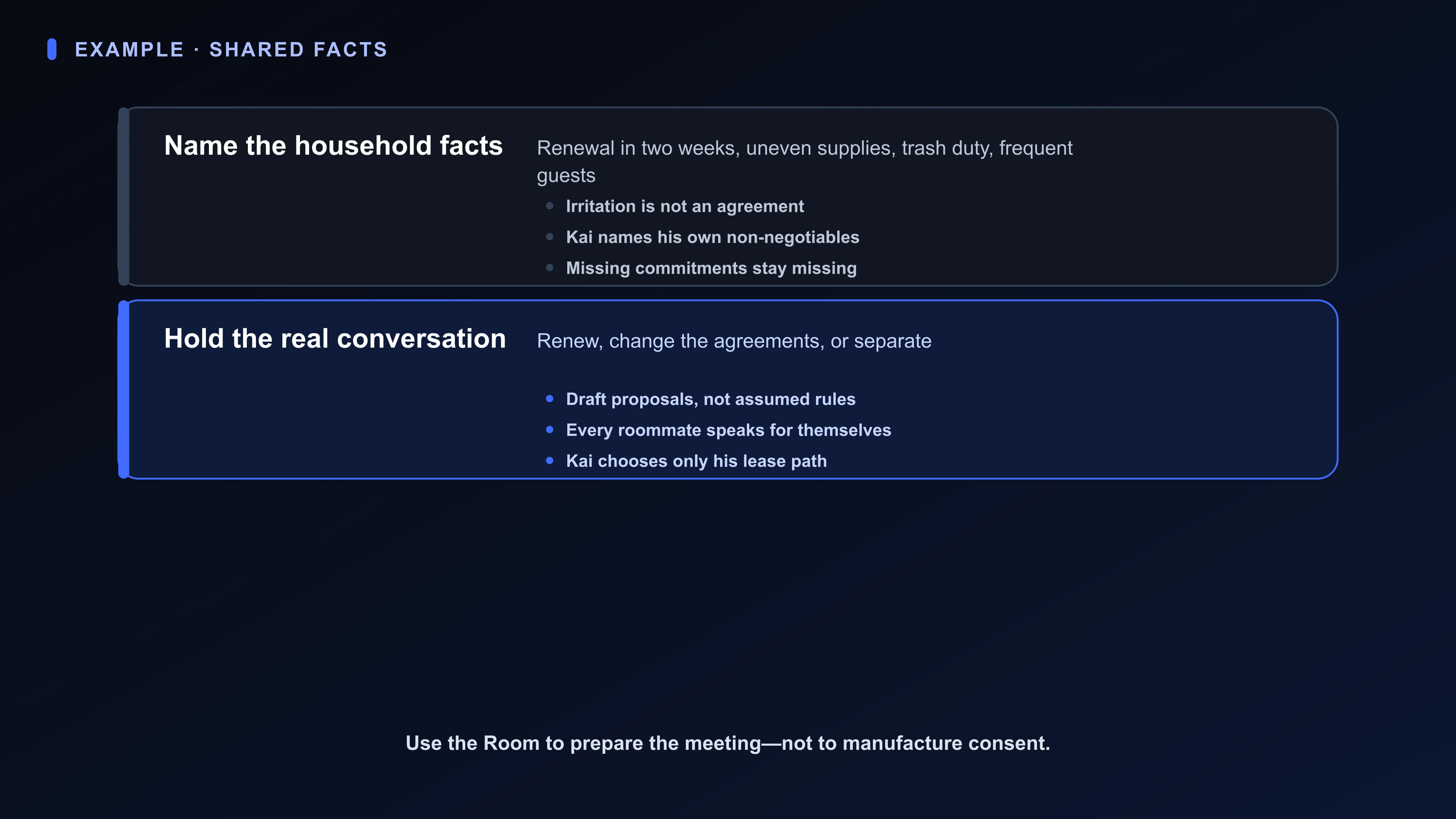
Kai’s apartment group chat can collect irritation without creating agreement. Before renewal, he needs to name his own non-negotiables, draft proposals rather than assumed rules, and see what each roommate has actually accepted.
Decide whether the apartment can work for another year with explicit, livable agreements
Kai's boundary for living here another year
Hold the mission and boundary: decide whether the apartment can work for another year with explicit, livable agreements
Hold the live choice—whether to renew together, renew with changed responsibilities, or separate at the end of the lease—so Kai can decide from the evidence in this Room
Agreements the roommates could test if everyone accepts them
Draft limits for guest frequency, notice, and shared-space use that all roommates can discuss
Draft a meeting invitation that names supplies, trash, guests, and the two-week lease window
Write Kai's own non-negotiables without assigning commitments to either roommate
Observed supply, trash, guest, and lease facts
Record which roommate buys which shared supplies and how often others reimburse them
Keep the recurring work pattern visible beside the renewal choice
Keep the guest impact visible before renewal is discussed
Keep the real decision window beside the household evidence
Use a Shared-home reset Board for the renewal decision, agreements to try, facts about the household, and work Kai still owns.
The renewal Room keeps a neutral comparison, Kai’s needs, the meeting invitation, and missing commitments attached to the deadline.
Ava can help prepare the conversation from visible Room context. Kai invites the meeting and chooses his lease path; every roommate owns their own commitments.
Shared-home reset has one live choice: Renew, change, or separate
The work has a clear center: Decide whether the apartment can work for another year with explicit, livable agreements.
Organizing the evidence does not authorize the software to decide: Whether to renew together, renew with changed responsibilities, or separate at the end of the lease.
You.one can keep the work, evidence, and “Renew, change, or separate” decision visible through its Superboard view. Authority does not move to the software: Kai owns inviting the meeting, naming his needs, and choosing his own lease path. Each roommate owns their commitments and renewal decision.
Available today
Name the work in plain language
These Card titles come directly from Kai's situation: “Renew, change, or separate” is the live choice, “One roommate buys most supplies” holds evidence, and “Draft the roommate meeting invitation” is still work Kai controls—not something already awaiting another person. The point is recognition, not a perfect taxonomy.
Swipe or scroll sideways to see every column.
| Card | List | Job |
|---|---|---|
| Can this apartment work another year? | Another year here | Hold the mission and boundary: decide whether the apartment can work for another year with explicit, livable agreements |
| Renew, change, or separate | Another year here | Hold the live choice—whether to renew together, renew with changed responsibilities, or separate at the end of the lease—so Kai can decide from the evidence in this Room |
| One roommate buys most supplies | Supplies, trash, guests, and lease | Record which roommate buys which shared supplies and how often others reimburse them |
| Draft guest rules for frequency, notice, and shared-space impact | Agreements to try | Draft limits for guest frequency, notice, and shared-space use that all roommates can discuss |
| Draft the roommate meeting invitation | Agreements to try | Draft a meeting invitation that names supplies, trash, guests, and the two-week lease window |
| Write Kai’s non-negotiables | Agreements to try | Write Kai's own non-negotiables without assigning commitments to either roommate |
| Informal trash rotation | Supplies, trash, guests, and lease | Keep the recurring work pattern visible beside the renewal choice |
| Overnight guests becoming frequent | Supplies, trash, guests, and lease | Keep the guest impact visible before renewal is discussed |
| Lease renewal in two weeks | Supplies, trash, guests, and lease | Keep the real decision window beside the household evidence |
Available today
Shared-home reset: separate the kinds of attention
The Shared-home reset Board gives this mission one durable operating picture. Kai can use familiar language instead of translating the situation into project-management jargon. Its three Lists separate the kinds of attention this situation actually requires.
The Lists use Kai's own language so actions, evidence, open questions, and decisions do not collapse into one queue. A separate place for replies is useful only after Kai has asked someone or a real outside event must happen first.
Swipe or scroll sideways to see every column.
| List | What belongs here |
|---|---|
| Another year here | Kai's boundary for living here another year |
| Agreements to try | Agreements the roommates could test if everyone accepts them |
| Supplies, trash, guests, and lease | Observed supply, trash, guest, and lease facts |
Ask Ava to prepare the judgment—not make it
These requests stay with the facts Kai has made visible around “Renew, change, or separate.” Kai supplies the evidence, checks Ava's work, and decides what belongs in the Room.
Current Ava can prepare help after an explicit request. She cannot make the choice, represent Kai, watch other work on her own, or contact anyone.
Kai owns inviting the meeting, naming his needs, and choosing his own lease path. Each roommate owns their commitments and renewal decision.
Kai finishes “Write Kai’s non-negotiables,” keeps “One roommate buys most supplies” beside “Renew, change, or separate,” and does not treat “Draft the roommate meeting invitation” as completed or sent before doing the work.
- Request idea: from this Room only, draft a neutral comparison for Renew, change, or separate. Cite only notes visible in this Room, name missing evidence, and do not decide or contact anyone.
- Request idea: use only the Renewal conversation brief and notes the Owner has placed in this Card Room to separate facts, assumptions, and unanswered questions
- Request idea: in “Renew, change, or separate,” group the visible evidence by option and leave the decision open
Available today
One Card Room for the consequential choice
Opening the Card gives the visible item durable depth. Stage can hold Renewal conversation brief: Keep “Lease renewal in two weeks,” “Informal trash rotation,” “One roommate buys most supplies,” “Overnight guests becoming frequent,” and the renew / change / separate options visible. Live choice: Whether to renew together, renew with changed responsibilities, or separate at the end of the lease. Chat keeps the request and response beside that artifact instead of in a detached thread. Notifications can bring this update forward: “Open decision: Kai will choose his own lease path after all three roommates discuss renewal.”
A Card Chat request can ask Ava to prepare the specific comparison or extraction in “Renew, change, or separate” from the visible evidence. Ava can work from the context Kai deliberately brings into this Card, List, or Board; she cannot monitor the rest of life, contact anyone, or inherit the decision.
Kai's call remains explicit: Kai owns inviting the meeting, naming his needs, and choosing his own lease path. Each roommate owns their commitments and renewal decision.
Swipe or scroll sideways to see every column.
| Surface | Job in this example |
|---|---|
| Stage | Renewal conversation brief: Keep “Lease renewal in two weeks,” “Informal trash rotation,” “One roommate buys most supplies,” “Overnight guests becoming frequent,” and the renew / change / separate options visible. Live choice: Whether to renew together, renew with changed responsibilities, or separate at the end of the lease |
| Chat | Keep Kai's request and Ava's attributed response with the work |
| Notifications | Open decision: Kai will choose his own lease path after all three roommates discuss renewal |
Build only enough Board to make the next decision
Kai should rename every List or Card that feels artificial. This recipe succeeds when “Renew, change, or separate” becomes easier to decide and fewer open loops depend on memory—not when the Board looks tidy.
Swipe or scroll sideways to see every column.
| Step | Action |
|---|---|
| 1. Write Kai's boundary | Name what must change for another year to work |
| 2. Record the recurring facts | Separate supplies, trash, guests, and the lease date |
| 3. Draft testable agreements | Write specific guest and household rules without assigning them |
| 4. Invite one meeting | Name the four topics and the two-week window |
| 5. Renew, change, or separate | Renew, request changes, or separate after the conversation |
Where this example stops
- This is a fictional example, not a customer story.
- This fictional example is not tenancy, legal, relationship, or conflict-resolution advice; each roommate chooses their own lease path and agreement.
- It does not show Ava completing external actions or contacting anyone for Kai.
- It does not report a measured result, and this Board is a starting shape to adapt—not a universal prescription.