
Founder story
How I’m building You.one — with You.one
I use separate Boards for major missions, then open a Card’s Room when the discussion, references, spec, drafts, files, priority, and decisions need to survive the week. This is how I decided to rehabilitate the ranked 20 pages before adding more. Ava helped me prepare; I made the call.
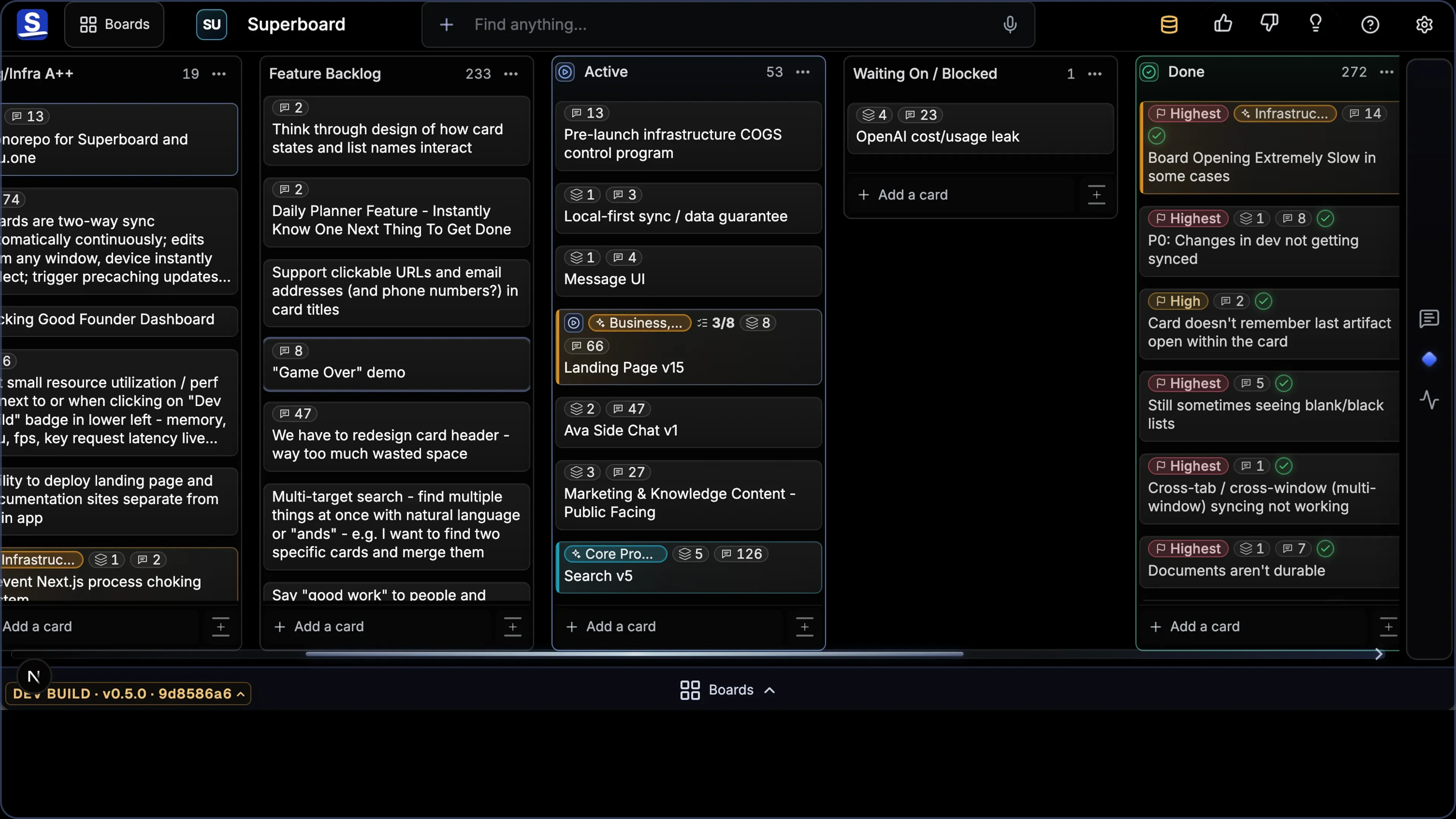
I keep personal life and major areas of work on separate Boards so each mission has a picture I can actually scan.
Chat holds the ideas, debates, references, and decisions; Stage holds working documents and spec revisions; Cards keep status, priority, files, and history attached.
Ava can help draft, organize, and rank bounded work already on the Board. She does not own the company, deploy the product, or create her own authority.
How I keep the whole mission visible
I am building You.one with You.one. Superboard—You.one’s Board view—is where I organize, plan, track, discuss, and move the work. I choose which Boards to keep and what belongs in each. On the product-development Board, customer needs, product decisions, implementation, launch work, support, and public content stay visible together instead of living only in my head.
The large Board image on this page is a sanitized screenshot of my actual Founder Board, captured on August 21, 2026. The Card Room below is a public-safe reconstruction of a real decision from this content program; it teaches the operating pattern without exposing private Board data.
The Board, Card Room, Stage, Chat, files, status, priority, and explicit Ava help shown here are current. Ava and Codex helped prepare and review the content evidence; I decided to stop adding undifferentiated pages and rehabilitate the ranked 20 first. Neither Ava nor Codex published or deployed that decision for me.
I use one Board for each major mission
I currently keep a Personal Board and separate Boards for major areas of work. You.one is the product, and Superboard is its Board view. The useful rule is that each genuinely different mission gets its own Lists, Cards, Rooms, files, decisions, and pace.
I do not show my Personal Board publicly because it is personal. It uses the same pattern and stays separate because that mission is genuinely different from building the product.
That is the practical rule I recommend: keep a separate Board for every part of life or work that deserves its own clear operating picture.
Your missions will be different from mine. You might have one Board for school, one for a job search, one for caring for someone, one for a home project, and one for a hobby or side hustle. The point is not to become a project manager. It is to give each important mission one clear place where the work, notes, files, decisions, and conversation with Ava stay together.
Chat is where I hold the thinking and decisions
If I leave the thinking in a temporary AI chat, a browser tab, or my head, I lose it. For each Card, I keep the ideas, debate, tradeoffs, and decisions with Ava in Chat. If an external article or reference bears on the Card, I copy the link and useful context into the same Chat.
That rule travels. If the thinking belongs to a course, renovation, volunteer campaign, book, or job search, it belongs in that Card’s Chat instead of a disposable thread.
In my engineering work, Ava also drafts large feature specs with me. Sometimes we begin in Chat; sometimes Codex—part of my programming setup, not a public You.one feature—produces a code-grounded draft first because it can inspect the repository, and Ava helps me question, revise, and improve it. The discussion stays in Chat; the resulting writing moves onto Stage.
Stage is my drafting table and durable spec shelf
I use native Stage Documents for drafting, working through ideas, and treating the page like a sketchpad. A proper visual Sketchpad is Direction; today the native Document is the flexible place where I think in writing.
I put the working specification on the Card’s Stage. After discussion and revision, I add the next named revision there too, so the Card holds the history of the spec beside the conversation that changed it. I name each revision myself; You.one does not yet version a Document automatically.
The same shelf can hold a syllabus, contractor plan, chapter draft, application packet, or event brief. Stage is simply where the work you are shaping stays with the reason it exists.
Status, priority, and files keep the operating picture honest
I keep Card status current and express priority in two ways: by ordering work within a List and with the Card’s priority picker. The Board tells me what is active, blocked, or done; the order and priority tell me what deserves attention first.
I attach relevant files—including PDFs—to the Card so the source material stays with the work and Search can find its filename later. You.one does not yet search inside every attached document.
In my programming setup today, governed internal tooling lets Codex post comments and updates directly to the Card. That is Founder infrastructure, not a public connector. A general public Codex connection is Direction.
Separately, on my Founder Board I explicitly ask Ava in Card Chat to review the Bugs List, rank the Cards from highest impact to lowest, and leave a one-line why so I can see the reasoning later. That is current, on-request help inside the Board. Ava does not continuously prepare or reprioritize across the mission by default; that broader default preparation is Direction.
Available today
The actual Board keeps the product-building mission visible
My mission is to build You.one for the first hundred people who depend on it; You.one’s Superboard view holds and moves that work. The sanitized Board image above is the actual operating picture I used: engineering and infrastructure, the feature backlog, active work, blocked work, and completed work. It contains real Founder work but no customer records, credentials, or private conversation.
My Cards hold customer evidence, product specifications, defects, release work, support issues, and this public-content rehabilitation program. You.one can hold these different forms of work in its Superboard view without forcing them into one task-only schema.
These Lists happen to be engineering, backlog, active, blocked, and done because that is this mission. A course, household project, book, volunteer year, or side hustle would use names that fit that work. The point is the same: I can see one mission without rebuilding it from chats, notes, and memory.
Available today
The Room keeps the work and reasoning together
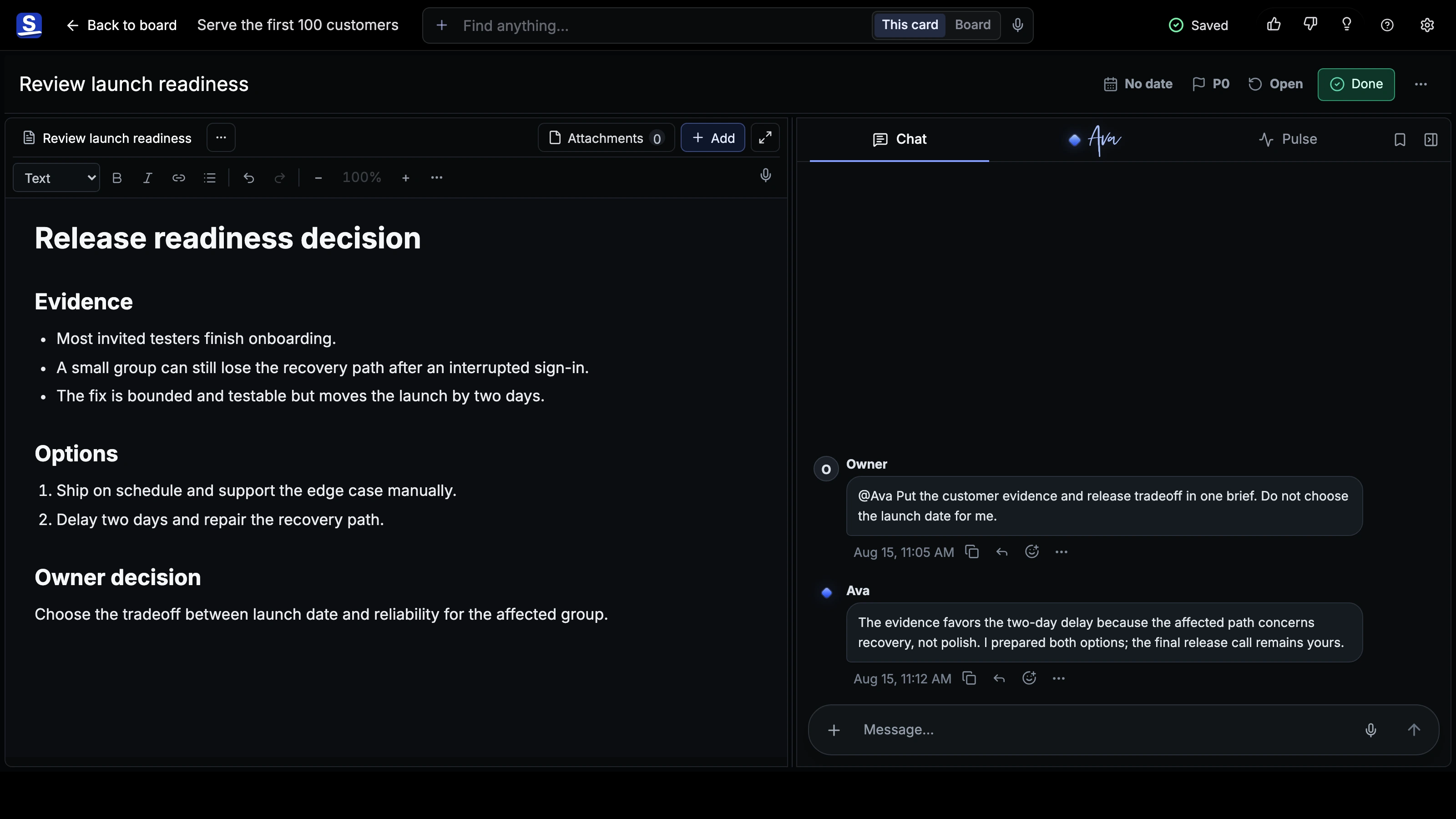
When I open a Card that actually matters, I do not want the draft in one place, the debate in another, and the files in a third. The Room keeps them with the Card: Stage for the working Document, checklist, and files; Chat for the discussion and explicit @Ava requests; and Notifications for alerts and updates that need attention.
Those Room surfaces and supported Undo are current. The public-safe Room below reconstructs the decision to rehabilitate the ranked 20 pages before adding more. Ava prepared the visible tradeoff; I recorded the choice. It does not show autonomous publishing, deployment, or broader default monitoring.
Direction
Direction: Ava returns prepared judgment
Direction is for Ava to prepare more of this judgment across the mission by default: gather the relevant evidence, keep it current, identify uncertainty, and return when a decision truly needs me. I still make consequential choices and provide any authority needed for external action; Ava does not create that authority for herself.
You.one today does not continuously monitor every Board, publish public content, or deploy the product autonomously. Any future external action still requires the applicable connection and authority.
First-class connections for Codex and other external agents are Direction. They should work with Ava and update Board content only when I have clearly allowed it, and every change should be visible and reversible.
What remains with me
I remain the Owner of the calls that matter: what deserves attention, what quality the work must clear, which tradeoff I will live with, and what moves forward. Ava can help me prepare the decision; she cannot grant herself permission to deploy, publish, spend, or make a customer promise.
What to do next
If this might fit your life, start with one Board for one mission you already carry. See whether keeping the work, thinking, files, priorities, and decisions together makes the next move clearer. Then read where human judgment belongs. The waitlist is appropriate only if today’s product fits a real mission you carry—work, study, a household, a craft, or a company.
What is current and what is illustrative
The Board, Cards, Rooms, Stage artifacts, Chat, Notifications, search, saving, and supported recovery shown here are current product surfaces. The large Board image is a sanitized screenshot of my actual Founder Board. The separate Card Room is a deterministic public-safe reconstruction and contains no private production or customer data.
The deeper cross-work reasoning, continuous monitoring, prepared external workflow, and sending or spending described in my story are illustrative Direction unless a current Help article says otherwise. I remain responsible for the mission, its constraints, every consequential judgment, and real authority throughout both the current workflow and that Direction.
Swipe or scroll sideways to see every column.
| Available today | Direction illustrated by the story |
|---|---|
| Board, Lists, Cards, and Card Rooms | Deeper reasoning across the mission by default |
| Documents, Checklists, Files, Chat, and Notifications | Prepared recommendations using broader evidence |
| Bounded Ava actions and explicit @Ava requests | Governed sending, publishing, purchasing, or external execution |