
Example
How to prepare for study abroad without losing documents in five tabs
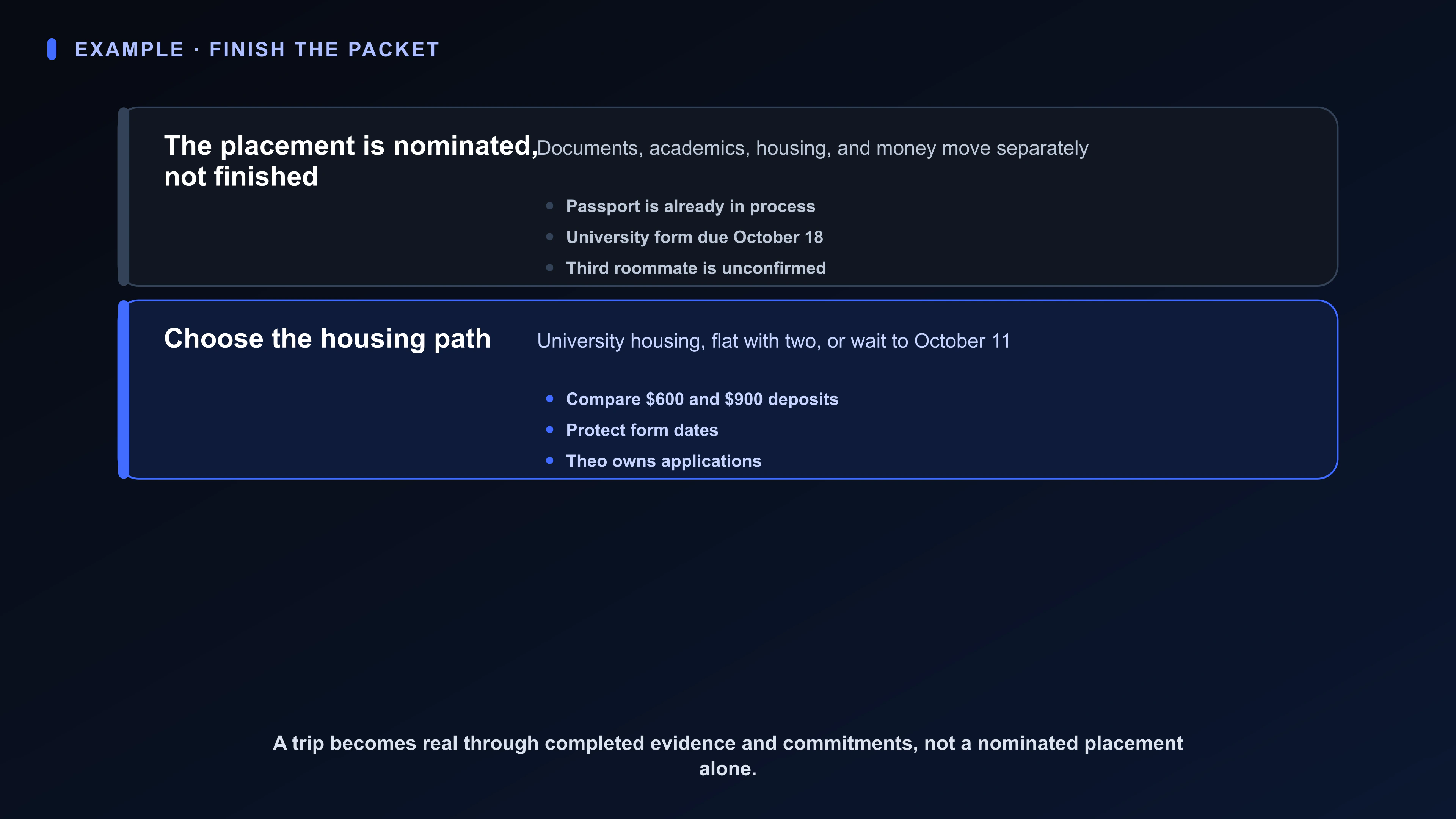
Theo has a nominated placement but no honest housing path yet. He must choose university housing, an independent flat with two classmates, or wait until October 11 for a third roommate who has not committed.
Complete the exchange packet—courses, documents, housing, and scholarship statement—before the office’s hard dates, without treating nomination as done
Office dates and what “ready to go” actually includes
Keep office dates visible and refuse to treat nomination as completion
Course equivalencies and department approvals
Hold the syllabus and the department question together
Passport, forms, and scans the office still needs
Hold the unsubmitted housing form and its official deadline beside the housing decision
Keep the remaining signed and scanned office documents visible as actual packet work
Housing choice, deposits, and scholarship writing
Compare university housing, independent flat, and waiting on a third roommate
Attach the statement to the housing decision it still depends on
Keep the uncommitted third-person lead visible without treating it as a request already in motion or a lease plan
Make the two-classmate flat a real housing path while the third roommate remains uncommitted
Ground the housing comparison in the deposit notes Theo already captured
Keep the owner-set cutoff beside the third-roommate option and one week ahead of the October 18 university housing form
Submitted passport and signature requests already in motion
Keep an already-submitted document from looking like Theo’s next action
The Exchange packet Board separates academics, documents, housing, money steps, and real replies so a daydream cannot masquerade as a finished packet.
The Choose housing path Card becomes a Room for deadlines, deposit amounts, known roommates, and the unconfirmed third person.
Ava can compare the evidence Theo provides. Theo owns applications, deposits, documents, and every office or classmate conversation; Ava does not file documents or book travel.
Nomination is not departure; the remaining packet is the work
This Board has one job: Complete the exchange packet—courses, documents, housing, and scholarship statement—before the office’s hard dates, without treating nomination as done.
The decision still belongs to Theo: Whether to accept university housing, pursue an independent flat with two classmates, or wait until the October 11 roommate cutoff for a third roommate who has not committed.
You.one can keep the work, evidence, anything already waiting on another person or event, and the “Choose housing path” decision visible through its Superboard view. Theo still owns the call: Theo chooses housing, spends any deposit, writes the scholarship statement, and owns every office and roommate conversation.
Available today
Exchange packet: one place for the mission
The Exchange packet Board gives this mission one durable operating picture. Theo can use familiar language instead of translating the situation into project-management jargon. Its five Lists separate the kinds of attention this situation actually requires.
The Board is not a master task list. It keeps the live choice, the facts that could change it, and any reply or outside event already in motion visible without pretending every uncertainty is work in progress.
Swipe or scroll sideways to see every column.
| List | What belongs here |
|---|---|
| Mission | Office dates and what “ready to go” actually includes |
| Academics | Course equivalencies and department approvals |
| Documents | Passport, forms, and scans the office still needs |
| Housing and money steps | Housing choice, deposits, and scholarship writing |
| Replies already requested | Submitted passport and signature requests already in motion |
Available today
Cards that sound like the real work
These Card titles come directly from Theo's situation: “Choose housing path” is the live choice, “Course equivalency for statistics” holds evidence, and “Passport renewal in process” names something genuinely in motion outside Theo's control. The point is recognition, not a perfect taxonomy.
Swipe or scroll sideways to see every column.
| Card | List | Job |
|---|---|---|
| Finish the packet, not the daydream | Mission | Keep office dates visible and refuse to treat nomination as completion |
| Choose housing path | Housing and money steps | Compare university housing, independent flat, and waiting on a third roommate |
| Course equivalency for statistics | Academics | Hold the syllabus and the department question together |
| Passport renewal in process | Replies already requested | Keep an already-submitted document from looking like Theo’s next action |
| Scholarship statement draft | Housing and money steps | Attach the statement to the housing decision it still depends on |
| Roommate lead from a classmate | Housing and money steps | Keep the uncommitted third-person lead visible without treating it as a request already in motion or a lease plan |
| University housing form — due October 18 | Documents | Hold the unsubmitted housing form and its official deadline beside the housing decision |
| Exchange-office forms still to scan | Documents | Keep the remaining signed and scanned office documents visible as actual packet work |
| Independent flat with Maya and Luis | Housing and money steps | Make the two-classmate flat a real housing path while the third roommate remains uncommitted |
| Housing deposits: university $600 / flat $900 | Housing and money steps | Ground the housing comparison in the deposit notes Theo already captured |
| Third-roommate cutoff: October 11 | Housing and money steps | Keep the owner-set cutoff beside the third-roommate option and one week ahead of the October 18 university housing form |
Available today
Keep the evidence with “Choose housing path”
Opening the Card gives the visible item durable depth. Stage can hold Housing-path brief: Place “University housing form — due October 18,” “Housing deposits: university $600 / flat $900,” “Independent flat with Maya and Luis,” “Roommate lead from a classmate,” “Third-roommate cutoff: October 11,” and the university-housing / two-classmate-flat / wait-until-October-11 paths on one page. Chat keeps the request and response beside that artifact instead of in a detached thread. Notifications can bring this update forward: “Open decision: Theo will choose university housing, the two-classmate flat, or waiting until the October 11 third-roommate cutoff (university form still due October 18).”
A Card Chat request can ask Ava to prepare the specific comparison or extraction in “Choose housing path” from the visible evidence. Ava can work from the context Theo deliberately brings into this Card, List, or Board; she cannot monitor the rest of life, contact anyone, or inherit the decision.
Theo's call remains explicit: Theo chooses housing, spends any deposit, writes the scholarship statement, and owns every office and roommate conversation.
Swipe or scroll sideways to see every column.
| Surface | Job in this example |
|---|---|
| Stage | Housing-path brief: Place “University housing form — due October 18,” “Housing deposits: university $600 / flat $900,” “Independent flat with Maya and Luis,” “Roommate lead from a classmate,” “Third-roommate cutoff: October 11,” and the university-housing / two-classmate-flat / wait-until-October-11 paths on one page |
| Chat | Keep Theo's request and Ava's attributed response with the work |
| Notifications | Open decision: Theo will choose university housing, the two-classmate flat, or waiting until the October 11 third-roommate cutoff (university form still due October 18) |
Start small and rename what feels artificial
Theo should rename every List or Card that feels artificial. This recipe succeeds when “Choose housing path” becomes easier to decide and fewer open loops depend on memory—not when the Board looks tidy.
Swipe or scroll sideways to see every column.
| Step | Action |
|---|---|
| 1. List office dates | Keep the exchange timeline on Mission and each hard date on the List that owns its form, including housing and document cutoffs |
| 2. Split the packet | Create Cards for courses, documents, housing, and money steps |
| 3. Mark what is already in motion | Move submitted passport and signature requests to Replies already requested |
| 4. Surface outside conditions | Note which writing still depends on a housing choice |
| 5. Choose housing path | Open a Room before a deposit or a statement locks an unmade call |
Browser tabs plus a university portal can remain part of the system
Browser tabs plus a university portal can be enough while the situation stays simple: one office and one form remain.
It starts to break when courses, passport, housing, and a scholarship all depend on each other.
The Exchange packet Board earns its place only when the familiar tool—browser tabs plus a university portal—can no longer keep the reason, Housing-path brief, conversation, current state, decision, and history connected.
Where this example stops
- This is a fictional example, not a customer story.
- This is not immigration, visa, financial-aid, or housing-legal advice.
- It does not show Ava filing forms, paying deposits, or contacting a university office.
- It is not a measured admission, scholarship, or placement result.