
Example
How to set up a home woodworking shop around the work you will actually do
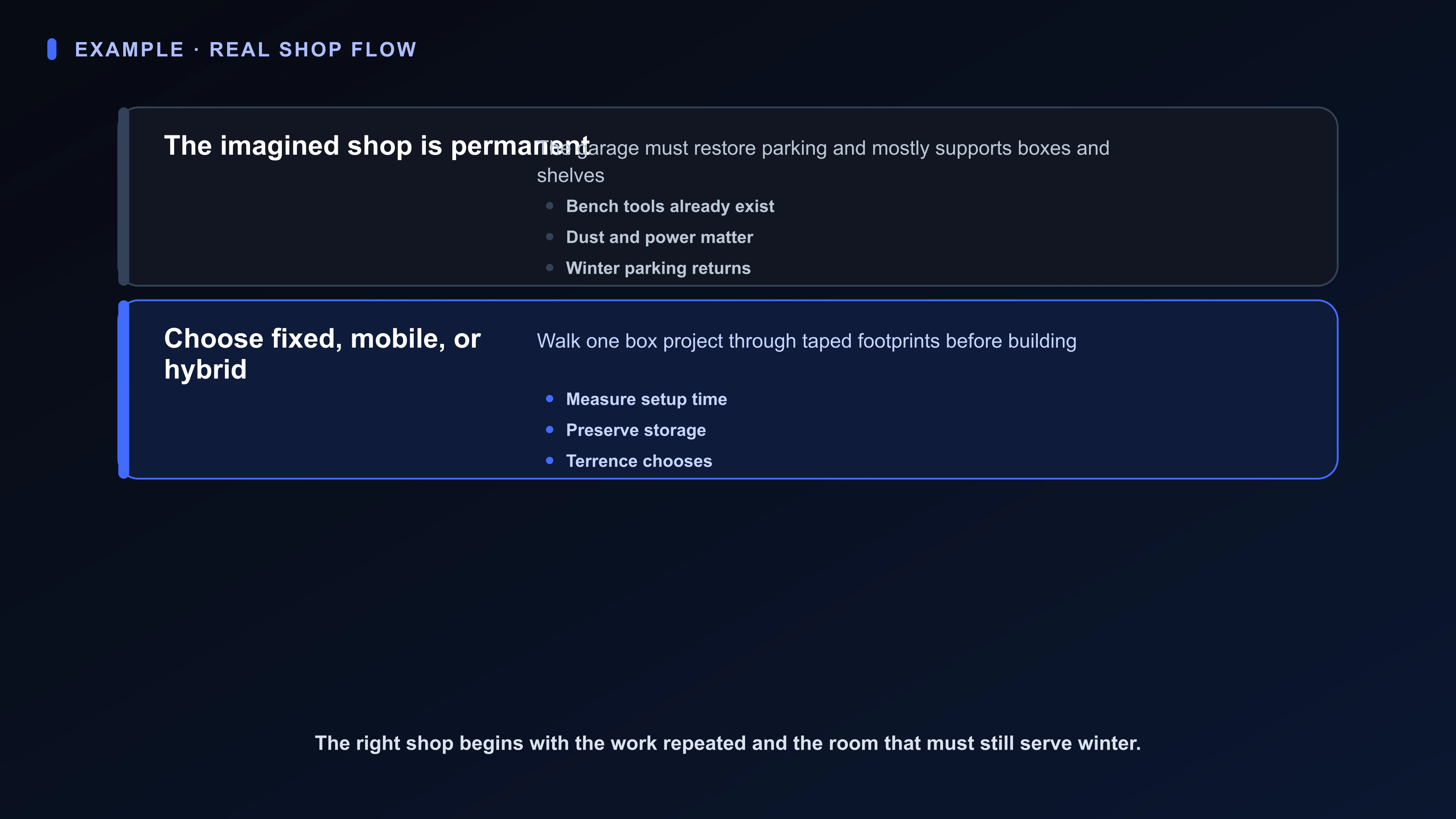
Terrence dreams about large furniture but repeatedly builds boxes and shelves, and part of the garage must return to parking each winter. He must choose a fixed bench, mobile stations, or one fixed assembly surface with mobile tools from a walked project flow—not from an imagined permanent shop.
Create a reversible shop that makes common work easy and restores the garage when needed
The governing promise behind every other List
Hold the mission and boundary: create a reversible shop that makes common work easy and restores the garage when needed
Work Terrence can actually advance in the current window
Hold the live choice—whether to build a fixed bench, use mobile stations, or keep one fixed assembly surface with mobile tools—so Terrence can decide from the evidence in this Room
Prepare the next owned move without treating a draft, check, or test as evidence that anyone has agreed
Complete this as owned preparation; if another person must answer, keep it as an unsent draft until it is actually sent
Use the result of the first owned action to update the Layout-choice brief; record the finding, not merely the effort
Facts worth returning to before Terrence decides: whether to build a fixed bench, use mobile stations, or keep one fixed assembly surface with mobile tools
Supply the evidence for the Layout-choice brief: place common projects, power, dust, parking, storage, and setup time together. Live choice: Whether to build a fixed bench, use mobile stations, or keep one fixed assembly surface with mobile tools.
The One-car workshop Board keeps the making promise, setup actions, measured workflow evidence, material facts, and working arrangements visible.
Open Fixed, mobile, or hybrid as the decision Room with the Layout-choice brief and one real box project walked through taped footprints.
Ava can compare only the visible layout facts. Terrence and qualified people own tools, electricity, dust control, building conditions, material purchases, parking, and workshop safety.
One-car workshop has one live choice: Fixed, mobile, or hybrid
What belongs together is specific: Create a reversible shop that makes common work easy and restores the garage when needed.
The consequential judgment remains human: Whether to build a fixed bench, use mobile stations, or keep one fixed assembly surface with mobile tools.
You.one can keep the work, evidence, and “Fixed, mobile, or hybrid” decision visible through its Superboard view. Authority does not move to the software: Terrence, as the weekend woodworker moving into a one-car garage, owns the preparation and the decision about whether to build a fixed bench, use mobile stations, or keep one fixed assembly surface with mobile tools.
What changes after a garage sketch
A garage sketch can be enough while the situation stays simple: “Tape the tool footprints” and “Check caster availability” no longer change the “Fixed, mobile, or hybrid” choice.
It starts to break when “Three common project flows” and “Check caster availability” must inform the same choice.
The One-car workshop Board earns its place only when the familiar tool—a garage sketch—can no longer keep the reason, Layout-choice brief, conversation, current state, decision, and history connected.
Available today
A focused One-car workshop Board
The One-car workshop Board gives this mission one durable operating picture. Terrence can use familiar language instead of translating the situation into project-management jargon. Its three Lists separate the kinds of attention this situation actually requires.
The point is a fast scan: what is moving, what is known, what is unresolved, and what Terrence must choose. Questions not yet asked stay with Terrence; they do not move to a list for outside replies.
Swipe or scroll sideways to see every column.
| List | What belongs here |
|---|---|
| Making promise | The governing promise behind every other List |
| Setup next | Work Terrence can actually advance in the current window |
| Workflow evidence | Facts worth returning to before Terrence decides: whether to build a fixed bench, use mobile stations, or keep one fixed assembly surface with mobile tools |
Available today
Inside the “Fixed, mobile, or hybrid” Room
Opening the Card gives the visible item durable depth. Stage can hold Layout-choice brief: Place common projects, power, dust, parking, storage, and setup time together. Live choice: Whether to build a fixed bench, use mobile stations, or keep one fixed assembly surface with mobile tools. Chat keeps the request and response beside that artifact instead of in a detached thread. Notifications can bring this update forward: “Open decision: Terrence will decide whether to build a fixed bench, use mobile stations, or keep one fixed assembly surface with mobile tools.”
A Card Chat request can ask Ava to prepare the specific comparison or extraction in “Fixed, mobile, or hybrid” from the visible evidence. Ava can work from the context Terrence deliberately brings into this Card, List, or Board; she cannot monitor the rest of life, contact anyone, or inherit the decision.
Terrence's call remains explicit: Terrence, as the weekend woodworker moving into a one-car garage, owns the preparation and the decision about whether to build a fixed bench, use mobile stations, or keep one fixed assembly surface with mobile tools.
Swipe or scroll sideways to see every column.
| Surface | Job in this example |
|---|---|
| Stage | Layout-choice brief: Place common projects, power, dust, parking, storage, and setup time together. Live choice: Whether to build a fixed bench, use mobile stations, or keep one fixed assembly surface with mobile tools |
| Chat | Keep Terrence's request and Ava's attributed response with the work |
| Notifications | Open decision: Terrence will decide whether to build a fixed bench, use mobile stations, or keep one fixed assembly surface with mobile tools |
What Ava can prepare from visible context
These requests stay with the facts Terrence has made visible around “Fixed, mobile, or hybrid.” Terrence supplies the evidence, checks Ava's work, and decides what belongs in the Room.
Current Ava can prepare help after an explicit request. She cannot make the choice, represent Terrence, watch other work on her own, or contact anyone.
Terrence, as the weekend woodworker moving into a one-car garage, owns the preparation and the decision about whether to build a fixed bench, use mobile stations, or keep one fixed assembly surface with mobile tools. Ava may help only inside this Card Room; she cannot decide, represent anyone, contact people, or act elsewhere.
Terrence finishes “Walk one real box project through a taped floor layout,” keeps “Three common project flows” beside “Fixed, mobile, or hybrid,” and does not treat “Check caster availability” as completed or sent before doing the work.
- Request idea: summarize what this Card Room and the Layout-choice brief show about Fixed, mobile, or hybrid. Keep “Check caster availability” as work I still control, and leave every external action with me.
- Request idea: use only the Layout-choice brief and notes the Owner has placed in this Card Room to separate facts, assumptions, and unanswered questions
- Request idea: from “Fixed, mobile, or hybrid,” draft a short decision note and name Terrence as the decider
A starter shape, not a prescribed workflow
Terrence should rename every List or Card that feels artificial. This recipe succeeds when “Fixed, mobile, or hybrid” becomes easier to decide and fewer open loops depend on memory—not when the Board looks tidy.
Swipe or scroll sideways to see every column.
| Step | Action |
|---|---|
| 1. Write the mission | Create a reversible shop that makes common work easy and restores the garage when needed |
| 2. Open the live choice | Put “Fixed, mobile, or hybrid” in a Room of its own |
| 3. Attach the evidence | Layout-choice brief: Place common projects, power, dust, parking, storage, and setup time together. Live choice: Whether to build a fixed bench, use mobile stations, or keep one fixed assembly surface with mobile tools. |
| 4. Keep the work owned | Keep “Check caster availability” in owned work and name the next visible move |
| 5. Take the first owned action | Walk one real box project through a taped floor layout |
Where this example stops
- This is a fictional example, not a customer story.
- This fictional example is not tool, electrical, dust-control, building, or workshop-safety advice; qualified guidance governs the actual setup and work.
- It does not show Ava completing external actions or contacting anyone for Terrence.
- It does not report a measured result, and this Board is a starting shape to adapt—not a universal prescription.