
Example
How a working student can organize school, work, money, and life
Maya has a tuition form, group presentation, shift, problem set, and family ride competing for the same few days. Her Board makes the collision visible; the decision still belongs to her.
Example walkthrough: Maya’s before-Friday collision
A 40-second current-product walkthrough of one working-student Example: Board, decision Room, visible evidence, a supported Ava request, Maya’s choice, and the resulting record.
Read the transcript
Maya treats her paid shift and promised family ride as fixed while a tuition form, presentation, and problem set collide before Friday. The Choose what moves before Friday Room keeps those fixed life commitments beside the school deadlines and published late window. Maya’s saved question asks Ava to compare visible Friday deadlines, without doing schoolwork or contacting anyone. Ava’s comparison reflects the supplied fixed commitments and keeps the late window visible. Maya still chooses the sequence. Notifications can surface what needs attention without choosing the sequence for Maya. Maya records: shift and ride fixed; form first, presentation protected, late window for the problem set. The work stays hers. you.one/examples.
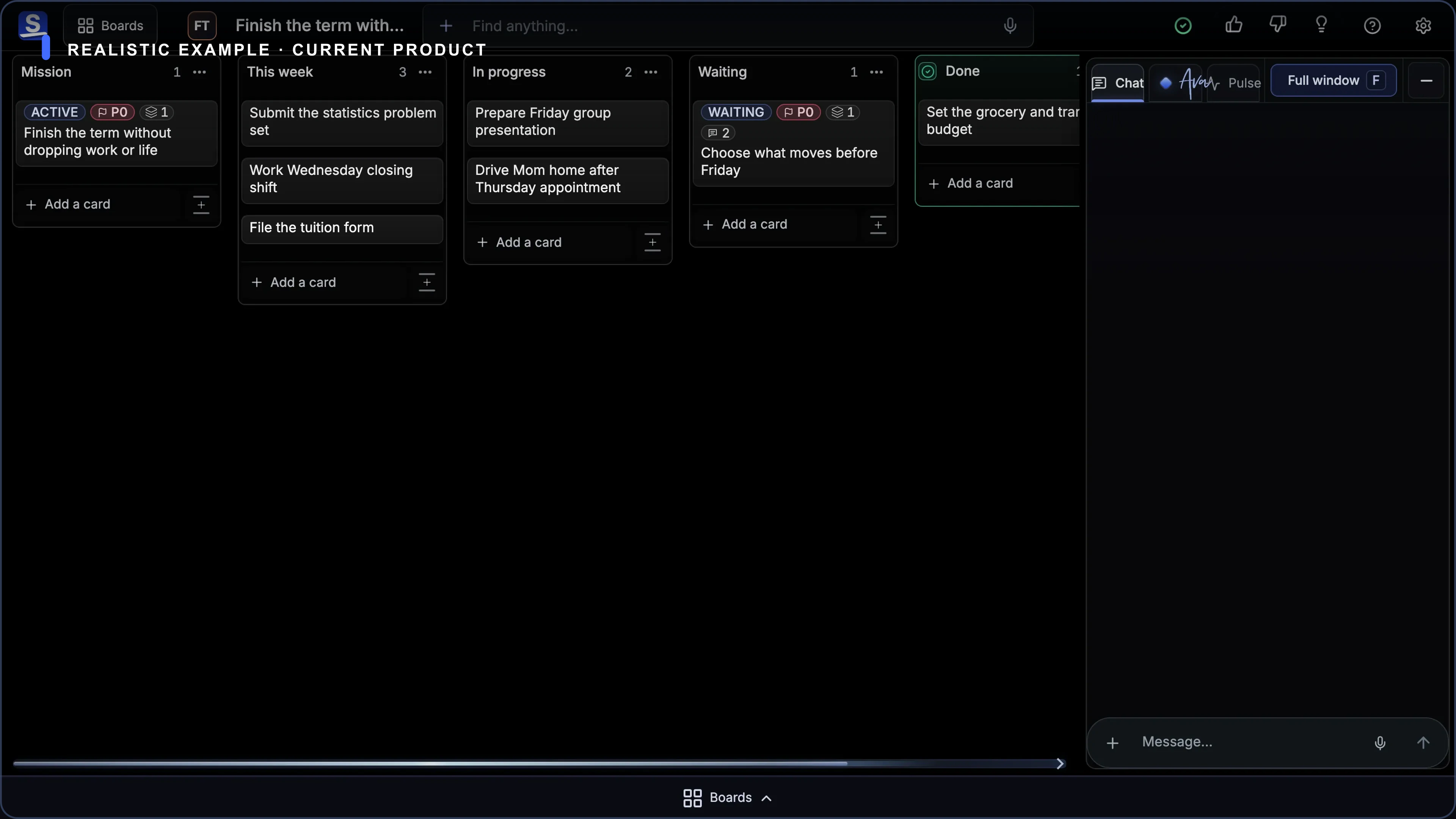
Example: Maya is a working student with school, paid work, money, food, transportation, and family responsibilities in the same week.
Her Superboard view keeps each major part of life on a focused Board, then opens one Card as a Room when the evidence and decision need depth.
Inside that Room, Ava can organize the deadlines Maya provides. Maya chooses what moves, does the schoolwork, and contacts people herself.
School is only one of the jobs she is already doing
A working student can organize school, work, money, and life by bringing competing obligations into one decision Room. Maya is a fictional 29-year-old in Vancouver completing a part-time data-analytics certificate while working thirty-two hours a week at a community recreation centre. She is careful, capable, and already uses a calendar. The pressure is not a missing planner. It is six legitimate commitments landing before Friday—school, paid work, money, family, food, and transportation—each of which looks reasonable until they are seen together.
A statistics problem set, a Wednesday closing shift, a tuition form, a Friday group presentation, a ride her mother needs after a Thursday appointment, and setting tonight’s transit budget so the food shop can move do not fail because Maya is unserious about school. They fail because no single syllabus, staff schedule, or banking reminder is responsible for the whole person. The useful system is the one that can hold all six without pretending homework is the only adult work in the room.
Available today
Organize the whole student
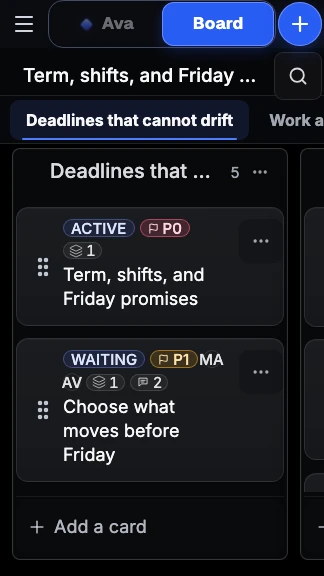
Maya uses three focused Boards in You.one’s Superboard view: Term, shifts, and Friday promises; Money, food, and getting there; and Family, home, and usable energy. School does not swallow the rest of her life. When obligations collide, she brings the relevant facts into one decision Card rather than copying every task onto one enormous Board.
On the term-and-shifts Board, Deadlines that cannot drift holds the tuition form and group presentation. Work already under way holds the presentation evidence slide and unfinished problem-set questions. Replies Maya needs separates a manager’s answer from work Maya can do herself. Promises Maya kept preserves completed work. Dates and optional priority show urgency; they are not a moral ranking of the people behind it.
Opening any consequential Card creates a Room for the working artifact, Checklist, File references, conversation, and current state. Maya can return to the actual reasoning instead of reconstructing it from a calendar title that says “stats” and hides the late policy, or “Mom” and hides the appointment time. The collision becomes a picture with reasons, not a feeling that she is failing six systems at once.
Available today
The decision is what moves—not how to do everything
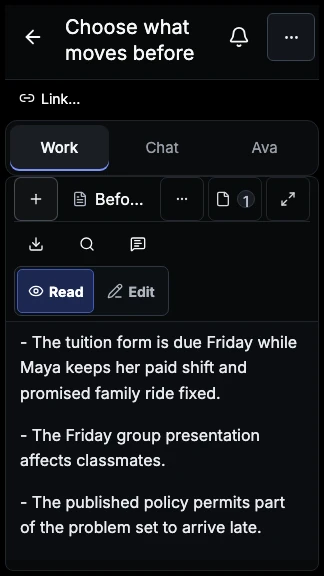
The Choose what moves before Friday Room holds the fixed commitments, the people affected, the documented late window, and the conversations Maya can actually have. The tuition form has a hard Friday administrative deadline. The group presentation cannot move without affecting classmates who are counting on Friday. The Thursday ride is already confirmed. The closing shift may be negotiable, but only a manager can approve leaving two hours early. Part of the statistics problem set has a published late policy. The food shop is the most flexible, if the transit budget is set tonight so Maya is not solving dinner and fares in the same panic as the form.
Maya can ask Ava to put the deadlines, the people affected, and the movable work into one tradeoff brief—and not to write the coursework or contact anyone. The Stage Document keeps that evidence in view. Chat keeps the request and bounded response. Notifications bring relevant updates forward. Every real conversation remains Maya’s. You.one does not become her school, her employer, or her family.
The walkthrough ends with a recorded plan, not extra hours or completed schoolwork: form first, protect the presentation, use the published late window deliberately. Maya still has to do those things. The shift conversation, transit budget, and food shop remain hers to handle. Closing the decision Card records that she chose a sequence; it does not claim the other obligations are finished.
Available today
Where Ava helps today
When the relevant Cards and dates are already on the Board, Maya can explicitly ask Ava to summarize the collision, identify visible constraints, or help organize supported Board items. Current bounded actions remain attributable and recoverable through supported paths. That help is preparation: a clearer brief, a cleaner List, a shorter reconstruction of what is already there.
Ava does not currently sign into Maya’s learning system, read university email, change a work shift, submit the form, contact a professor, complete academic work, or invent an accommodation. Maya remains the Owner of every consequential choice. She is responsible for the truth of her commitments and for any deadline or shift conversation. This page does not tell her which shift to keep, how to spend, or how to study. A Board that writes her problem set would not be help. It would be a different product, and a dishonest one.
A starter Board for a working student
Start with the area that is hardest to hold in your head. Maya’s term-and-shifts Board is one example, not a required school template. A different term might need a List for labs or a second job. Add separate Boards when money, family, a hobby, or another project needs its own picture. Keep the deadlines small enough to be true; keep unanswered messages separate from your own next action.
When several legitimate commitments collide, open the consequential Card as a Room. The Room holds the evidence and tradeoff; it is depth behind a Card, not another List on the Board.
Swipe or scroll sideways to see every column.
| Part | What belongs there |
|---|---|
| Board: Term, shifts, and Friday promises | The reason for studying and the paid-work commitments it must coexist with |
| Deadlines that cannot drift | Only obligations with a real near-term consequence |
| Work already under way | Work that already has attention and artifacts |
| Replies Maya needs | Replies, approvals, group input, and administrative dependencies |
| Promises Maya kept | Submitted, confirmed, or consciously closed work |
Direction
Direction: less reconstruction across the week
Direction is for one Ava to carry Maya’s relevant personalized context across days, help notice emerging collisions, and prepare options through the same guidance and Board system. That could reduce the repeated effort of explaining school, work, money, and family constraints in separate chats.
This page does not claim automatic portal, inbox, employer, or cross-product access. Any future connection and action would require applicable capability and authority. Maya is a fictional example.