
Example
How to turn the work you already did into proof for a career change
Lena has store-operations experience, three possible proof pieces, and a mentor note. Her problem is choosing the first public piece—and removing confidential details—before another week disappears into collecting job posts.
Assemble three truthful proof pieces for product-operations roles without abandoning the current job or inventing a software past
Target role family and the rule that proof stays truthful
Keep the product-operations target beside the rule that store work is evidence, not costume
Each case, artifact, or portfolio-shape choice as its own Card
Compare inventory-loss, seasonal staffing model, and vendor-onboarding drafts
Hold the actual write-up, figures, and what still needs redaction
Hold the staffing-model write-up and the evidence still needed
Hold the timeline draft and mark details that need permission before publication
Job posts worth mapping, not spraying
Map one real posting to missing proof instead of bookmarking twenty
Mentor notes and class comments to apply
Attach the chat comment to the draft it belongs to
Sent permission requests and reviews awaiting another person
Keep Lena's sent confidentiality question visible until her manager replies
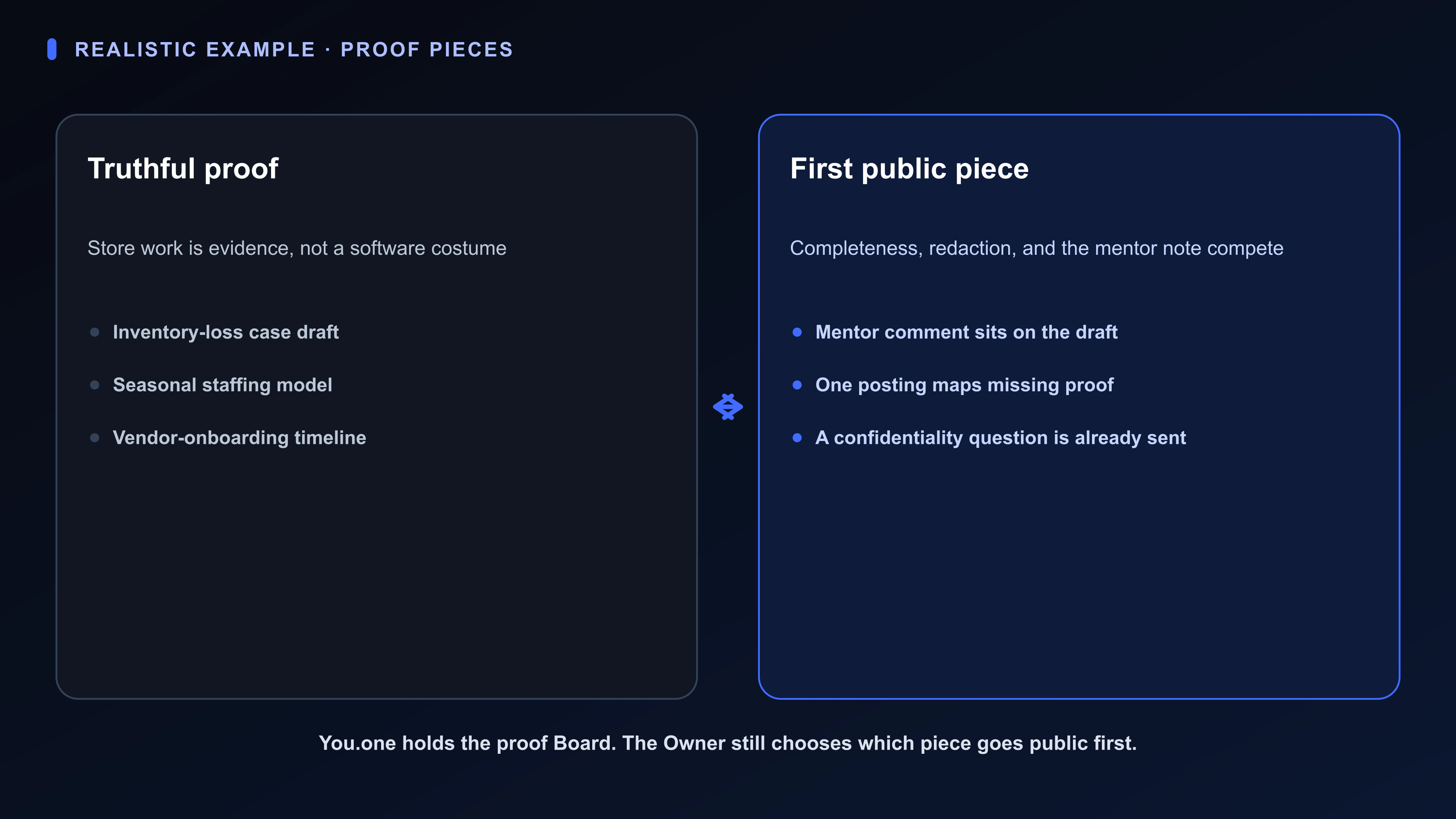
Use one Board for target roles, proof pieces, feedback, and evidence that still needs permission or redaction.
Open a Room for the first-public-piece decision so the draft, mentor comment, confidentiality question, and choice stay together.
Ava can help compare the evidence already present and prepare a comparison. Lena owns every claim, redaction, publication, and career decision.
Why Lena needs one operating picture for the career change
Lena is a fictional 34-year-old retail operations supervisor moving toward product operations in Seattle, Washington. Lena has ten years of store and district operations experience and three unfinished case write-ups that might become a portfolio. Target job posts, a mentor’s comments, and a night class project currently live in three folders and a bookmarks bar.
Job posts expire while the case write-ups stay half-done because she keeps starting a cleaner story.
A mentor said the inventory project is the strongest proof. That sentence is in a chat thread, not attached to the draft.
In You.one's Superboard view, Lena can give “Assemble three truthful proof pieces for product-operations roles without abandoning the current job or inventing a software past” a Board of its own. That Board connects store-proof drafts, expiring portfolio posts, the mentor conversation, and a sent confidentiality request awaiting the manager; opening “Choose the first public piece” creates a Room for its evidence, discussion, state, and decision.
The portfolio is a set of proof pieces, not a new personality
The mission is specific: Assemble three truthful proof pieces for product-operations roles without abandoning the current job or inventing a software past.
The consequential choice is not something a board or an AI should quietly make: Whether the first public piece is the inventory-loss case, the seasonal staffing model, or the vendor-onboarding timeline.
You.one can keep the work, evidence, anything already waiting on another person or event, and the “Choose the first public piece” decision visible through its Superboard view. Lena still owns the call: Lena chooses the first piece, writes it, waits for her manager's reply before using confidential detail, and owns every application.
Available today
Career-change proof: one Board shape to adapt
A Board named “Career-change proof” gives this mission one durable operating picture. Lena can use familiar language instead of translating the situation into project-management jargon. Its five Lists separate the kinds of attention this situation actually requires.
Its Cards deliberately distinguish actions, evidence, something already waiting on another person or event, and decisions. A Waiting List is useful here only because a named request or outside condition is already in motion. That separation makes the current choice, evidence, and next move easier to scan.
Swipe or scroll sideways to see every column.
| List | What belongs here |
|---|---|
| Mission | Target role family and the rule that proof stays truthful |
| Proof pieces | Each case, artifact, or portfolio-shape choice as its own Card |
| Target roles | Job posts worth mapping, not spraying |
| Feedback | Mentor notes and class comments to apply |
| Waiting | Sent permission requests and reviews awaiting another person |
Available today
The Cards make the operating picture concrete
These Card titles come directly from Lena's situation: “Choose the first public piece” is the live choice, “Inventory-loss case draft” holds evidence, and “Manager reply on describing vendor work requested” names something genuinely in motion outside Lena's control. The point is recognition, not a perfect taxonomy.
Swipe or scroll sideways to see every column.
| Card | List | Job |
|---|---|---|
| Three truthful proof pieces | Mission | Keep the product-operations target beside the rule that store work is evidence, not costume |
| Choose the first public piece | Proof pieces | Compare inventory-loss, seasonal staffing model, and vendor-onboarding drafts |
| Inventory-loss case draft | Proof pieces | Hold the actual write-up, figures, and what still needs redaction |
| Seasonal staffing model draft | Proof pieces | Hold the staffing-model write-up and the evidence still needed |
| Vendor-onboarding timeline draft | Proof pieces | Hold the timeline draft and mark details that need permission before publication |
| Mentor note on inventory project | Feedback | Attach the chat comment to the draft it belongs to |
| Northshore product ops posting | Target roles | Map one real posting to missing proof instead of bookmarking twenty |
| Manager reply on describing vendor work requested | Waiting | Keep Lena's sent confidentiality question visible until her manager replies |
Available today
Available today: Choose the first public piece becomes a Room
Opening the Card gives the visible item durable depth. Stage can hold Proof-piece comparison: Place completeness, redaction risk, and mentor notes beside the three candidate pieces. Chat keeps the request and response beside that artifact instead of in a detached thread. Notifications can bring this update forward: “Open decision: Lena will choose which proof piece becomes public first.”
A Card Chat request can ask Ava to prepare the specific comparison or extraction in “Choose the first public piece” from the visible evidence. Ava can work from the context Lena deliberately brings into this Card, List, or Board; she cannot monitor the rest of life, contact anyone, or inherit the decision.
Lena's call remains explicit: Lena chooses the first piece, writes it, waits for her manager's reply before using confidential detail, and owns every application.
Swipe or scroll sideways to see every column.
| Surface | Job in this example |
|---|---|
| Stage | Proof-piece comparison: Place completeness, redaction risk, and mentor notes beside the three candidate pieces |
| Chat | Keep Lena's request and Ava's attributed response with the work |
| Notifications | Open decision: Lena will choose which proof piece becomes public first |
What to ask Ava—and what not to assume
These requests stay with the facts Lena has made visible around “Choose the first public piece.” Lena supplies the evidence, checks Ava's work, and decides what belongs in the Room.
Current Ava can prepare help after an explicit request. She cannot make the choice, represent Lena, watch other work on her own, or contact anyone.
Lena owns the writing, confidentiality calls, applications, and conversations with her manager and mentor. Ava does not invent experience, apply, or contact anyone.
A portfolio with an order: one piece is chosen to finish, the mentor note is attached, and job posts stop substituting for proof.
- Request idea: using only the context visible in this Card Room, compare the three proof pieces on completeness, redaction, and mentor notes. Do not write the case or choose for me.
- Request idea: use only the Proof-piece comparison and notes the Owner has placed in this Card Room to separate facts, assumptions, and unanswered questions
- Request idea: name which visible Room note could most change the comparison; do not watch other Lists or follow up autonomously
Where a bookmarks folder of job posts stops being enough
A bookmarks folder of job posts can be enough while the situation stays simple: there is one posting and one existing sample.
It starts to break when three drafts, confidentiality, and expiring posts all claim to be next.
The “Career-change proof” Board earns its place only when the familiar tool—a bookmarks folder of job posts—can no longer keep the reason, Proof-piece comparison, conversation, current state, decision, and history connected.
A starter recipe to adapt, not obey
Lena should rename every List or Card that feels artificial. This recipe succeeds when “Choose the first public piece” becomes easier to decide and fewer open loops depend on memory—not when the Board looks tidy.
Swipe or scroll sideways to see every column.
| Step | Action |
|---|---|
| 1. Name the role family | Write the target and the truthfulness constraint on a Mission Card |
| 2. Card each proof piece | One Card per case, with the draft attached |
| 3. Map a few postings | Add only roles you would actually take, and note missing proof |
| 4. Capture feedback | Move mentor comments onto the Board beside the draft they concern |
| 5. Choose the first public piece | Open a Room before starting a fourth cleaner story |
Direction
Direction, not a current promise
Later, Ava may help this Board notice when a target-role Card still has no mapped proof piece, still leaving every application with Lena.
A future unified You.one experience could carry relevant context from “Choose the first public piece” across guidance and the Superboard view. Broad proactive coordination, cross-surface personalized memory, realtime shared editing, and general external execution are not available today. Any future action would still require the applicable capability, connection, grant, and human authority.
What this realistic example does not claim
- Lena is fictional and is not a customer, testimonial, research participant, or disguised real person.
- This is not career counseling, a hiring prediction, or a claim Superboard applied to jobs.
- It does not show Ava writing the portfolio, contacting a manager, or inventing experience.
- It is not a measured salary or placement result.