
Example
Rebuild your job search without missing important deadlines
Separate urgent paperwork from longer-term career choices so neither gets lost.
Your situation
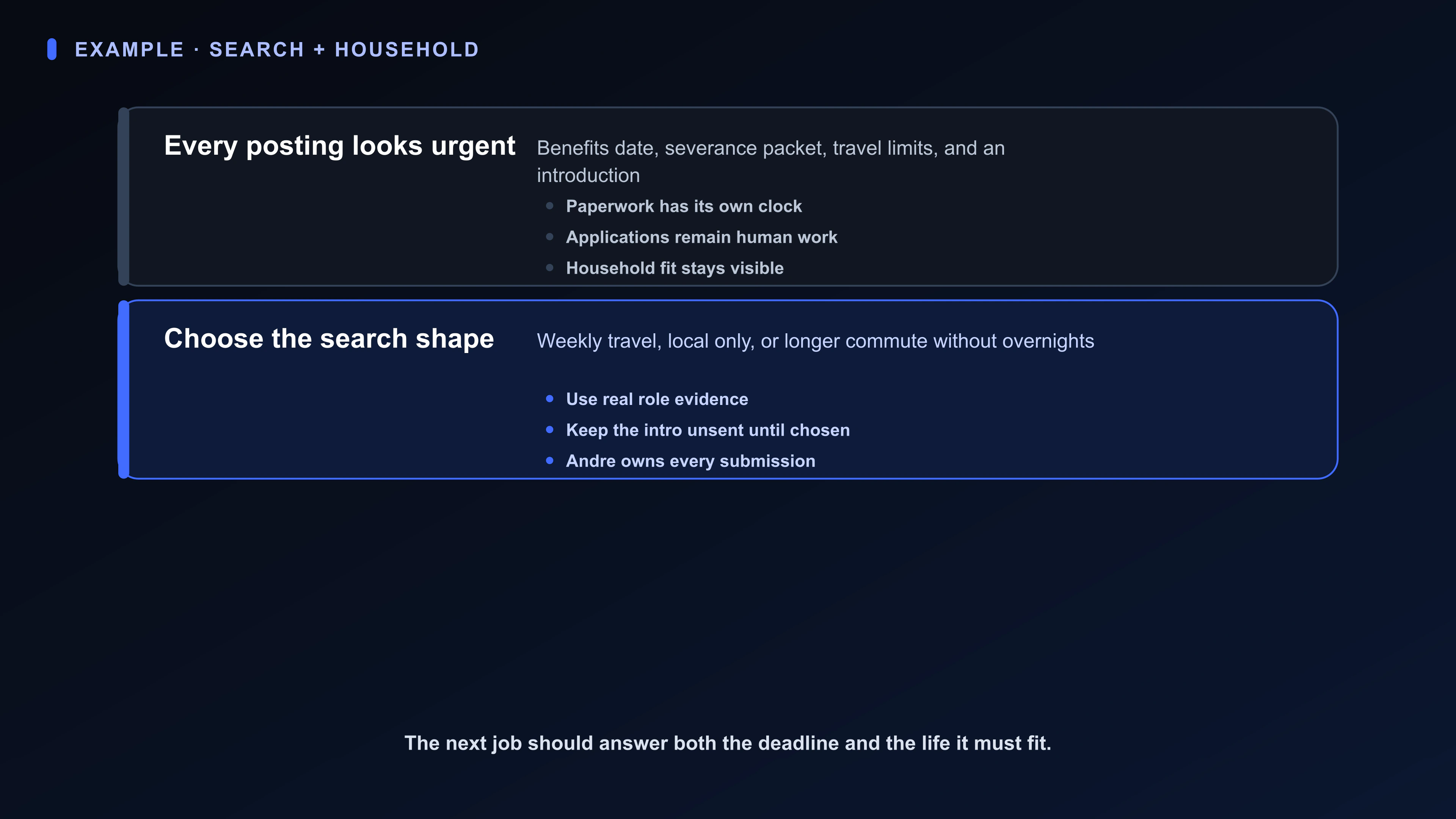
In this fictional example, Andre was laid off. A benefits form is due Friday, a former colleague offered an introduction, and jobs with very different travel demands compete for his attention.
How Ava can help
Ava can separate the deadline from the search, compare three work options using the facts Andre adds, and help him choose a next step.
What stays together
The severance packet, verified deadline, résumé versions, household travel limits, introduction, applications and the reason behind his chosen search direction.
Available today and limits
Current Cards, Documents, Checklists, files and Card Chat can keep that record together. Andre files forms, applies and talks to people himself. Ava does not submit or contact anyone in this example.
Run a targeted search for scheduling or operations roles while finishing layoff paperwork and protecting household travel limits
Role family, travel limit, and remaining paperwork dates
Keep travel limits and remaining benefits dates on the same mission as the search
Severance, benefits, and records that have hard dates
Keep the kitchen-table envelope visible as separate work with a date
Résumé and other files Andre prepares for target roles
Keep the actual file attached to the role family it serves
Travel, commute, and role-path decisions that govern which postings deserve work
Compare weekly-travel, local-only, and longer-commute-no-overnight options
Record the household's overnight-travel ceiling and measured commute times before filtering roles
Roles worth preparing, not every posting
Hold the role whose pay is strongest and whose overnight travel exceeds the current household limit
Hold the local option with no overnight travel and a smaller pay range
Hold the introduced role as a distinct commute tradeoff rather than a generic lead
Introductions and references as promises with owners
Record what the colleague offered, not just a company name
Applications, referrals, and benefit confirmations
Hold a submitted application so it stops occupying preparation energy
See the detailed walkthrough
Benefits dates and role judgment are not the same list
The work has a clear center: Run a targeted search for scheduling or operations roles while finishing layoff paperwork and protecting household travel limits.
Organizing the evidence does not authorize the software to decide: Whether to pursue a well-paid role with weekly travel, keep the search local, or use the colleague introduction at a plant that is a longer commute but no overnight travel.
You.one can keep the work, evidence, anything already waiting on another person or event, and the “Choose weekly travel, local, or longer commute” decision visible through its Superboard view. Andre still owns the call: Andre chooses the travel constraint, files paperwork, and owns every conversation and application.
Available today
Name the work in plain language
These Card titles come directly from Andre's situation: “Choose weekly travel, local, or longer commute” is the live choice, “Household travel limits and commute times” holds evidence, and “Applied: Westend production planner” names something genuinely in motion outside Andre's control. The point is recognition, not a perfect taxonomy.
Swipe or scroll sideways to see every column.
| Card | List | Job |
|---|---|---|
| Find work that fits the household | Mission | Keep travel limits and remaining benefits dates on the same mission as the search |
| Choose weekly travel, local, or longer commute | Search constraints | Compare weekly-travel, local-only, and longer-commute-no-overnight options |
| Household travel limits and commute times | Search constraints | Record the household's overnight-travel ceiling and measured commute times before filtering roles |
| Benefits continuation form Friday | Paperwork | Keep the kitchen-table envelope visible as separate work with a date |
| Colleague intro to Lakeside scheduling | People and replies | Record what the colleague offered, not just a company name |
| Applied: Westend production planner | Replies already requested | Hold a submitted application so it stops occupying preparation energy |
| Résumé version for scheduler roles | Application materials | Keep the actual file attached to the role family it serves |
| Weekly-travel operations role | Target roles | Hold the role whose pay is strongest and whose overnight travel exceeds the current household limit |
| Local scheduler role | Target roles | Hold the local option with no overnight travel and a smaller pay range |
| Lakeside scheduler role: longer commute, no overnights | Target roles | Hold the introduced role as a distinct commute tradeoff rather than a generic lead |
Available today
Search after layoff: separate the kinds of attention
The Search after layoff Board gives this mission one durable operating picture. Andre can use familiar language instead of translating the situation into project-management jargon. Its 7 Lists separate the kinds of attention this situation actually requires.
The Lists use Andre's own language so actions, evidence, open questions, and decisions do not collapse into one queue. A separate place for replies is useful only after Andre has asked someone or a real outside event must happen first.
Swipe or scroll sideways to see every column.
| List | What belongs here |
|---|---|
| Mission | Role family, travel limit, and remaining paperwork dates |
| Paperwork | Severance, benefits, and records that have hard dates |
| Application materials | Résumé and other files Andre prepares for target roles |
| Search constraints | Travel, commute, and role-path decisions that govern which postings deserve work |
| Target roles | Roles worth preparing, not every posting |
| People and replies | Introductions and references as promises with owners |
| Replies already requested | Applications, referrals, and benefit confirmations |
Ask Ava to prepare the judgment—not make it
These requests stay with the facts Andre has made visible around “Choose weekly travel, local, or longer commute.” Andre supplies the evidence, checks Ava's work, and decides what belongs in the Room.
Current Ava can prepare help after an explicit request. She cannot make the choice, represent Andre, watch other work on her own, or contact anyone.
Andre owns paperwork, applications, household decisions, and every conversation. Ava does not file benefits, apply, or contact colleagues.
A search with a governing constraint: Friday’s form is on the Board, travel is a decision, and introductions are specific promises.
- Request idea: using only the context visible in this Card Room, compare the travel role, local-only search, and longer-commute introduction. Do not contact anyone or choose for me.
- Request idea: use only the Search-constraint brief and notes the Owner has placed in this Card Room to separate facts, assumptions, and unanswered questions
- Request idea: in “Choose weekly travel, local, or longer commute,” group the visible evidence by option and leave the decision open
Available today
One Card Room for the consequential choice
Opening the Card gives the visible item durable depth. Stage can hold Search-constraint brief: Place household travel limits, commute times, and the three role-path options on one page. Chat keeps the request and response beside that artifact instead of in a detached thread. Notifications can bring this update forward: “Open decision: Andre will choose the travel constraint that will govern the search.”
A Card Chat request can ask Ava to prepare the specific comparison or extraction in “Choose weekly travel, local, or longer commute” from the visible evidence. Ava can work from the context Andre deliberately brings into this Card, List, or Board; she cannot monitor the rest of life, contact anyone, or inherit the decision.
Andre's call remains explicit: Andre chooses the travel constraint, files paperwork, and owns every conversation and application.
Swipe or scroll sideways to see every column.
| Surface | Job in this example |
|---|---|
| Stage | Search-constraint brief: Place household travel limits, commute times, and the three role-path options on one page |
| Chat | Keep Andre's request and Ava's attributed response with the work |
| Notifications | Open decision: Andre will choose the travel constraint that will govern the search |
Build only enough Board to make the next decision
Andre should rename every List or Card that feels artificial. This recipe succeeds when “Choose weekly travel, local, or longer commute” becomes easier to decide and fewer open loops depend on memory—not when the Board looks tidy.
Swipe or scroll sideways to see every column.
| Step | Action |
|---|---|
| 1. Put paperwork on the Board | Benefits and severance dates are Cards, not kitchen piles |
| 2. Write the household constraint | Travel and commute limits go on the Mission Card |
| 3. Add only real targets | One Card per role you would actually take |
| 4. Name the people | Record what each colleague offered to do |
| 5. Choose weekly travel, local, or longer commute | Open a Room before applying to a role that breaks the household |
Where this example stops
- This is a fictional example, not a customer story.
- This is not employment-law, benefits, or financial advice.
- It does not show Ava applying, contacting employers, or filing government forms.
- It is not a measured time-to-hire or a testimonial about a layoff.