
Example
How to return from a career sabbatical without apologizing for the gap
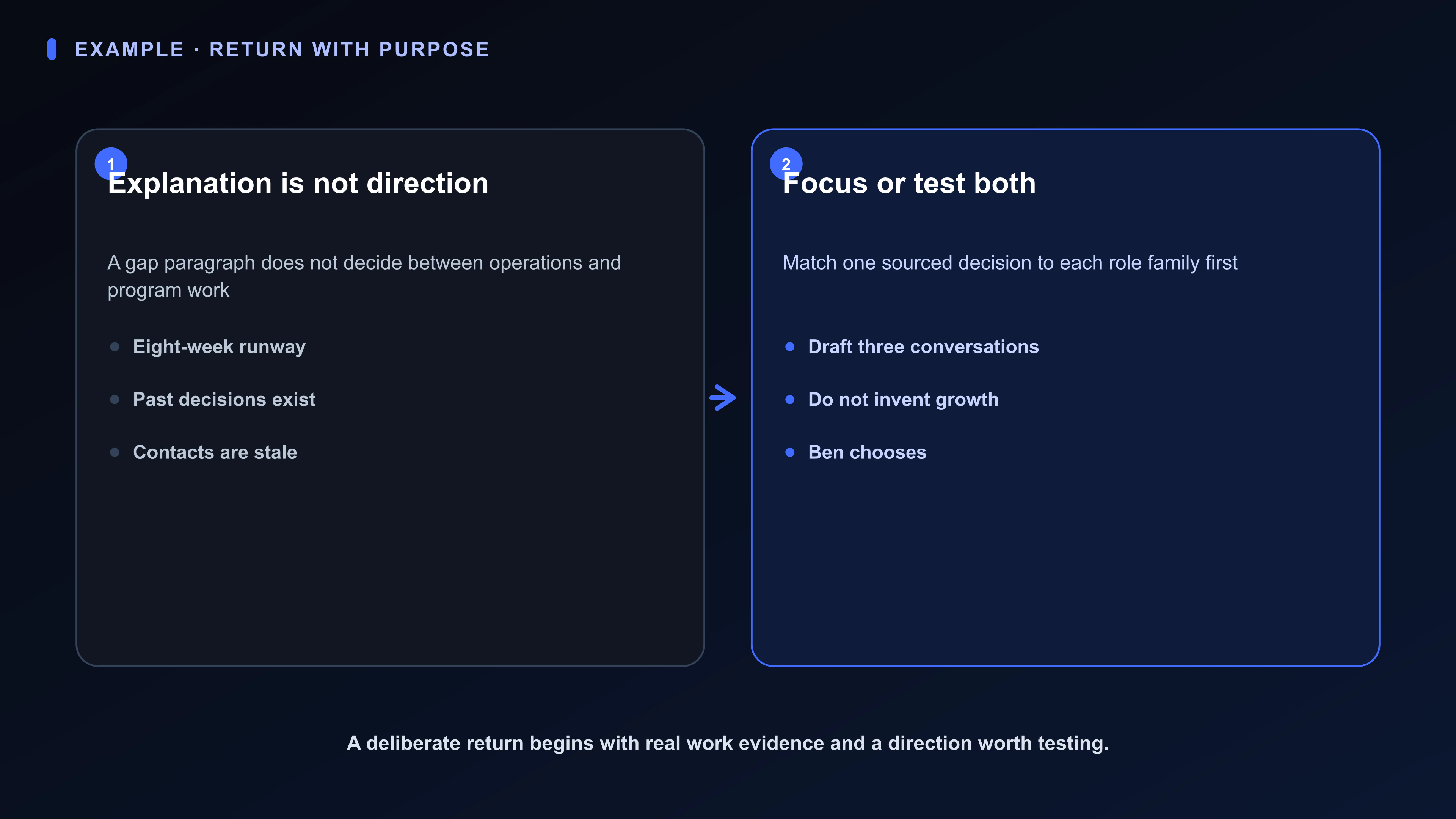
A résumé paragraph can explain why Ben left and still offer no direction for what comes next. He must lead with operations leadership, pursue program roles, or test both paths through three distinct conversations before applying.
Re-enter work through roles that use Ben's operating judgment and respect why the sabbatical happened
The governing promise behind every other List
Hold the mission and boundary: re-enter work through roles that use Ben's operating judgment and respect why the sabbatical happened
Work Ben can actually advance in the current window
Hold the live choice—whether to lead with operations leadership, pursue program roles, or test both through three named conversations before applying—so Ben can decide from the evidence in this Room
Connect one past operating decision, the intentional year, and the role direction Ben is testing
Draft small invitations to Maya in operations, Colin in program delivery, and Renée who changed between both
Match one sourced operating decision to operations leadership and one to program work
Sabbatical truths, current runway, past operating decisions, and facts about operations and program roles
Keep the three factual sabbatical truths separate from apology or invented growth claims
Hold the decisions and consequences Ben can truthfully carry into a forward-looking story
Name the two role families without pretending either path is already chosen
Name the operations-specific question Ben could ask a stale former peer
Name the program-specific question Ben could ask a stale former collaborator
Name the comparison question only someone who changed paths can answer
Keep Ben's present timebox beside the choice to focus or test both
In You.one’s Superboard view, the Return with purpose Board keeps the return rule, role paths, factual story evidence, invitations Ben may send, and real replies separate.
Open Operations, programs, or test both as the Room with the Return-story brief and one past operating decision matched to each role family.
After an explicit request, Ava can compare only the visible evidence but cannot invent growth, contact anyone, apply, or choose the story. Ben owns the narrative, invitations, applications, and search direction.
Return with purpose has one live choice: Operations, programs, or test both
This Board has one job: Re-enter work through roles that use Ben's operating judgment and respect why the sabbatical happened.
The decision still belongs to Ben: Whether to lead with operations leadership, pursue program roles, or test both through three named conversations before applying.
You.one can keep the work, evidence, and “Operations, programs, or test both” decision visible through its Superboard view. Authority does not move to the software: Ben chooses operations, programs, or test both, drafts his story and outreach, and owns every request. Other people own whether to reply.
Available today
Return with purpose: one place for the mission
The Return with purpose Board gives this mission one durable operating picture. Ben can use familiar language instead of translating the situation into project-management jargon. Its three Lists separate the kinds of attention this situation actually requires.
The Board is not a master task list. It keeps the live choice, the facts that could change it, and any reply or outside event already in motion visible without pretending every uncertainty is work in progress.
Swipe or scroll sideways to see every column.
| List | What belongs here |
|---|---|
| Return rule | The governing promise behind every other List |
| Paths to compare | Work Ben can actually advance in the current window |
| Story evidence | Sabbatical truths, current runway, past operating decisions, and facts about operations and program roles |
Available today
Cards that sound like the real work
These Card titles come directly from Ben's situation: “Operations, programs, or test both” is the live choice, “Three truths: the year was intentional, savings funded it, and the return is deliberate” holds evidence, and “Draft invitations to Maya, Colin, and Renée” is still work Ben controls—not something already awaiting another person. The point is recognition, not a perfect taxonomy.
Swipe or scroll sideways to see every column.
| Card | List | Job |
|---|---|---|
| Return with purpose | Return rule | Hold the mission and boundary: re-enter work through roles that use Ben's operating judgment and respect why the sabbatical happened |
| Operations, programs, or test both | Paths to compare | Hold the live choice—whether to lead with operations leadership, pursue program roles, or test both through three named conversations before applying—so Ben can decide from the evidence in this Room |
| Three truths: the year was intentional, savings funded it, and the return is deliberate | Story evidence | Keep the three factual sabbatical truths separate from apology or invented growth claims |
| Draft the forward story | Paths to compare | Connect one past operating decision, the intentional year, and the role direction Ben is testing |
| Draft invitations to Maya, Colin, and Renée | Paths to compare | Draft small invitations to Maya in operations, Colin in program delivery, and Renée who changed between both |
| Match one past operating decision to each role family | Paths to compare | Match one sourced operating decision to operations leadership and one to program work |
| Past operating evidence | Story evidence | Hold the decisions and consequences Ben can truthfully carry into a forward-looking story |
| Operations vs programs role families | Story evidence | Name the two role families without pretending either path is already chosen |
| Maya: operations leadership | Story evidence | Name the operations-specific question Ben could ask a stale former peer |
| Colin: program delivery | Story evidence | Name the program-specific question Ben could ask a stale former collaborator |
| Renée: moved between both | Story evidence | Name the comparison question only someone who changed paths can answer |
| Current search runway: eight weeks | Story evidence | Keep Ben's present timebox beside the choice to focus or test both |
Available today
Keep the evidence with “Operations, programs, or test both”
Opening the Card gives the visible item durable depth. Stage can hold Return-story brief: Place past operating evidence, the intentional year, the savings-backed eight-week runway, the deliberate return, and the operations-versus-programs choice together. Live choice: Whether to lead with operations leadership, pursue program roles, or test both through three named conversations before applying. Chat keeps the request and response beside that artifact instead of in a detached thread. Notifications can bring this update forward: “Open decision: Ben will decide whether to lead with operations leadership, pursue program roles, or test both through three named conversations before applying.”
A Card Chat request can ask Ava to prepare the specific comparison or extraction in “Operations, programs, or test both” from the visible evidence. Ava can work from the context Ben deliberately brings into this Card, List, or Board; she cannot monitor the rest of life, contact anyone, or inherit the decision.
Ben's call remains explicit: Ben chooses operations, programs, or test both, drafts his story and outreach, and owns every request. Other people own whether to reply.
Swipe or scroll sideways to see every column.
| Surface | Job in this example |
|---|---|
| Stage | Return-story brief: Place past operating evidence, the intentional year, the savings-backed eight-week runway, the deliberate return, and the operations-versus-programs choice together. Live choice: Whether to lead with operations leadership, pursue program roles, or test both through three named conversations before applying |
| Chat | Keep Ben's request and Ava's attributed response with the work |
| Notifications | Open decision: Ben will decide whether to lead with operations leadership, pursue program roles, or test both through three named conversations before applying |
Start small and rename what feels artificial
Ben should rename every List or Card that feels artificial. This recipe succeeds when “Operations, programs, or test both” becomes easier to decide and fewer open loops depend on memory—not when the Board looks tidy.
Swipe or scroll sideways to see every column.
| Step | Action |
|---|---|
| 1. State the year plainly | Keep the intentional year, savings runway, and deliberate return factual |
| 2. Bring forward real work | Match one past operating decision to operations and one to program work |
| 3. Compare the two role families | Name what each path uses and what remains untested |
| 4. Draft three small conversations | Write distinct perspective requests for Maya, Colin, and Renée without calling them applications |
| 5. Operations, programs, or test both | Review the evidence before the first invitation or any panic application |
A résumé gap paragraph can remain part of the system
A résumé gap paragraph can be enough while the situation stays simple: the eight-week runway is stable and operations-versus-programs facts are clear enough that three named conversations would not change the path.
It starts to break when the three factual sabbatical truths, past operating evidence, two role families, and unanswered conversation invitations must inform the same choice.
The Return with purpose Board earns its place only when the familiar tool—a résumé gap paragraph—can no longer keep the reason, Return-story brief, conversation, current state, decision, and history connected.
Where this example stops
- This is a fictional example, not a customer story.
- This fictional example is not employment, hiring, financial, mental-health, or career-transition advice; the person owns their story, outreach, timing, and role choice.
- It does not show Ava completing external actions or contacting anyone for Ben.
- It does not report a measured result, and this Board is a starting shape to adapt—not a universal prescription.