
Example
How to rebuild a résumé from evidence when the old bullets sound generic
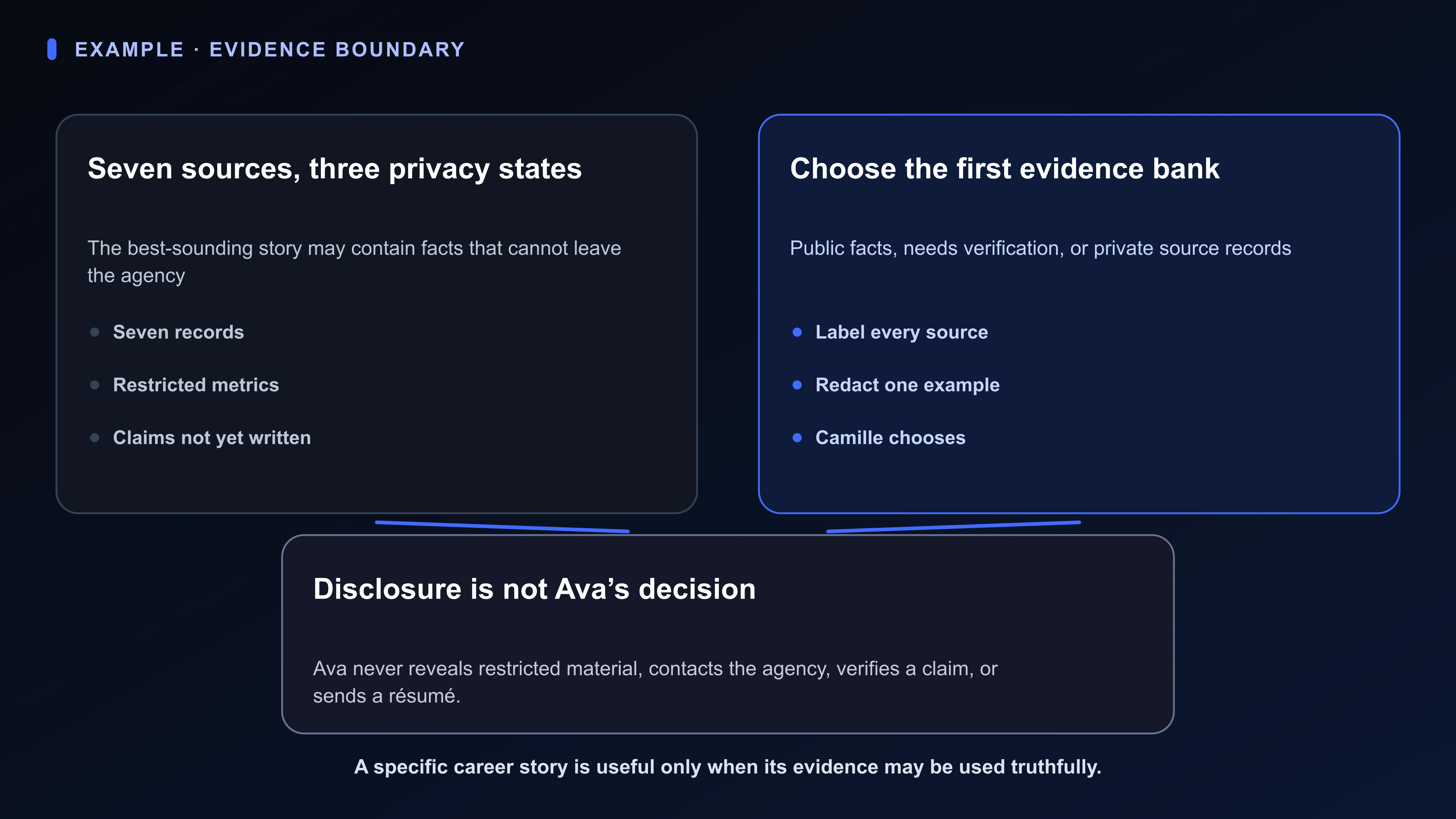
Camille’s two reviews, two project briefs, two thank-you emails, and vendor-recovery memo contain stronger work stories than her old résumé, but they do not share one disclosure boundary. She must build the public, verification, or private bank first while restricted agency metrics stay out.
Build a truthful evidence file that produces specific résumé stories without leaking restricted information
The promise and limits Camille is protecting
Hold the mission and boundary: build a truthful evidence file that produces specific résumé stories without leaking restricted information
Choices and actions Camille can move without pretending every fact or outside wait is owned work
Hold the live choice—whether to build the public-facts bank, employer-verification bank, or private-source bank first—so Camille can decide from the evidence in this Room
Write a vendor-recovery claim using only public action and consequence, with restricted metrics omitted
Draft one agency disclosure question and one former-colleague verification question
Label every source public, needs verification, or private before writing résumé bullets
Source facts, observations, and artifacts that can change “Public, verification, or private bank first”
List the seven source files and mark the privacy boundary still unknown for each
Record only the public facts and mark restricted metrics
Separate Camille's decision from agency-confidential implementation detail
Identify what a former colleague could verify without disclosing restricted material
The Career evidence rebuild Board keeps the evidence rule, sorting and redaction, source records, questions Camille may draft, and material ready for résumé use distinct.
Open Public, verification, or private bank first as the Room with the Evidence-boundary brief and every source labeled before a bullet is written.
Ava can compare only the visible, permitted notes. Camille owns redaction, claims, requests, and outreach; her agency owns disclosure permission, and Ava never reveals or sends restricted material.
Career evidence rebuild has one live choice: Public, verification, or private bank first
What belongs together is specific: Build a truthful evidence file that produces specific résumé stories without leaking restricted information.
The consequential judgment remains human: Whether to build the public-facts bank, employer-verification bank, or private-source bank first.
You.one can keep the work, evidence, and “Public, verification, or private bank first” decision visible through its Superboard view. Authority does not move to the software: Camille chooses which evidence bank to build first, redacts the examples, and owns every résumé claim and verification request. Her agency owns what may be disclosed.
What changes after an old résumé
An old résumé can be enough while the situation stays simple: “Draft a public action-and-consequence note for vendor recovery” and “Draft agency-disclosure and colleague-verification requests” no longer change the “Public, verification, or private bank first” choice.
It starts to break when “Seven sources: two reviews, two project briefs, two thank-you emails, and one vendor-recovery memo” and “Draft agency-disclosure and colleague-verification requests” must inform the same choice.
The Career evidence rebuild Board earns its place only when the familiar tool—an old résumé—can no longer keep the reason, Evidence-boundary brief, conversation, current state, decision, and history connected.
Available today
A focused Career evidence rebuild Board
The Career evidence rebuild Board gives this mission one durable operating picture. Camille can use familiar language instead of translating the situation into project-management jargon. Its three Lists separate the kinds of attention this situation actually requires.
The point is a fast scan: what is moving, what is known, what is unresolved, and what Camille must choose. Questions not yet asked stay with Camille; they do not move to a list for outside replies.
Swipe or scroll sideways to see every column.
| List | What belongs here |
|---|---|
| Evidence rule | The promise and limits Camille is protecting |
| Sorting and redaction | Choices and actions Camille can move without pretending every fact or outside wait is owned work |
| Source records | Source facts, observations, and artifacts that can change “Public, verification, or private bank first” |
Available today
Inside the “Public, verification, or private bank first” Room
Opening the Card gives the visible item durable depth. Stage can hold Evidence-boundary brief: Place the seven sources beside the public / needs-verification / private boundaries and the next-role evidence they could support. Live choice: Whether to build the public-facts bank, employer-verification bank, or private-source bank first. Chat keeps the request and response beside that artifact instead of in a detached thread. Notifications can bring this update forward: “Open decision: Camille will decide whether to build the public-facts bank, employer-verification bank, or private-source bank first.”
A Card Chat request can ask Ava to prepare the specific comparison or extraction in “Public, verification, or private bank first” from the visible evidence. Ava can work from the context Camille deliberately brings into this Card, List, or Board; she cannot monitor the rest of life, contact anyone, or inherit the decision.
Camille's call remains explicit: Camille chooses which evidence bank to build first, redacts the examples, and owns every résumé claim and verification request. Her agency owns what may be disclosed.
Swipe or scroll sideways to see every column.
| Surface | Job in this example |
|---|---|
| Stage | Evidence-boundary brief: Place the seven sources beside the public / needs-verification / private boundaries and the next-role evidence they could support. Live choice: Whether to build the public-facts bank, employer-verification bank, or private-source bank first |
| Chat | Keep Camille's request and Ava's attributed response with the work |
| Notifications | Open decision: Camille will decide whether to build the public-facts bank, employer-verification bank, or private-source bank first |
What Ava can prepare from visible context
These requests stay with the facts Camille has made visible around “Public, verification, or private bank first.” Camille supplies the evidence, checks Ava's work, and decides what belongs in the Room.
Current Ava can prepare help after an explicit request. She cannot make the choice, represent Camille, watch other work on her own, or contact anyone.
Camille chooses which evidence bank to build first, redacts the examples, and owns every résumé claim and verification request. Her agency owns what may be disclosed. Ava compares only evidence in the choice Card Room and does not contact anyone, disclose restricted material, or decide.
Camille finishes “Label each of the seven sources public, needs verification, or private,” keeps “Seven sources: two reviews, two project briefs, two thank-you emails, and one vendor-recovery memo” beside “Public, verification, or private bank first,” and does not treat “Draft agency-disclosure and colleague-verification requests” as completed or sent before doing the work.
- Request idea: using only this Card Room and the Evidence-boundary brief, compare building the public-facts, employer-verification, or private-source bank first. Keep restricted evidence private, name what remains unverified, and leave every résumé claim to me.
- Request idea: use only the Evidence-boundary brief and notes the Owner has placed in this Card Room to separate facts, assumptions, and unanswered questions
- Request idea: from “Public, verification, or private bank first,” draft a short decision note and name Camille as the decider
A starter shape, not a prescribed workflow
Camille should rename every List or Card that feels artificial. This recipe succeeds when “Public, verification, or private bank first” becomes easier to decide and fewer open loops depend on memory—not when the Board looks tidy.
Swipe or scroll sideways to see every column.
| Step | Action |
|---|---|
| 1. Name all seven sources | Keep reviews, briefs, thank-you emails, and the recovery memo as separate records |
| 2. Sort by disclosure boundary | Label each source public, needs verification, or private |
| 3. Redact one real example | Remove restricted metrics before drafting résumé language |
| 4. Draft two different questions | Ask the agency about disclosure and a former colleague about verification |
| 5. Public, verification, or private bank first | Choose public facts, verification work, or private source records without choosing a lead story |
Where this example stops
- This is a fictional example, not a customer story.
- This fictional example is not employment, hiring, privacy, records, disclosure, or career-search advice; Camille verifies what may leave the agency and owns every résumé claim, verification request, and outreach.
- It does not show Ava completing external actions or contacting anyone for Camille.
- It does not report a measured result, and this Board is a starting shape to adapt—not a universal prescription.