
Example
How a primary caregiver can make the load visible before it becomes the whole life
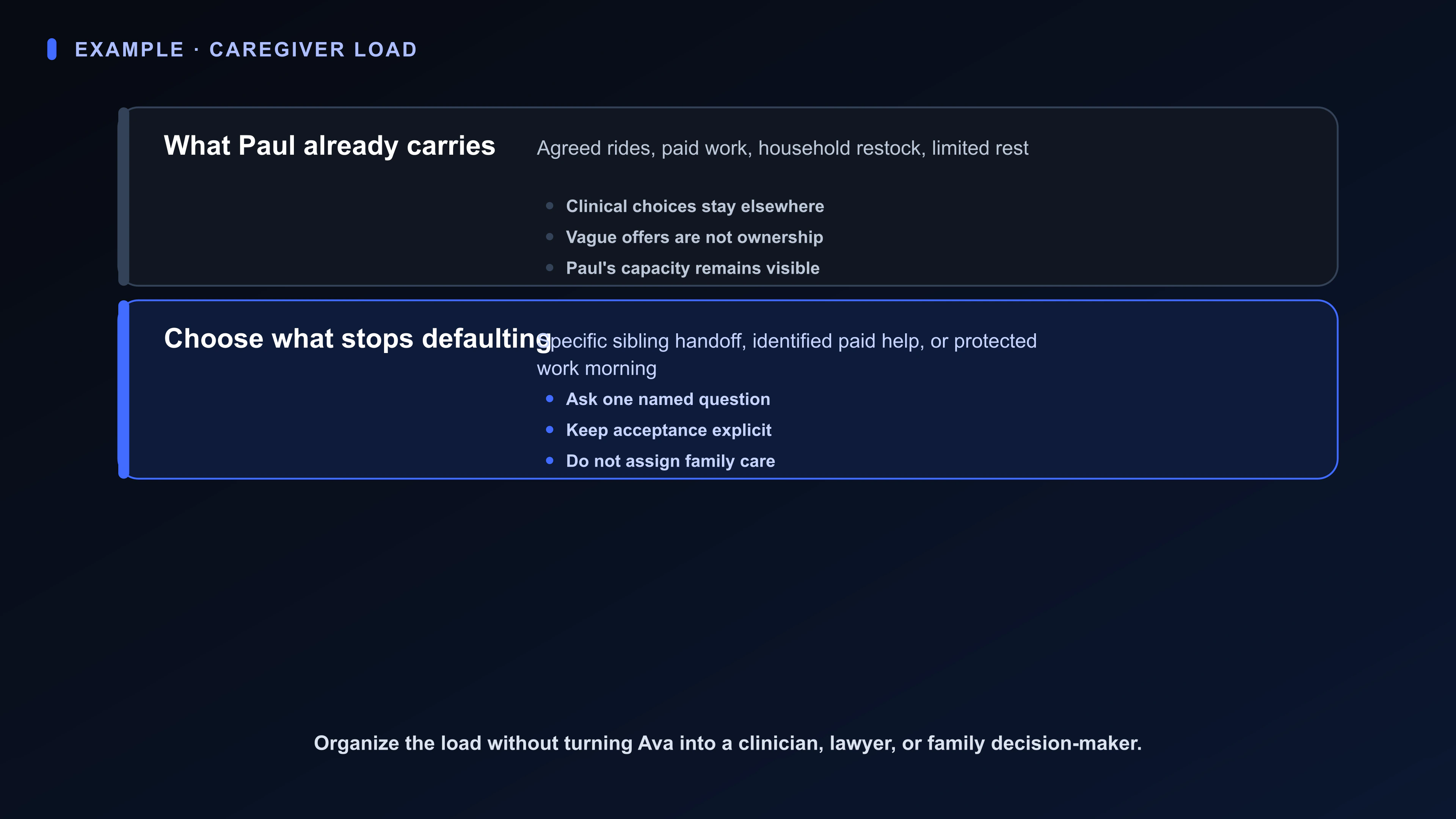
Paul is already carrying agreed rides and a full-time job. The consequential decision is which non-clinical load stops defaulting to him: a specific sibling handoff, paid household help the family has identified, or one protected Thursday work morning.
Make six weeks of non-clinical caregiving work and Paul’s real capacity visible so he can keep helping without becoming the only system
Keep Paul helpful without making him the invisible operating system
Keep Paul’s capacity visible while care authority stays with people and clinicians
Rides and presence already agreed by the family and clinicians
Keep one already-agreed ride visible without turning it into clinical instruction
Work, sleep, and commitments that are real constraints
Treat paid work as a real constraint rather than the first thing erased
Groceries, mail, forms, vague offers, and household work another person could own
Compare a sibling handoff, paid household help, and one protected work morning
Name recurring household work that does not require Paul specifically
Keep the vague offer as a hand-off candidate until Paul sends a specific request and the sibling accepts
Keep the family’s existing paid-help option visible without implying anyone has been hired
The Six-week caregiver load Board separates agreed logistics, Paul's real capacity, and household work another person could own without turning family support into care advice.
The Choose what Paul stops carrying Room holds the sibling, paid-help, and protected-morning options with the actual work and sleep constraints.
Ava can compare the organizational facts Paul provides. She cannot give medical, legal, or financial advice, contact relatives or clinicians, assign care, or decide what the family accepts.
Being reliable cannot mean becoming the invisible system
This Board has one job: Make six weeks of non-clinical caregiving work and Paul’s real capacity visible so he can keep helping without becoming the only system.
The decision still belongs to Paul: Whether Paul asks the sibling to own paperwork, uses the identified paid household help for groceries and restock, or asks work to protect one fixed morning while keeping the rest.
You.one can keep the work, evidence, and “Choose what Paul stops carrying” decision visible through its Superboard view. Authority does not move to the software: Paul chooses what to request, and the family owns every handoff plus all care, medical, legal, employment, and financial decisions.
Available today
Six-week caregiver load: one place for the mission
The Six-week caregiver load Board gives this mission one durable operating picture. Paul can use familiar language instead of translating the situation into project-management jargon. Its four Lists separate the kinds of attention this situation actually requires.
The Board is not a master task list. It keeps the live choice, the facts that could change it, and any reply or outside event already in motion visible without pretending every uncertainty is work in progress.
Swipe or scroll sideways to see every column.
| List | What belongs here |
|---|---|
| Mission | Keep Paul helpful without making him the invisible operating system |
| Fixed care logistics | Rides and presence already agreed by the family and clinicians |
| Paul’s capacity | Work, sleep, and commitments that are real constraints |
| Hand-off candidates | Groceries, mail, forms, vague offers, and household work another person could own |
Available today
Cards that sound like the real work
These Card titles come directly from Paul's situation: “Choose what Paul stops carrying” is the live choice, “Tuesday follow-up ride” holds evidence, and “Groceries and household restock” is still work Paul controls—not something already awaiting another person. The point is recognition, not a perfect taxonomy.
Swipe or scroll sideways to see every column.
| Card | List | Job |
|---|---|---|
| Help without becoming the whole system | Mission | Keep Paul’s capacity visible while care authority stays with people and clinicians |
| Choose what Paul stops carrying | Hand-off candidates | Compare a sibling handoff, paid household help, and one protected work morning |
| Tuesday follow-up ride | Fixed care logistics | Keep one already-agreed ride visible without turning it into clinical instruction |
| Thursday morning work review | Paul’s capacity | Treat paid work as a real constraint rather than the first thing erased |
| Groceries and household restock | Hand-off candidates | Name recurring household work that does not require Paul specifically |
| Sibling offered paperwork help, ownership unconfirmed | Hand-off candidates | Keep the vague offer as a hand-off candidate until Paul sends a specific request and the sibling accepts |
| Paid household help already identified | Hand-off candidates | Keep the family’s existing paid-help option visible without implying anyone has been hired |
Available today
Keep the evidence with “Choose what Paul stops carrying”
Opening the Card gives the visible item durable depth. Stage can hold Caregiver-load brief: Place fixed rides, Paul’s work constraints, hand-off candidates, and the sibling-paperwork / paid-groceries-and-restock / protected-Thursday-morning options on one page. Chat keeps the request and response beside that artifact instead of in a detached thread. Notifications can bring this update forward: “Open decision: Paul will choose which non-clinical load he will stop carrying alone.”
A Card Chat request can ask Ava to prepare the specific comparison or extraction in “Choose what Paul stops carrying” from the visible evidence. Ava can work from the context Paul deliberately brings into this Card, List, or Board; she cannot monitor the rest of life, contact anyone, or inherit the decision.
Paul's call remains explicit: Paul chooses what to request, and the family owns every handoff plus all care, medical, legal, employment, and financial decisions.
Swipe or scroll sideways to see every column.
| Surface | Job in this example |
|---|---|
| Stage | Caregiver-load brief: Place fixed rides, Paul’s work constraints, hand-off candidates, and the sibling-paperwork / paid-groceries-and-restock / protected-Thursday-morning options on one page |
| Chat | Keep Paul's request and Ava's attributed response with the work |
| Notifications | Open decision: Paul will choose which non-clinical load he will stop carrying alone |
Start small and rename what feels artificial
Paul should rename every List or Card that feels artificial. This recipe succeeds when “Choose what Paul stops carrying” becomes easier to decide and fewer open loops depend on memory—not when the Board looks tidy.
Swipe or scroll sideways to see every column.
| Step | Action |
|---|---|
| 1. State Paul’s capacity | Work, sleep, and immovable commitments belong on the Board |
| 2. Separate fixed logistics | Record already-agreed rides without turning them into care advice |
| 3. List hand-off candidates | Groceries, forms, mail, and household work |
| 4. Keep vague offers owned | An offer stays on Hand-off candidates until Paul sends a specific request; only then can a reply be Replies already requested |
| 5. Choose what Paul stops carrying | Open one Room for the load Paul will no longer carry alone |
A sibling group text plus Paul’s memory can remain part of the system
A sibling group text plus Paul’s memory can be enough while the situation stays simple: one short-lived errand needs one volunteer.
It starts to break when six weeks of rides, work constraints, household tasks, and vague offers all default to the same person.
The Six-week caregiver load Board earns its place only when the familiar tool—a sibling group text plus Paul’s memory—can no longer keep the reason, Caregiver-load brief, conversation, current state, decision, and history connected.
Where this example stops
- This is a fictional example, not a customer story.
- This is not medical, legal, employment, financial, or care-planning advice, and it is not a substitute for clinicians or authorized decision-makers.
- It does not show Ava contacting relatives, an employer, a household service, or a care office.
- It is not a measured caregiver or health outcome and does not imply the family shares Board access.