
Example
How to set up a first apartment when the mattress, utilities, and roommate are still unsettled
Kira has keys on the 1st, one afternoon of help, a mattress across town, and a friend who may take the second room. The real decision is whether to confirm that friend, reopen the search, or make the first-month plan work solo.
Sleep in the apartment on night one with utilities requested, a bed in the building, and a roommate yes or no that matches the rent plan
Night-one sleep and the rent-split rule
Keep the mattress and keys on the same mission as rent
Mattress, keys, and the parent afternoon
Name the bed that is not yet in the building
Treat limited help as a constraint, not as an open moving company
Utility form, parking, and landlord contacts
Hold the actual artifact the landlord named
Keep the written rent and occupancy terms beside the roommate choice without interpreting them as legal advice
Maybe, confirmed, or solo
Compare confirm-friend, different-roommate, and solo-for-one options
Keep an unconfirmed offer visible without pretending Kira has sent a confirmation request or secured a rent split
Ground the different-roommate path as Kira’s owned option without implying a posting or applicant already exists
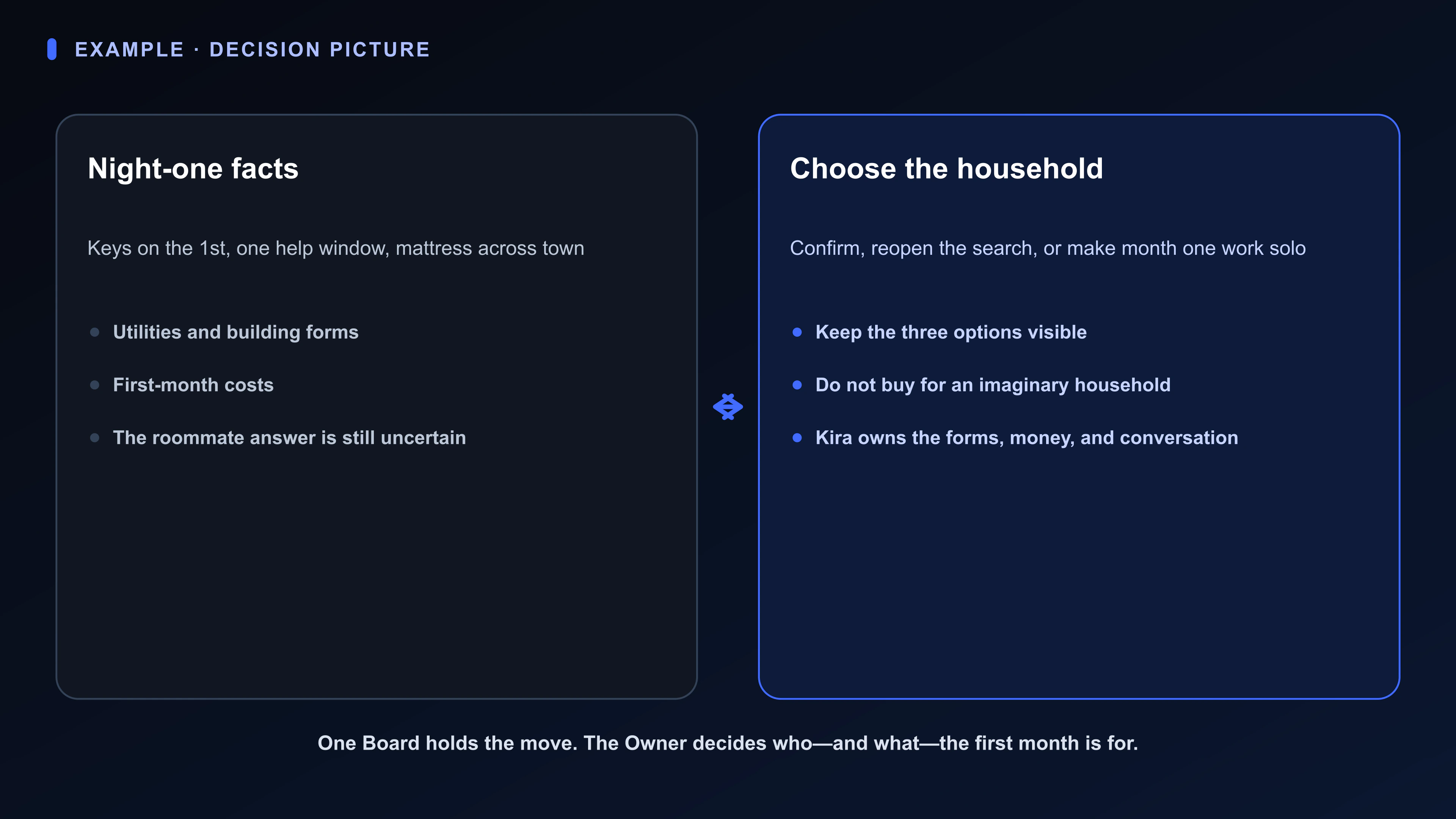
Give the first month one Board for move-in facts, building requirements, costs, and the roommate decision—not one giant shopping list.
Open the Choose roommate or solo Card as a Room so the lease, utility form, help window, rent split, and three real options stay together.
Ava can compare the facts Kira provides. Kira chooses the roommate path, submits every form, spends the money, and has the conversations.
Keys are not a household; a maybe-roommate is not rent split
The mission is specific: Sleep in the apartment on night one with utilities requested, a bed in the building, and a roommate yes or no that matches the rent plan.
The consequential choice is not something a board or an AI should quietly make: Whether to confirm the friend, look for a different roommate, or take the place solo and buy only for one.
You.one can keep the work, evidence, and “Choose roommate or solo” decision visible through its Superboard view. Authority does not move to the software: Kira chooses the roommate path, submits forms, and owns rent and conversations.
Available today
First month in the apartment: the working map
The First month in the apartment Board gives this mission one durable operating picture. Kira can use familiar language instead of translating the situation into project-management jargon. Its four Lists separate the kinds of attention this situation actually requires.
The Lists separate what Kira can move now, what is evidence, what is already waiting on a named person or event, and what still needs a decision.
Swipe or scroll sideways to see every column.
| List | What belongs here |
|---|---|
| Mission | Night-one sleep and the rent-split rule |
| Move-in | Mattress, keys, and the parent afternoon |
| Building | Utility form, parking, and landlord contacts |
| Roommate | Maybe, confirmed, or solo |
Available today
Open one decision: Choose roommate or solo
Opening the Card gives the visible item durable depth. Stage can hold Rent-split brief: Place the lease, the unconfirmed roommate answer, and the confirm / other-roommate / solo options on one page. Chat keeps the request and response beside that artifact instead of in a detached thread. Notifications can bring this update forward: “Open decision: Kira will choose whether rent is split.”
A Card Chat request can ask Ava to prepare the specific comparison or extraction in “Choose roommate or solo” from the visible evidence. Ava can work from the context Kira deliberately brings into this Card, List, or Board; she cannot monitor the rest of life, contact anyone, or inherit the decision.
Kira's call remains explicit: Kira chooses the roommate path, submits forms, and owns rent and conversations.
Swipe or scroll sideways to see every column.
| Surface | Job in this example |
|---|---|
| Stage | Rent-split brief: Place the lease, the unconfirmed roommate answer, and the confirm / other-roommate / solo options on one page |
| Chat | Keep Kira's request and Ava's attributed response with the work |
| Notifications | Open decision: Kira will choose whether rent is split |
Useful Ava requests, with the boundary intact
These requests stay with the facts Kira has made visible around “Choose roommate or solo.” Kira supplies the evidence, checks Ava's work, and decides what belongs in the Room.
Current Ava can prepare help after an explicit request. She cannot make the choice, represent Kira, watch other work on her own, or contact anyone.
Kira owns the lease, forms, and roommate conversations. Ava does not contact a landlord, submit utilities, or give legal or financial advice.
A night-one picture: the mattress has a move job, the utility form is listed, and an unconfirmed offer is no longer treated as a rent plan.
- Request idea: using only the context visible in this Card Room, compare confirming the friend, finding another roommate, and taking the place solo. Do not message anyone or choose for me.
- Request idea: use only the Rent-split brief and notes the Owner has placed in this Card Room to separate facts, assumptions, and unanswered questions
- Request idea: in “Choose roommate or solo,” show which visible fact could reverse the current choice
The limit of a lease PDF plus a group chat
A lease PDF plus a group chat can be enough while the situation stays simple: the roommate is signed and the bed is in the room.
It starts to break when an unconfirmed roommate answer, a mattress across town, and a one-afternoon helper share the 1st.
The First month in the apartment Board earns its place only when the familiar tool—a lease PDF plus a group chat—can no longer keep the reason, Rent-split brief, conversation, current state, decision, and history connected.
A practical way to start the First month in the apartment Board
Kira should rename every List or Card that feels artificial. This recipe succeeds when “Choose roommate or solo” becomes easier to decide and fewer open loops depend on memory—not when the Board looks tidy.
Swipe or scroll sideways to see every column.
| Step | Action |
|---|---|
| 1. Define night one | Bed, keys, lights |
| 2. Card the limited help | One afternoon is finite |
| 3. List building forms | Utilities as written |
| 4. Keep the roommate answer owned | The unconfirmed offer stays with Kira until she sends a confirmation request |
| 5. Choose roommate or solo | Open a Room before buying two of everything |
Where this example stops
- This is a fictional example, not a customer story.
- This is not legal, landlord-tenant, or financial advice.
- It does not show Ava contacting a landlord or submitting utility forms.
- It is not a measured move-in result.