
Example
How to run a community-garden season without losing plots or water days
Rosa's committee must choose how plots 14, 17, and 19 work without erasing informal use or treating unconfirmed waitlist replies as assignments. Water access and this year's heat belong in the same choice.
Open the season with claimed plots, a watering rotation that matches heat, and chores that do not live only in the shed
Open date, plot count, and water access
Keep the bib beside opening day
Claimed, unclaimed, and informal use
Compare assigning 14, 17, and 19 on confirmation; sharing 14 while assigning 17 and 19; or leaving all three unassigned until the bib is fixed
Show that the informal use of plot 14 occupies one of the three plots already offered to the waitlist
Name the undocumented kindness so it can be decided
Water days and seasonal work
Replace cooler-evening assumptions with this year’s forecast
Hose-bib washer and water access
Hold a leak that last year’s rotation did not know about
Replies from people offered unclaimed plots
Keep unconfirmed claims from filling the map
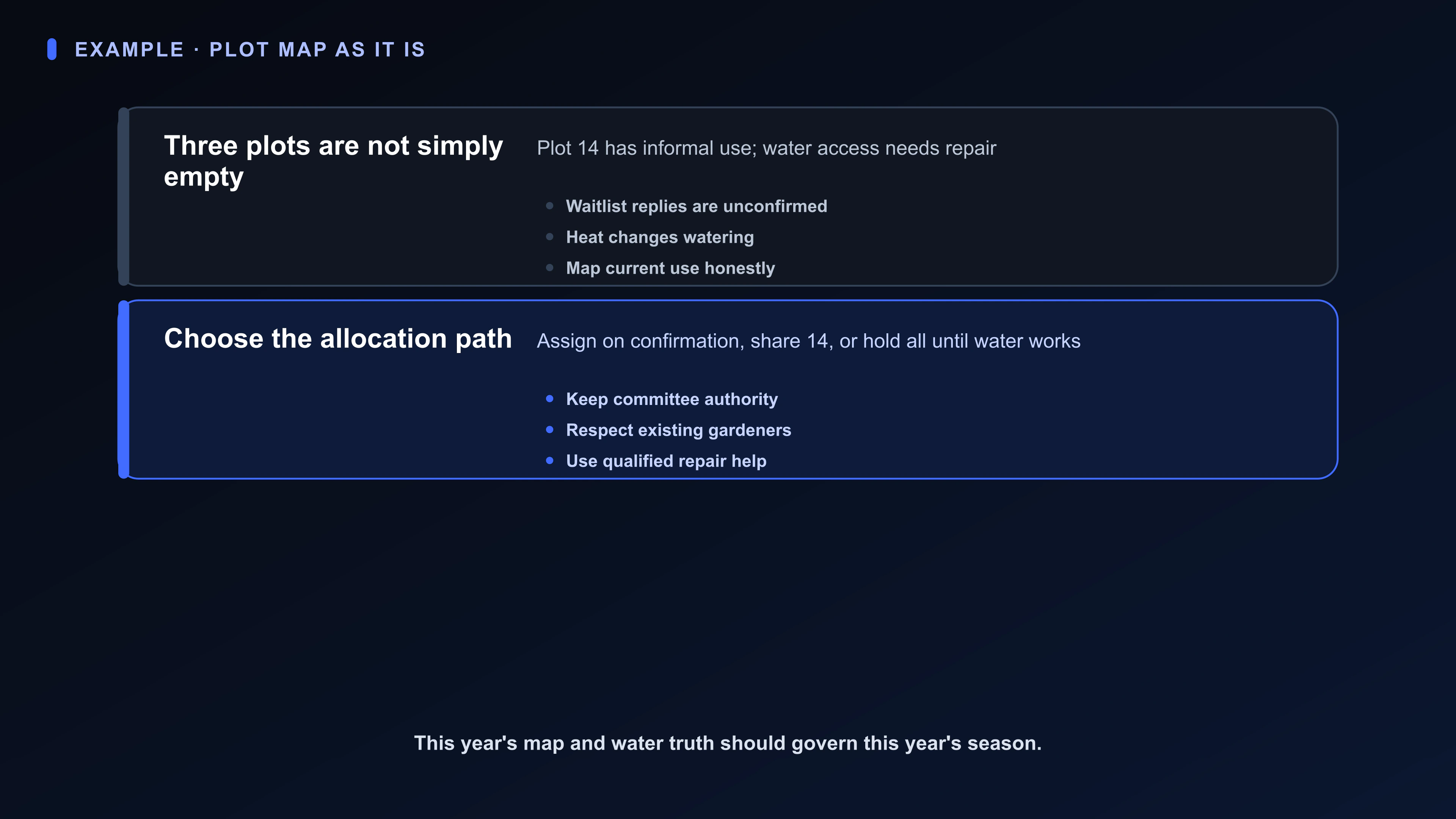
The Garden season Board maps real plot use, water access, seasonal chores, offers already made, and replies still open to the committee.
The Plot-path Room compares assigning on confirmation, sharing plot 14, or holding all three plots until the bib is repaired.
Ava can organize the facts the committee records. Rosa and the committee decide plots and rules; gardeners own their participation, and qualified people handle real repairs and safety.
Three unclaimed plots, informal use of plot 14, and a broken bib are one choice
The work has a clear center: Open the season with claimed plots, a watering rotation that matches heat, and chores that do not live only in the shed.
Organizing the evidence does not authorize the software to decide: Whether to assign plots 14, 17, and 19 only as waitlist replies confirm; make plot 14 the shared extra and assign 17 and 19 on confirmation; or leave all three unassigned, including ending informal use of 14, until the bib is fixed.
You.one can keep the work, evidence, anything already waiting on another person or event, and the “Choose unclaimed plots” decision visible through its Superboard view. Rosa still owns the call: The committee chooses plots; Rosa owns messages, repairs, and water days.
Available today
Name the work in plain language
These Card titles come directly from Rosa's situation: “Choose unclaimed plots” is the live choice, “Three unclaimed plots: 14, 17, and 19” holds evidence, and “Waitlist replies on plots” names something genuinely in motion outside Rosa's control. The point is recognition, not a perfect taxonomy.
Swipe or scroll sideways to see every column.
| Card | List | Job |
|---|---|---|
| Twenty plots, water that works | Mission | Keep the bib beside opening day |
| Choose unclaimed plots | Plots | Compare assigning 14, 17, and 19 on confirmation; sharing 14 while assigning 17 and 19; or leaving all three unassigned until the bib is fixed |
| Three unclaimed plots: 14, 17, and 19 | Plots | Show that the informal use of plot 14 occupies one of the three plots already offered to the waitlist |
| Informal use of plot 14 | Plots | Name the undocumented kindness so it can be decided |
| Hose bib washer | Repairs | Hold a leak that last year’s rotation did not know about |
| Heat-week watering | Chores | Replace cooler-evening assumptions with this year’s forecast |
| Waitlist replies on plots | Replies already requested | Keep unconfirmed claims from filling the map |
Available today
Garden season: separate the kinds of attention
The Garden season Board gives this mission one durable operating picture. Rosa can use familiar language instead of translating the situation into project-management jargon. Its five Lists separate the kinds of attention this situation actually requires.
The Lists use Rosa's own language so actions, evidence, open questions, and decisions do not collapse into one queue. A separate place for replies is useful only after Rosa has asked someone or a real outside event must happen first.
Swipe or scroll sideways to see every column.
| List | What belongs here |
|---|---|
| Mission | Open date, plot count, and water access |
| Plots | Claimed, unclaimed, and informal use |
| Chores | Water days and seasonal work |
| Repairs | Hose-bib washer and water access |
| Replies already requested | Replies from people offered unclaimed plots |
Ask Ava to prepare the judgment—not make it
These requests stay with the facts Rosa has made visible around “Choose unclaimed plots.” Rosa supplies the evidence, checks Ava's work, and decides what belongs in the Room.
Current Ava can prepare help after an explicit request. She cannot make the choice, represent Rosa, watch other work on her own, or contact anyone.
The committee chooses plot assignments; Rosa owns messages, repairs, and water days. Ava does not contact gardeners, buy parts, or manage the lot.
A season map: plot 14 is a decision, the bib is a repair, and watering matches heat rather than last year’s evenings.
- Request idea: using only the context visible in this Card Room, compare assigning plots 14, 17, and 19 only as replies confirm; keeping plot 14 shared while assigning 17 and 19 on confirmation; and leaving all three unassigned, including ending informal use of 14, until the bib is fixed. Do not message gardeners or choose for me.
- Request idea: use only the Plot-path brief and notes the Owner has placed in this Card Room to separate facts, assumptions, and unanswered questions
- Request idea: in “Choose unclaimed plots,” group the visible evidence by option and leave the decision open
Available today
One Card Room for the consequential choice
Opening the Card gives the visible item durable depth. Stage can hold Plot-path brief: Place bib repair, informal use of 14, replies for plots 14, 17, and 19, and the three explicit plot paths on one page. Chat keeps the request and response beside that artifact instead of in a detached thread. Notifications can bring this update forward: “Open decision: Rosa’s committee will choose how unclaimed plots work.”
A Card Chat request can ask Ava to prepare the specific comparison or extraction in “Choose unclaimed plots” from the visible evidence. Ava can work from the context Rosa deliberately brings into this Card, List, or Board; she cannot monitor the rest of life, contact anyone, or inherit the decision.
Rosa's call remains explicit: The committee chooses plots; Rosa owns messages, repairs, and water days.
Swipe or scroll sideways to see every column.
| Surface | Job in this example |
|---|---|
| Stage | Plot-path brief: Place bib repair, informal use of 14, replies for plots 14, 17, and 19, and the three explicit plot paths on one page |
| Chat | Keep Rosa's request and Ava's attributed response with the work |
| Notifications | Open decision: Rosa’s committee will choose how unclaimed plots work |
Build only enough Board to make the next decision
Rosa should rename every List or Card that feels artificial. This recipe succeeds when “Choose unclaimed plots” becomes easier to decide and fewer open loops depend on memory—not when the Board looks tidy.
Swipe or scroll sideways to see every column.
| Step | Action |
|---|---|
| 1. Map plots as they are | Including informal use |
| 2. Card repairs | Water access first |
| 3. Rewrite chores for this year | Heat is not last year’s notebook |
| 4. Park waitlist replies | Unconfirmed claims stay Replies already requested |
| 5. Choose unclaimed plots | Open a Room before kindness becomes a quiet fight |
Where this example stops
- This is a fictional example, not a customer story.
- This is not horticultural, water-use, or legal advice.
- It does not show Ava messaging gardeners or repairing hardware.
- It is not a measured harvest result.