
Example
How a neighborhood association can run a project without losing it in meeting minutes
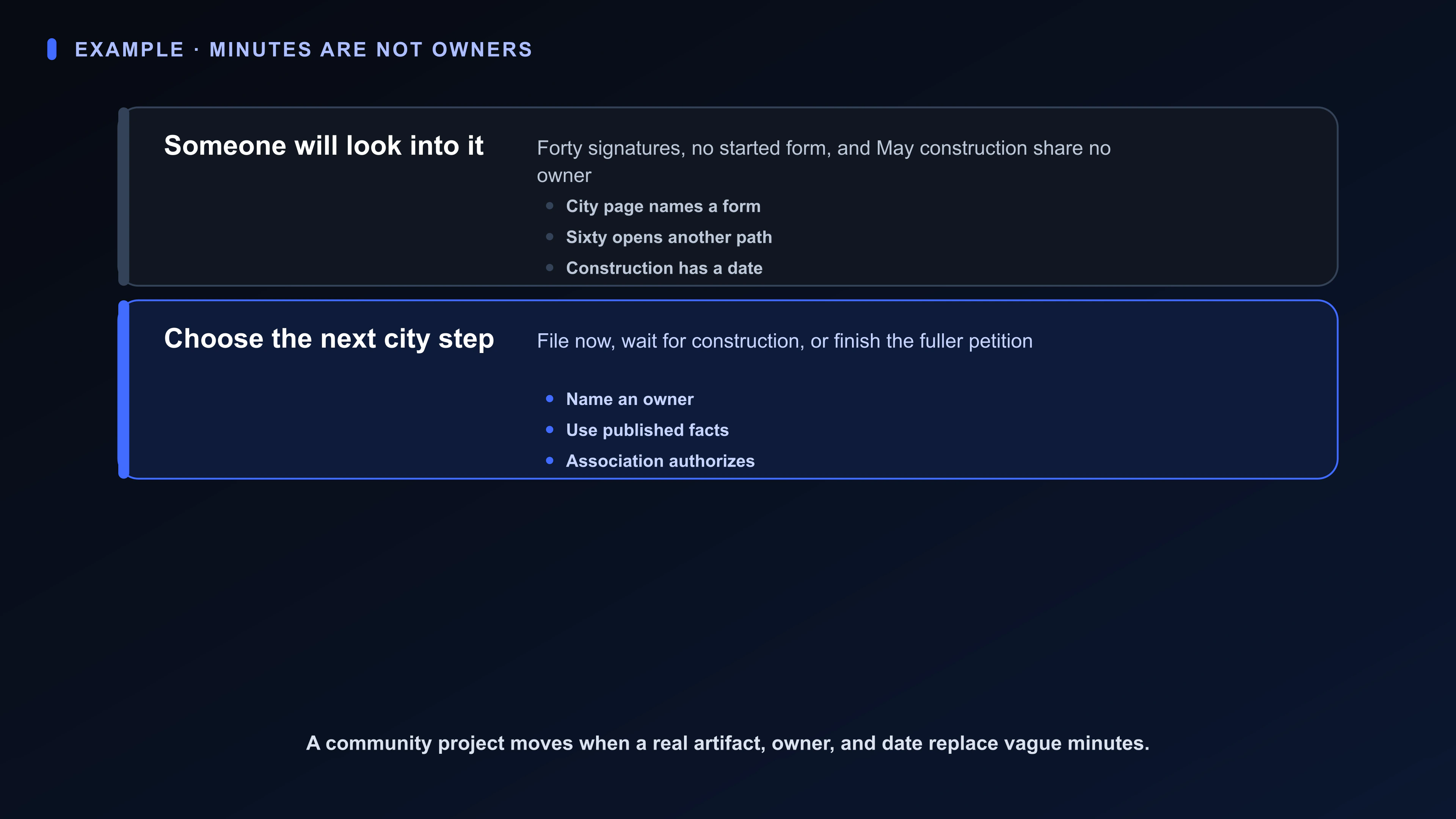
Harold’s association has enthusiasm and a petition, but ‘someone will look into it’ has no owner and no form. The group must file now, wait until construction ends, or spend a month completing the fuller petition path the city page describes.
Move the crosswalk from minutes to a named owner, a real city step, and a date that does not collide with May construction
What done means and the May construction constraint
Keep May closure beside the enthusiasm of forty signatures
Keep a dated constraint from living only on a lamp-post flyer
Named owners, not minutes language
Replace an unnamed task with an owner or park it
Forms and meetings as written on the city page
Compare file-now, wait-for-May, and petition-more options
Hold the actual next artifact
Ground the fuller-petition option in the threshold the city actually published
Petition, photos, and outreach
Count what exists without pretending it was submitted
The Crosswalk project Board separates the mission, named people, city steps, neighbor work, and the dated construction constraint.
Open Choose file, wait, or fuller petition as a Room with the city’s own steps and dates.
Ava can compare captured process facts without giving municipal, traffic-engineering, or legal advice. The association owns assignments, outreach, filings, and every government contact.
Minutes are not owners; a petition is not a submitted form
The mission is specific: Move the crosswalk from minutes to a named owner, a real city step, and a date that does not collide with May construction.
The consequential choice is not something a board or an AI should quietly make: Whether to file the city form now, wait until after construction, or spend the next month finishing a fuller petition the city page also mentions.
You.one can keep the work, evidence, and “Choose file, wait, or fuller petition” decision visible through its Superboard view. Authority does not move to the software: The association chooses the step and owns any filing and neighbor work; Harold prepares the material and files only if the association designates him.
Available today
Crosswalk project: the working map
The Crosswalk project Board gives this mission one durable operating picture. Harold can use familiar language instead of translating the situation into project-management jargon. Its four Lists separate the kinds of attention this situation actually requires.
The Lists separate what Harold can move now, what is evidence, what is already waiting on a named person or event, and what still needs a decision.
Swipe or scroll sideways to see every column.
| List | What belongs here |
|---|---|
| Mission | What done means and the May construction constraint |
| People and commitments | Named owners, not minutes language |
| City steps | Forms and meetings as written on the city page |
| Neighbor work | Petition, photos, and outreach |
Available today
Open one decision: Choose file, wait, or fuller petition
Opening the Card gives the visible item durable depth. Stage can hold City-step brief: Place May construction, the unstarted form, the forty-signature petition, the city's sixty-signature petition path, and file / wait / petition-more options on one page. Chat keeps the request and response beside that artifact instead of in a detached thread. Notifications can bring this update forward: “Open decision: the association will choose the next city step.”
A Card Chat request can ask Ava to prepare the specific comparison or extraction in “Choose file, wait, or fuller petition” from the visible evidence. Ava can work from the context Harold deliberately brings into this Card, List, or Board; she cannot monitor the rest of life, contact anyone, or inherit the decision.
Harold's call remains explicit: The association chooses the step and owns any filing and neighbor work; Harold prepares the material and files only if the association designates him.
Swipe or scroll sideways to see every column.
| Surface | Job in this example |
|---|---|
| Stage | City-step brief: Place May construction, the unstarted form, the forty-signature petition, the city's sixty-signature petition path, and file / wait / petition-more options on one page |
| Chat | Keep Harold's request and Ava's attributed response with the work |
| Notifications | Open decision: the association will choose the next city step |
Useful Ava requests, with the boundary intact
These requests stay with the facts Harold has made visible around “Choose file, wait, or fuller petition.” Harold supplies the evidence, checks Ava's work, and decides what belongs in the Room.
Current Ava can prepare help after an explicit request. She cannot make the choice, represent Harold, watch other work on her own, or contact anyone.
The association owns filings and neighbor work. Ava does not contact the city, submit forms, or speak for residents.
A next step with a name: the form is a decision, May is on the Board, and minutes are no longer the project.
- Request idea: using only the context visible in this Card Room, compare filing now, waiting until after construction, and gathering a fuller petition. Do not contact the city or choose for me.
- Request idea: use only the City-step brief and notes the Owner has placed in this Card Room to separate facts, assumptions, and unanswered questions
- Request idea: in “Choose file, wait, or fuller petition,” show which visible fact could reverse the current choice
The limit of meeting minutes plus a petition PDF
Meeting minutes plus a petition PDF can be enough while the situation stays simple: an owner and a form are already in motion.
It starts to break when “look into it,” forty signatures, and May construction never share a page.
The Crosswalk project Board earns its place only when the familiar tool—meeting minutes plus a petition PDF—can no longer keep the reason, City-step brief, conversation, current state, decision, and history connected.
A practical way to start the Crosswalk project Board
Harold should rename every List or Card that feels artificial. This recipe succeeds when “Choose file, wait, or fuller petition” becomes easier to decide and fewer open loops depend on memory—not when the Board looks tidy.
Swipe or scroll sideways to see every column.
| Step | Action |
|---|---|
| 1. Write what done means | A painted crossing, with constraints |
| 2. Replace minutes with owners | Someone is not a name |
| 3. Copy city steps as written | The form is work |
| 4. Count neighbor artifacts | Signatures that exist |
| 5. Choose file, wait, or fuller petition | Open a Room before painting into construction |
Where this example stops
- This is a fictional example, not a customer story.
- This is not legal, municipal, or traffic-engineering advice.
- It does not show Ava contacting a city or submitting a petition.
- It is not a measured infrastructure result.