
Example
How to ship a community publication issue without losing pieces in inboxes
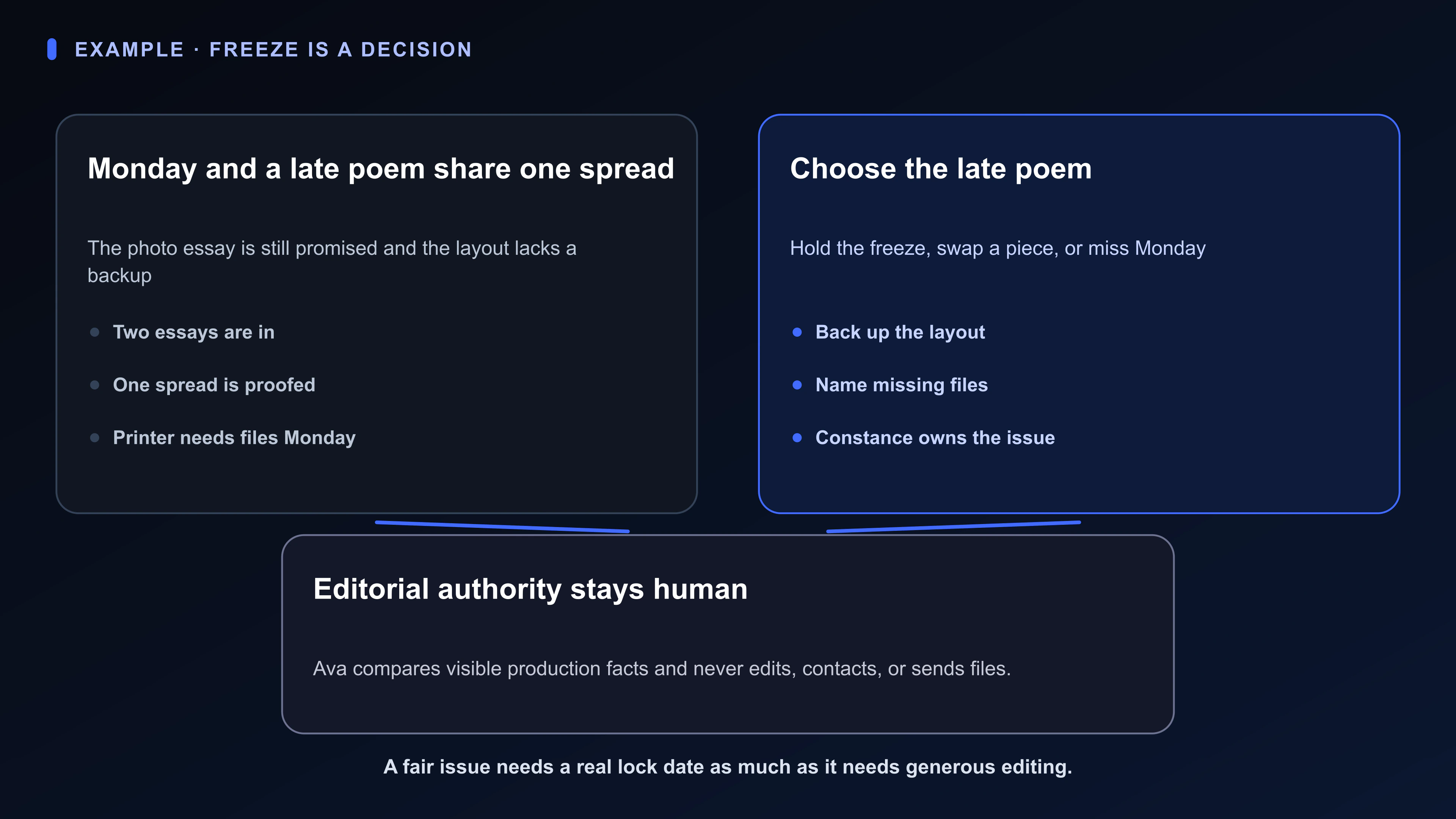
Constance wants to be fair to contributors and reliable to the printer. She must hold the freeze and move the poem, swap a shorter piece, or miss Monday to reopen a spread that was already proofed.
Send printer-ready files Monday with credited pieces that actually exist, and treat late arrivals as next issue unless a chosen swap happens
Monday files and the freeze rule
Keep the printer date beside the freeze
Each work with file and credit, including the late-piece exception decision
Hold the late regular-contributor poem as evidence while comparing hold-freeze, swap-a-short-piece, and miss-Monday options
Keep the pieces that actually exist separate from promised or late work
Keep the poem as evidence for hold, swap, or miss Monday without deciding its fate
Contributors and the printer
Keep the named production relationship beside the deadline it governs
Layout, proof, backup
Make backup a job before Monday
Separate export settings from editorial kindness
Promised files not yet received, such as the photo essay
Mark missing files so they cannot occupy a spread
The Spring issue Board keeps received pieces, contributor and printer commitments, production files, backup work, and genuinely missing files together.
Open Choose the late poem as a Room with Monday, the proofed spread, the promised photo essay, and hold, swap, or miss-date paths.
Ava can compare the issue facts Constance provides. Constance owns editorial judgment, credits, contributor and printer conversations, files, and handoff; Ava does not edit submissions or send files.
A freeze is a decision; inbox kindness is not a production system
This Board has one job: Send printer-ready files Monday with credited pieces that actually exist, and treat late arrivals as next issue unless a chosen swap happens.
The decision still belongs to Constance: Whether to hold the freeze and move the poem, swap out a shorter piece, or miss Monday to reopen layout.
You.one can keep the work, evidence, anything already waiting on another person or event, and the “Choose the late poem” decision visible through its Superboard view. Constance still owns the call: Constance chooses the issue, talks to contributors and the printer, and owns the files.
Available today
Spring issue: one place for the mission
The Spring issue Board gives this mission one durable operating picture. Constance can use familiar language instead of translating the situation into project-management jargon. Its five Lists separate the kinds of attention this situation actually requires.
The Board is not a master task list. It keeps the live choice, the facts that could change it, and any reply or outside event already in motion visible without pretending every uncertainty is work in progress.
Swipe or scroll sideways to see every column.
| List | What belongs here |
|---|---|
| Mission | Monday files and the freeze rule |
| Pieces | Each work with file and credit, including the late-piece exception decision |
| People and commitments | Contributors and the printer |
| Production | Layout, proof, backup |
| Replies and outside conditions | Promised files not yet received, such as the photo essay |
Available today
Cards that sound like the real work
These Card titles come directly from Constance's situation: “Choose the late poem” is the live choice, “Two essays received with credits” holds evidence, and “Photo essay still promised” names something genuinely in motion outside Constance's control. The point is recognition, not a perfect taxonomy.
Swipe or scroll sideways to see every column.
| Card | List | Job |
|---|---|---|
| Files on Monday | Mission | Keep the printer date beside the freeze |
| Choose the late poem | Pieces | Hold the late regular-contributor poem as evidence while comparing hold-freeze, swap-a-short-piece, and miss-Monday options |
| Two essays received with credits | Pieces | Keep the pieces that actually exist separate from promised or late work |
| Late poem arrived after freeze | Pieces | Keep the poem as evidence for hold, swap, or miss Monday without deciding its fate |
| Layout on the home computer | Production | Make backup a job before Monday |
| Photo essay still promised | Replies and outside conditions | Mark missing files so they cannot occupy a spread |
| Printer file checklist | Production | Separate export settings from editorial kindness |
| Printer contact and Monday handoff | People and commitments | Keep the named production relationship beside the deadline it governs |
Available today
Keep the evidence with “Choose the late poem”
Opening the Card gives the visible item durable depth. Stage can hold Freeze brief: Place Monday, proofed spreads, and hold / swap / miss-Monday options on one page. Chat keeps the request and response beside that artifact instead of in a detached thread. Notifications can bring this update forward: “Open decision: Constance will choose whether the freeze holds.”
A Card Chat request can ask Ava to prepare the specific comparison or extraction in “Choose the late poem” from the visible evidence. Ava can work from the context Constance deliberately brings into this Card, List, or Board; she cannot monitor the rest of life, contact anyone, or inherit the decision.
Constance's call remains explicit: Constance chooses the issue, talks to contributors and the printer, and owns the files.
Swipe or scroll sideways to see every column.
| Surface | Job in this example |
|---|---|
| Stage | Freeze brief: Place Monday, proofed spreads, and hold / swap / miss-Monday options on one page |
| Chat | Keep Constance's request and Ava's attributed response with the work |
| Notifications | Open decision: Constance will choose whether the freeze holds |
Start small and rename what feels artificial
Constance should rename every List or Card that feels artificial. This recipe succeeds when “Choose the late poem” becomes easier to decide and fewer open loops depend on memory—not when the Board looks tidy.
Swipe or scroll sideways to see every column.
| Step | Action |
|---|---|
| 1. Write the freeze and the printer date | Kindness is not a file format |
| 2. Card each piece | File and credit, or it is not in |
| 3. Make backup a job | One home computer is a risk |
| 4. Card the late arrival | Keep next issue as the default, not a settled fate, until the exception Room records a path |
| 5. Decide the exception | Open the Choose the late poem Room and record hold, swap, or miss Monday before moving the poem |
Email, a shared drive folder, and a layout file on one machine can remain part of the system
Email, a shared drive folder, and a layout file on one machine can be enough while the situation stays simple: every piece is in and backed up.
It starts to break when a late poem, a promised photo essay, and Monday all claim the same spread.
The Spring issue Board earns its place only when the familiar tool—email, a shared drive folder, and a layout file on one machine—can no longer keep the reason, Freeze brief, conversation, current state, decision, and history connected.
Where this example stops
- This is a fictional example, not a customer story.
- This is not a circulation, funding, or editorial-quality claim.
- It does not show Ava contacting contributors or a printer.
- It is not a measured publishing result.