
Example
How to decide a creator sponsorship without letting the invoice write the ethics
Skye needs the money without surprising a loyal audience. The choice is a higher payer with rewritten mentions, a lower-rate stronger fit, or no sponsor—while treating slow-invoice history as a claim, not a verdict.
Choose a spring sponsor—or none—against a visible series calendar, audience-fit notes, and unpaid-work risk, without letting the largest number decide alone
Series dates and the no-surprise-audience rule
Keep audience-fit beside the need to get paid
The sponsorship decision and each offer's rate, mentions, and dates
Compare rewritten-higher, smaller-fit, and skip-series-sponsorship
Hold talking points against the outlined episodes
Give the smaller-fit path its own rate, mention load, and audience-fit evidence
Episodes already outlined
Show work that would have to change
Warnings and unpaid-work history as claims to check
Keep a claim visible as something to check, not as already-proven fact
Questions Skye still owns before choosing
Turn a warning into a question Skye can choose to ask
The Spring sponsor choice Board keeps offers, series work, risk notes, and questions still to check separate so the largest rate cannot decide alone.
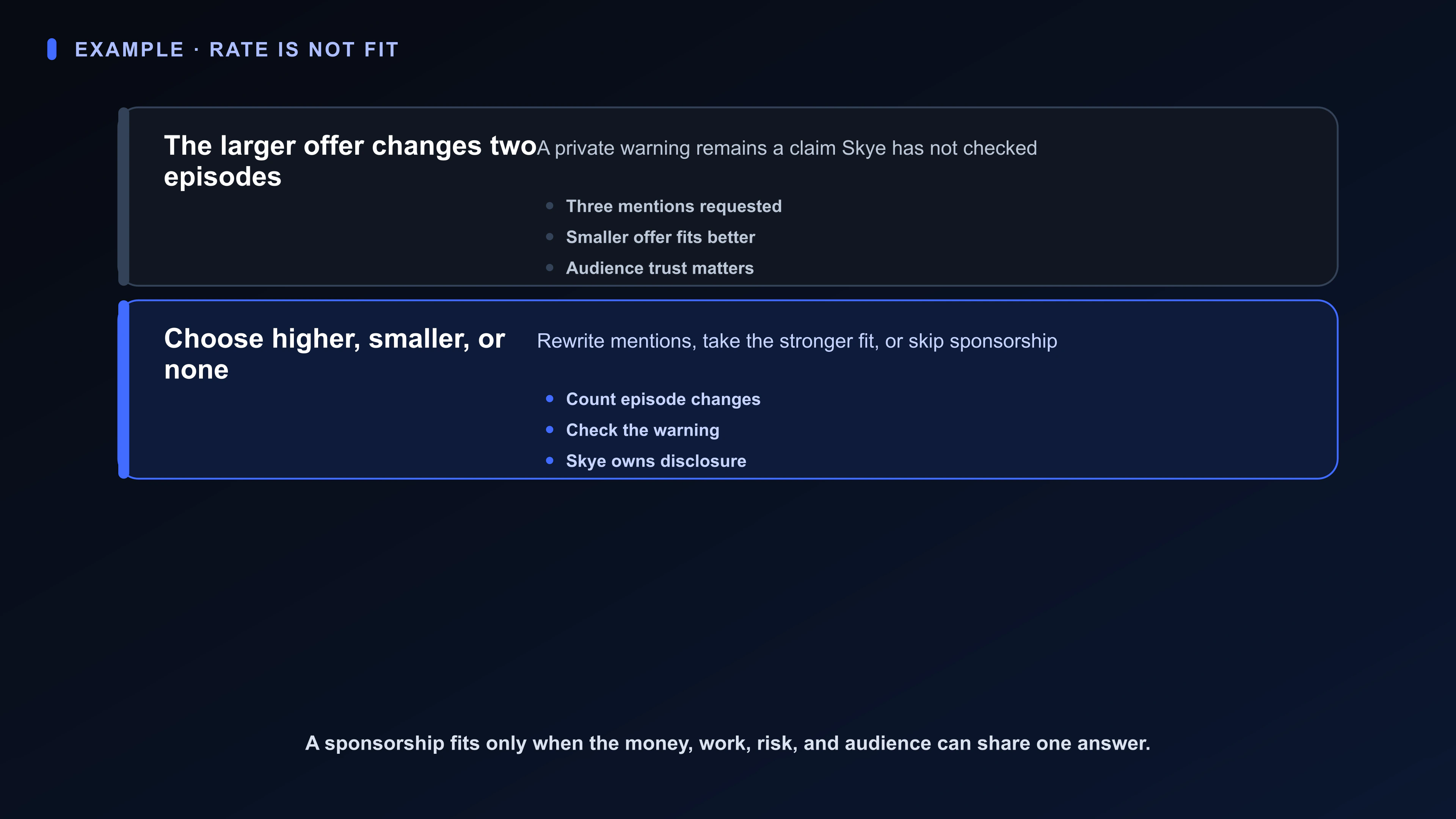
Open Choose higher, smaller, or none as a Room with rates, three mentions, episode changes, audience fit, and the unchecked warning.
Ava can compare visible terms and help frame the check. Skye owns contracts, disclosure, verification, brand conversations, audience-facing words, and the decision; Ava does not negotiate or publish.
A rate is not a fit, and a warning is not yet a fact you have checked
The work has a clear center: Choose a spring sponsor—or none—against a visible series calendar, audience-fit notes, and unpaid-work risk, without letting the largest number decide alone.
Organizing the evidence does not authorize the software to decide: Whether to take the higher payer with rewritten mentions, take the smaller fit, or skip sponsorship for this series.
You.one can keep the work, several kinds of evidence, and “Choose higher, smaller, or none” decision visible through its Superboard view. The organized facts support Skye; they do not replace Skye's judgment: Skye chooses the sponsor, checks the warning, and owns every brand and audience-facing sentence.
Available today
Name the work in plain language
These Card titles come directly from Skye's situation: “Choose higher, smaller, or none” is the live choice, while “Higher payer: three mentions” and “Episode 2 outline already drafted” hold different facts that can change it. The point is recognition, not a perfect taxonomy.
Swipe or scroll sideways to see every column.
| Card | List | Job |
|---|---|---|
| No surprise integrations | Mission | Keep audience-fit beside the need to get paid |
| Choose higher, smaller, or none | Offers | Compare rewritten-higher, smaller-fit, and skip-series-sponsorship |
| Higher payer: three mentions | Offers | Hold talking points against the outlined episodes |
| Smaller sponsor: lower rate, stronger fit | Offers | Give the smaller-fit path its own rate, mention load, and audience-fit evidence |
| Episode 2 outline already drafted | Series | Show work that would have to change |
| Private warning: slow to invoice | Risk notes | Keep a claim visible as something to check, not as already-proven fact |
| Draft the peer invoice-timing question | Questions still to check | Turn a warning into a question Skye can choose to ask |
Available today
Spring sponsor choice: separate the kinds of attention
The Spring sponsor choice Board gives this mission one durable operating picture. Skye can use familiar language instead of translating the situation into project-management jargon. Its five Lists separate the kinds of attention this situation actually requires.
The Lists use Skye's own language so actions, evidence, open questions, and decisions do not collapse into one queue. A separate place for replies is useful only after Skye has asked someone or a real outside event must happen first.
Swipe or scroll sideways to see every column.
| List | What belongs here |
|---|---|
| Mission | Series dates and the no-surprise-audience rule |
| Offers | The sponsorship decision and each offer's rate, mentions, and dates |
| Series | Episodes already outlined |
| Risk notes | Warnings and unpaid-work history as claims to check |
| Questions still to check | Questions Skye still owns before choosing |
Ask Ava to prepare the judgment—not make it
These requests stay with the facts Skye has made visible around “Choose higher, smaller, or none.” Skye supplies the evidence, checks Ava's work, and decides what belongs in the Room.
Current Ava can prepare help after an explicit request. She cannot make the choice, represent Skye, watch other work on her own, or contact anyone.
Skye owns contracts, disclosures, and brand conversations. Ava does not negotiate, send email, or give legal advice.
A chosen path: mentions are counted against outlined episodes, the warning is a check rather than a rumor, and the largest rate is not automatically the yes.
- Request idea: using only the context visible in this Card Room, compare the higher payer with rewritten mentions, the smaller fit, and skipping sponsorship. Do not email brands or choose for me.
- Request idea: use only the Sponsor-fit brief and notes the Owner has placed in this Card Room to separate facts, assumptions, and unanswered questions
- Request idea: in “Choose higher, smaller, or none,” group the visible evidence by option and leave the decision open
Available today
One Card Room for the consequential choice
Opening the Card gives the visible item durable depth. Stage can hold Sponsor-fit brief: Place rates, mention load, episode outlines, and higher / smaller / skip options on one page. Chat keeps the request and response beside that artifact instead of in a detached thread. Notifications can bring this update forward: “Open decision: Skye will choose a sponsorship path.”
A Card Chat request can ask Ava to prepare the specific comparison or extraction in “Choose higher, smaller, or none” from the visible evidence. Ava can work from the context Skye deliberately brings into this Card, List, or Board; she cannot monitor the rest of life, contact anyone, or inherit the decision.
Skye's call remains explicit: Skye chooses the sponsor, checks the warning, and owns every brand and audience-facing sentence.
Swipe or scroll sideways to see every column.
| Surface | Job in this example |
|---|---|
| Stage | Sponsor-fit brief: Place rates, mention load, episode outlines, and higher / smaller / skip options on one page |
| Chat | Keep Skye's request and Ava's attributed response with the work |
| Notifications | Open decision: Skye will choose a sponsorship path |
Build only enough Board to make the next decision
Skye should rename every List or Card that feels artificial. This recipe succeeds when “Choose higher, smaller, or none” becomes easier to decide and fewer open loops depend on memory—not when the Board looks tidy.
Swipe or scroll sideways to see every column.
| Step | Action |
|---|---|
| 1. Put the series on the Board | Episodes already outlined |
| 2. Card each offer | Rate, mentions, dates |
| 3. Capture warnings as checks | A private note is not a verdict |
| 4. Prepare the check | Draft the peer question before anyone else has the ball |
| 5. Choose in a Room | Open “Choose higher, smaller, or none” before the branded PDF becomes the decision |
Where this example stops
- This is a fictional example, not a customer story.
- This is not legal, tax, or brand-safety advice.
- It does not show Ava contacting sponsors or publishing integrations.
- It is not a measured revenue or audience result.