
Example
How to run a dog-grooming holiday week without overbooking every familiar client
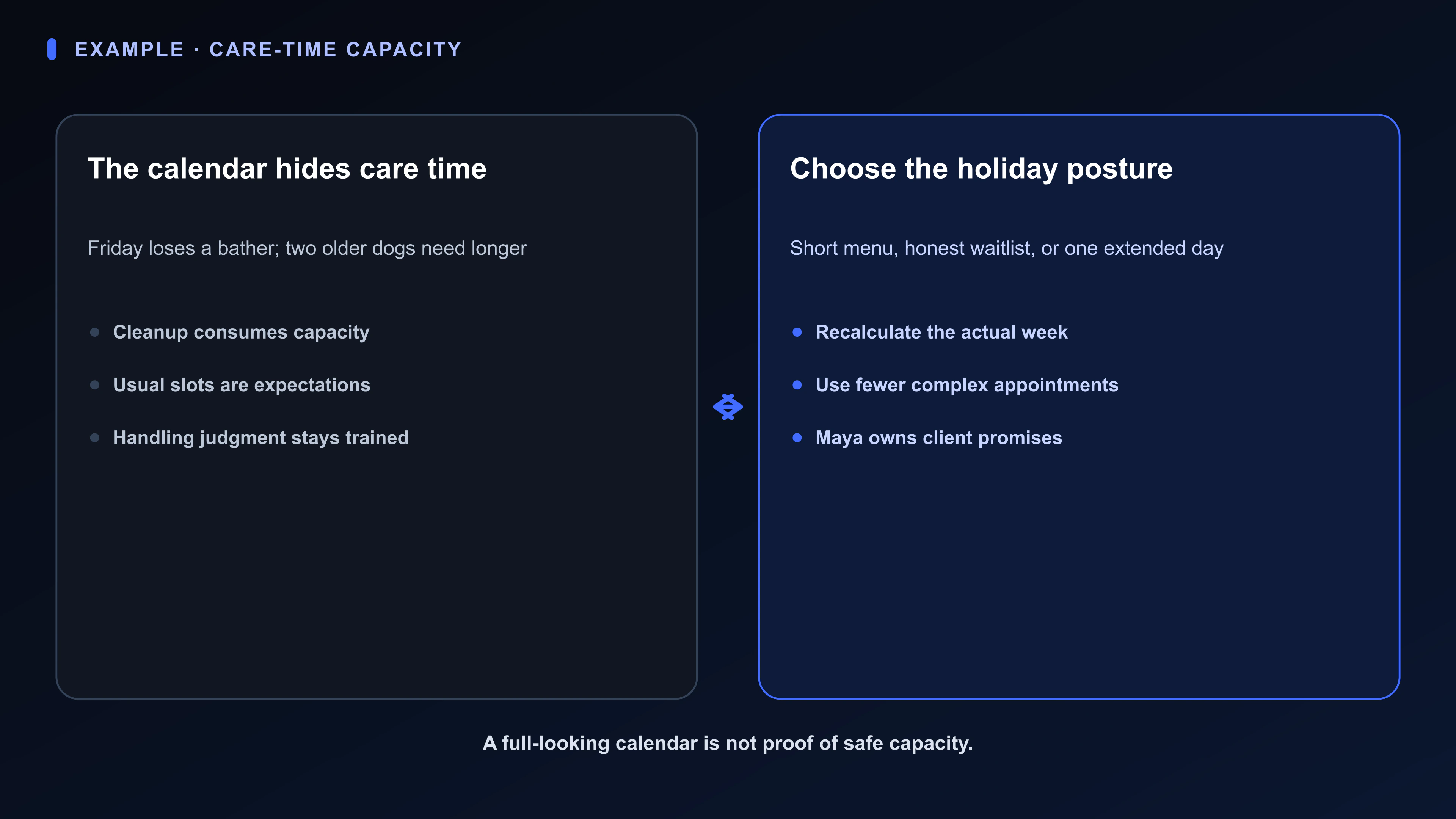
Maya cannot preserve every regular client's usual slot and still claim the calendar reflects safe capacity. The live choice is a shorter service menu, an honest waitlist, or one extended day with fewer complex appointments.
Serve a safe, honest holiday schedule that protects animal handling time and staff capacity
Purpose, boundaries, and the definition of enough
Keep safe handling time and honest client promises above a full-looking calendar
The decision and preparation that deserve attention next
Compare a shorter menu, a waitlist, and one extended day
Recalculate the week's capacity from actual staff and care time
The visible proof behind the plan—not a vague feeling of readiness
Show Friday's capacity loss without the bather
Record the longer handling and cleanup time for the two older dogs
A separate place for client promises without pretending an outside reply is already in motion
Keep regular-client expectations visible without presenting usual slots as promised
The Holiday grooming week Board keeps actual staffing, service duration, animal needs, cleanup, and client promises in the same weekly picture.
The Holiday-capacity Room compares a shorter menu, waitlist, and one-day extension after Friday's capacity is recalculated.
Ava can organize the schedule evidence Maya records. Maya and the trained salon team own care and every booking; Ava cannot handle animals, give veterinary advice, or contact clients.
Holiday grooming week has one live choice: Short menu, waitlist, or one extension
This Board has one job: Serve a safe, honest holiday schedule that protects animal handling time and staff capacity.
The decision still belongs to Maya: Whether to shorten the service menu, add a waitlist, or extend one day with fewer complex appointments.
You.one can keep the work, evidence, and “Short menu, waitlist, or one extension” decision visible through its Superboard view. Authority does not move to the software: Maya and the trained salon team assess handling needs, schedule services, care for each dog, and own every client promise.
Available today
Holiday grooming week: one place for the mission
The Holiday grooming week Board gives this mission one durable operating picture. Maya can use familiar language instead of translating the situation into project-management jargon. Its four Lists separate the kinds of attention this situation actually requires.
The Board is not a master task list. It keeps the live choice, the facts that could change it, and any reply or outside event already in motion visible without pretending every uncertainty is work in progress.
Swipe or scroll sideways to see every column.
| List | What belongs here |
|---|---|
| Care promise | Purpose, boundaries, and the definition of enough |
| Appointments to place | The decision and preparation that deserve attention next |
| Time evidence | The visible proof behind the plan—not a vague feeling of readiness |
| Client promises | A separate place for client promises without pretending an outside reply is already in motion |
Available today
Cards that sound like the real work
These Card titles come directly from Maya's situation: “Short menu, waitlist, or one extension” is the live choice, “Friday without a bather” holds evidence, and “Regulars expect usual slots” is still work Maya controls—not something already awaiting another person. The point is recognition, not a perfect taxonomy.
Swipe or scroll sideways to see every column.
| Card | List | Job |
|---|---|---|
| Holiday grooming week | Care promise | Keep safe handling time and honest client promises above a full-looking calendar |
| Short menu, waitlist, or one extension | Appointments to place | Compare a shorter menu, a waitlist, and one extended day |
| Friday without a bather | Time evidence | Show Friday's capacity loss without the bather |
| Two older dogs need longer | Time evidence | Record the longer handling and cleanup time for the two older dogs |
| Regulars expect usual slots | Client promises | Keep regular-client expectations visible without presenting usual slots as promised |
| Recalculate capacity with Friday's actual staffing | Appointments to place | Recalculate the week's capacity from actual staff and care time |
Available today
Keep the evidence with “Short menu, waitlist, or one extension”
Opening the Card gives the visible item durable depth. Stage can hold Holiday-capacity brief: Place service duration, animal needs, staffing, cleanup, and client promises together. Live choice: Whether to shorten the service menu, add a waitlist, or extend one day with fewer complex appointments. Chat keeps the request and response beside that artifact instead of in a detached thread. Notifications can bring this update forward: “Open decision: Maya will decide whether to shorten the service menu, add a waitlist, or extend one day with fewer complex appointments.”
A Card Chat request can ask Ava to prepare the specific comparison or extraction in “Short menu, waitlist, or one extension” from the visible evidence. Ava can work from the context Maya deliberately brings into this Card, List, or Board; she cannot monitor the rest of life, contact anyone, or inherit the decision.
Maya's call remains explicit: Maya and the trained salon team assess handling needs, schedule services, care for each dog, and own every client promise.
Swipe or scroll sideways to see every column.
| Surface | Job in this example |
|---|---|
| Stage | Holiday-capacity brief: Place service duration, animal needs, staffing, cleanup, and client promises together. Live choice: Whether to shorten the service menu, add a waitlist, or extend one day with fewer complex appointments |
| Chat | Keep Maya's request and Ava's attributed response with the work |
| Notifications | Open decision: Maya will decide whether to shorten the service menu, add a waitlist, or extend one day with fewer complex appointments |
Start small and rename what feels artificial
Maya should rename every List or Card that feels artificial. This recipe succeeds when “Short menu, waitlist, or one extension” becomes easier to decide and fewer open loops depend on memory—not when the Board looks tidy.
Swipe or scroll sideways to see every column.
| Step | Action |
|---|---|
| 1. Write the mission | Serve a safe, honest holiday schedule that protects animal handling time and staff capacity |
| 2. Open the live choice | Put “Short menu, waitlist, or one extension” in a Room of its own |
| 3. Attach the evidence | Holiday-capacity brief: Place service duration, animal needs, staffing, cleanup, and client promises together. Live choice: Whether to shorten the service menu, add a waitlist, or extend one day with fewer complex appointments. |
| 4. Keep the work owned | Keep “Regulars expect usual slots” in owned work and name the next visible move |
| 5. Take the first owned action | Recalculate capacity with Friday's actual staffing |
An appointment calendar can remain part of the system
An appointment calendar can be enough while the situation stays simple: “Two older dogs need longer” and “Regulars expect usual slots” no longer change the “Short menu, waitlist, or one extension” choice.
It starts to break when “Friday without a bather” and “Regulars expect usual slots” must inform the same choice.
The Holiday grooming week Board earns its place only when the familiar tool—an appointment calendar—can no longer keep the reason, Holiday-capacity brief, conversation, current state, decision, and history connected.
Where this example stops
- This is a fictional example, not a customer story.
- This fictional example is not animal-care, handling, welfare, medical, employment, or salon-safety advice; trained people remain responsible for every animal and appointment.
- It does not show Ava completing external actions or contacting anyone for Maya.
- It does not report a measured result, and this Board is a starting shape to adapt—not a universal prescription.