
Example
How to schedule a home-organizer client week when emotional work changes the estimate
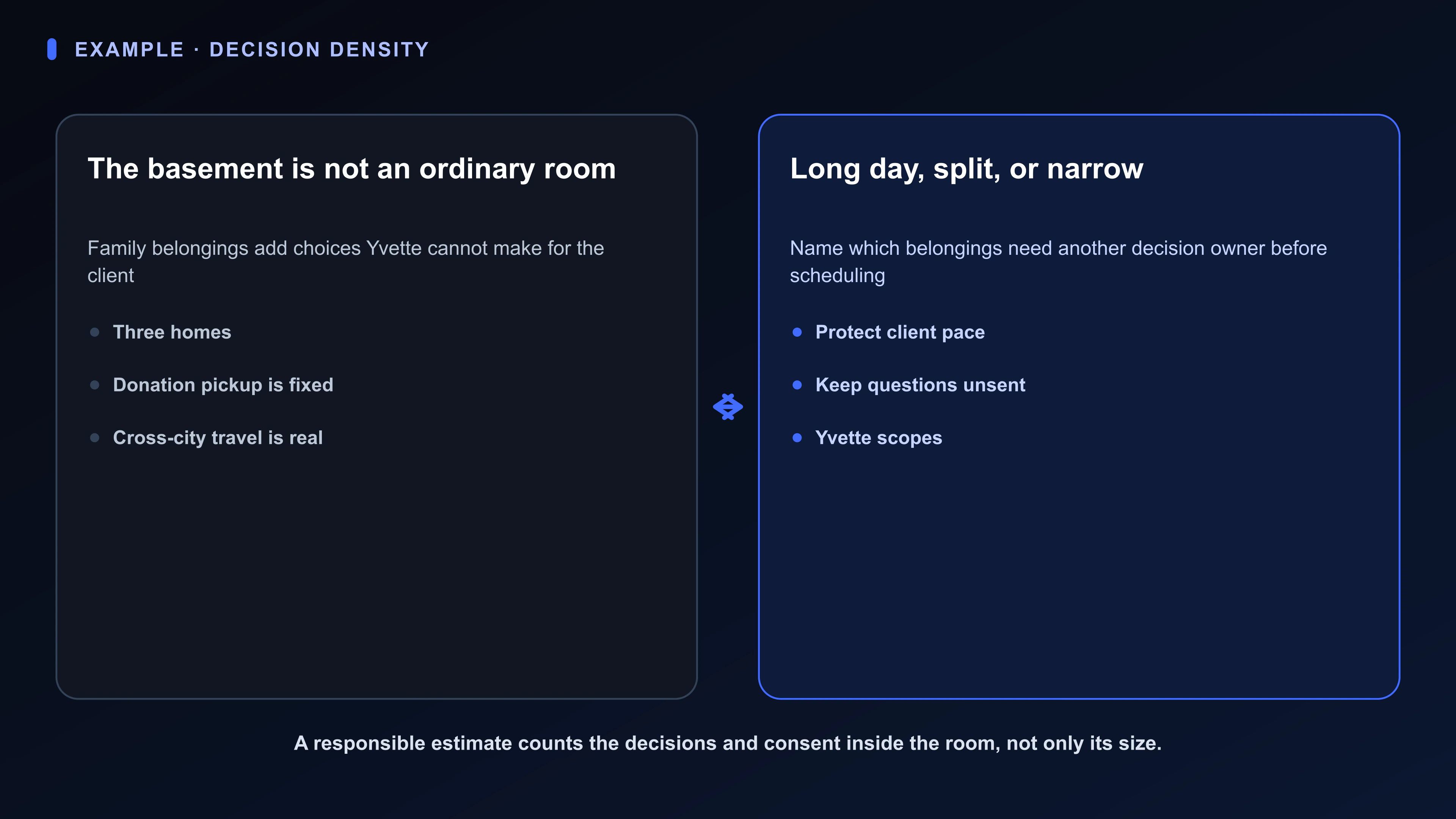
Yvette can estimate an ordinary room, but the basement contains belongings she cannot decide about and family questions she has not sent. She must keep one long day, split the work into two sessions, or narrow the scope while client pace, permission, travel, and pickup timing stay visible.
Schedule a week that respects client decision pace, travel, and promised completion boundaries
Purpose, boundaries, and the definition of enough
Keep client pace, travel, and completion boundaries as the weekly promise
The decision and preparation that deserve attention next
Compare one long basement day, two sessions, and a narrower scope
The visible proof behind the plan—not a vague feeling of readiness
Show why family belongings create more decisions than a pantry
Hold the donation pickup as a hard timing constraint
Map the hard travel time around the three homes and donation pickup
A separate place for people to contact without pretending an outside reply is already in motion
Draft the family-availability question without treating it as answered
Draft one question that identifies which belongings require another family member's decision
The Three-client week Board separates the client promise, sessions, scope evidence, people Yvette may contact, and rooms actually closed.
Open Long day, split, or narrow as the Room with the Basement-session brief and one question naming belongings another family member controls.
Ava can compare the visible schedule only. Yvette owns scope and client communication; each client controls belongings, privacy, pace, disposal, family decisions, and permission to handle property.
Three-client week has one live choice: Long day, split, or narrow
What belongs together is specific: Schedule a week that respects client decision pace, travel, and promised completion boundaries.
The consequential judgment remains human: Whether to keep the basement as one long day, split it into two sessions, or narrow the scope before arrival.
You.one can keep the work, evidence, and “Long day, split, or narrow” decision visible through its Superboard view. Authority does not move to the software: Yvette scopes and schedules her work, protects client consent, handles belongings only with permission, and owns every client question.
What changes after a booking calendar
A booking calendar can be enough while the situation stays simple: “Donation pickup time” and “Family availability question” no longer change the “Long day, split, or narrow” choice.
It starts to break when “Basement decision density” and “Family availability question” must inform the same choice.
The Three-client week Board earns its place only when the familiar tool—a booking calendar—can no longer keep the reason, Basement-session brief, conversation, current state, decision, and history connected.
Available today
A focused Three-client week Board
The Three-client week Board gives this mission one durable operating picture. Yvette can use familiar language instead of translating the situation into project-management jargon. Its four Lists separate the kinds of attention this situation actually requires.
The point is a fast scan: what is moving, what is known, what is unresolved, and what Yvette must choose. Questions not yet asked stay with Yvette; they do not move to a list for outside replies.
Swipe or scroll sideways to see every column.
| List | What belongs here |
|---|---|
| Client promise | Purpose, boundaries, and the definition of enough |
| Sessions next | The decision and preparation that deserve attention next |
| Scope evidence | The visible proof behind the plan—not a vague feeling of readiness |
| People to contact | A separate place for people to contact without pretending an outside reply is already in motion |
Available today
Inside the “Long day, split, or narrow” Room
Opening the Card gives the visible item durable depth. Stage can hold Basement-session brief: Place room scope, decision owners, pickup timing, travel, and completion boundary together. Live choice: Whether to keep the basement as one long day, split it into two sessions, or narrow the scope before arrival. Chat keeps the request and response beside that artifact instead of in a detached thread. Notifications can bring this update forward: “Open decision: Yvette will decide whether to keep the basement as one long day, split it into two sessions, or narrow the scope before arrival.”
A Card Chat request can ask Ava to prepare the specific comparison or extraction in “Long day, split, or narrow” from the visible evidence. Ava can work from the context Yvette deliberately brings into this Card, List, or Board; she cannot monitor the rest of life, contact anyone, or inherit the decision.
Yvette's call remains explicit: Yvette scopes and schedules her work, protects client consent, handles belongings only with permission, and owns every client question.
Swipe or scroll sideways to see every column.
| Surface | Job in this example |
|---|---|
| Stage | Basement-session brief: Place room scope, decision owners, pickup timing, travel, and completion boundary together. Live choice: Whether to keep the basement as one long day, split it into two sessions, or narrow the scope before arrival |
| Chat | Keep Yvette's request and Ava's attributed response with the work |
| Notifications | Open decision: Yvette will decide whether to keep the basement as one long day, split it into two sessions, or narrow the scope before arrival |
What Ava can prepare from visible context
These requests stay with the facts Yvette has made visible around “Long day, split, or narrow.” Yvette supplies the evidence, checks Ava's work, and decides what belongs in the Room.
Current Ava can prepare help after an explicit request. She cannot make the choice, represent Yvette, watch other work on her own, or contact anyone.
Yvette scopes and schedules her work, protects client consent, handles belongings only with permission, and owns every client question. Ava does not decide what to discard, contact families, or enter homes.
Yvette finishes “Draft one question that identifies which belongings need another family member's decision,” keeps “Basement decision density” beside “Long day, split, or narrow,” and does not treat “Family availability question” as completed or sent before doing the work.
- Request idea: compare the options on the Long day, split, or narrow Card using only the context visible in this Card Room. Tell me what is missing; do not choose, submit, book, buy, or message anyone.
- Request idea: use only the Basement-session brief and notes the Owner has placed in this Card Room to separate facts, assumptions, and unanswered questions
- Request idea: from “Long day, split, or narrow,” draft a short decision note and name Yvette as the decider
A starter shape, not a prescribed workflow
Yvette should rename every List or Card that feels artificial. This recipe succeeds when “Long day, split, or narrow” becomes easier to decide and fewer open loops depend on memory—not when the Board looks tidy.
Swipe or scroll sideways to see every column.
| Step | Action |
|---|---|
| 1. Write the mission | Schedule a week that respects client decision pace, travel, and promised completion boundaries |
| 2. Open the live choice | Put “Long day, split, or narrow” in a Room of its own |
| 3. Attach the evidence | Basement-session brief: Place room scope, decision owners, pickup timing, travel, and completion boundary together. Live choice: Whether to keep the basement as one long day, split it into two sessions, or narrow the scope before arrival. |
| 4. Keep the work owned | Keep “Family availability question” in owned work and name the next visible move |
| 5. Take the first owned action | Draft one question that identifies which belongings need another family member's decision |
Where this example stops
- This is a fictional example, not a customer story.
- This fictional example is not mental-health, privacy, property, disposal, relationship, or professional-organizing advice; each client controls their belongings and decisions.
- It does not show Ava completing external actions or contacting anyone for Yvette.
- It does not report a measured result, and this Board is a starting shape to adapt—not a universal prescription.