
Example
How to reset an empty-nest household without turning rooms into storage
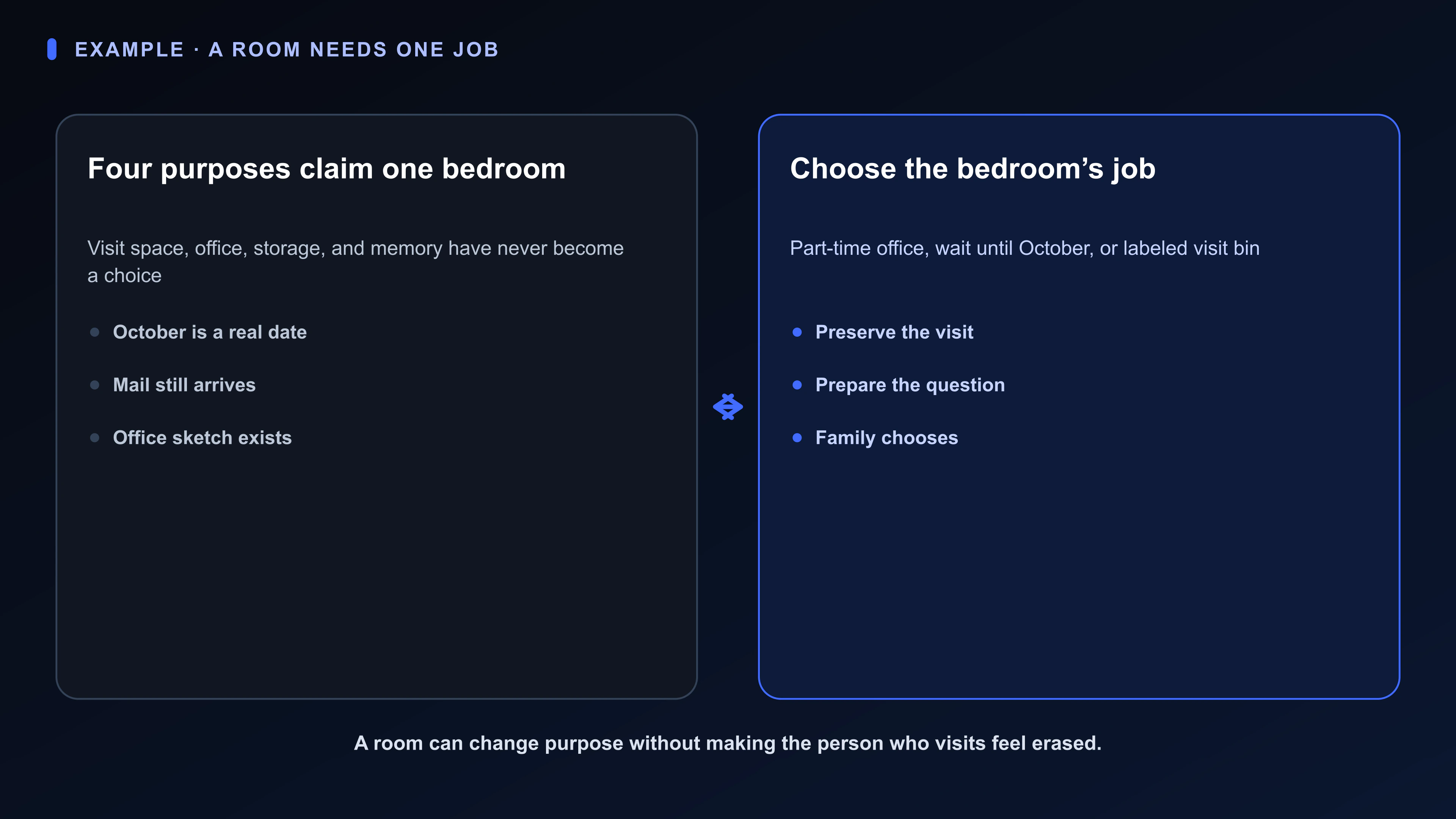
Diane is not erasing anyone, but the room cannot stay a bedroom, office, storage unit, and symbol by default. The family must choose a part-time office, wait until after October, or pack a labeled visit bin while keeping the return workable.
Give each room a job between visits, handle mail on purpose, and make the October stay possible without keeping the house in suspended animation
Rooms with jobs and October as a real date
Keep October possible without freezing the house
What each space is for now
Compare part-time office, wait-until-after-October, and labeled-bin options
Hold a competing job for the same square footage
Keep, store, ask, or mail-forward
Name a pile that is neither packed nor used
Keep the live mail question visible until Diane chooses a forwarding or handoff routine
Spouse and the student who still visits
Put the return on the Board so packing is not a secret eviction
Questions Diane still owns before changing belongings
Prepare the question without pretending it has been asked
The House between visits Board keeps rooms, belongings, family promises, mail, visit dates, and conversations Diane still owns distinct.
Open Choose the bedroom’s job as a Room with the Room-job brief and all three uses.
Ava can compare the visible room facts and help prepare a question. Diane and her family own belongings, mail, household changes, and every conversation; Ava does not contact, donate, counsel, or decide.
A room can support visits, work, or memory—not every purpose by default
The mission is specific: Give each room a job between visits, handle mail on purpose, and make the October stay possible without keeping the house in suspended animation.
The consequential choice is not something a board or an AI should quietly make: Whether the bedroom becomes a part-time office, stays a bedroom until after the October visit, or is packed with a labeled bin for visits.
You.one can keep the work, several kinds of evidence, and “Choose the bedroom’s job” decision visible through its Superboard view. The organized facts support Diane; they do not replace Diane's judgment: Diane and her family choose the rooms, talk to the student, and own what is kept or given away.
Available today
House between visits: the working map
The House between visits Board gives this mission one durable operating picture. Diane can use familiar language instead of translating the situation into project-management jargon. Its five Lists separate the kinds of attention this situation actually requires.
The Lists separate what Diane can move now, what is evidence, what is already waiting on a named person or event, and what still needs a decision.
Swipe or scroll sideways to see every column.
| List | What belongs here |
|---|---|
| Mission | Rooms with jobs and October as a real date |
| Rooms | What each space is for now |
| Belongings | Keep, store, ask, or mail-forward |
| People and commitments | Spouse and the student who still visits |
| Conversations to prepare | Questions Diane still owns before changing belongings |
Available today
Open one decision: Choose the bedroom’s job
Opening the Card gives the visible item durable depth. Stage can hold Room-job brief: Place October dates, the clothes pile, the spouse office sketch, and office / after-October / labeled-bin options on one page. Chat keeps the request and response beside that artifact instead of in a detached thread. Notifications can bring this update forward: “Open decision: Diane and her spouse will choose the bedroom’s job.”
A Card Chat request can ask Ava to prepare the specific comparison or extraction in “Choose the bedroom’s job” from the visible evidence. Ava can work from the context Diane deliberately brings into this Card, List, or Board; she cannot monitor the rest of life, contact anyone, or inherit the decision.
Diane's call remains explicit: Diane and her family choose the rooms, talk to the student, and own what is kept or given away.
Swipe or scroll sideways to see every column.
| Surface | Job in this example |
|---|---|
| Stage | Room-job brief: Place October dates, the clothes pile, the spouse office sketch, and office / after-October / labeled-bin options on one page |
| Chat | Keep Diane's request and Ava's attributed response with the work |
| Notifications | Open decision: Diane and her spouse will choose the bedroom’s job |
Useful Ava requests, with the boundary intact
These requests stay with the facts Diane has made visible around “Choose the bedroom’s job.” Diane supplies the evidence, checks Ava's work, and decides what belongs in the Room.
Current Ava can prepare help after an explicit request. She cannot make the choice, represent Diane, watch other work on her own, or contact anyone.
Diane owns the house, conversations, and what is kept. Ava does not contact the student, donate items, or give family advice.
A house with jobs: the bedroom is a chosen use, October is on the Board, and a pile of in-case clothes is no longer the plan.
- Request idea: using only the context visible in this Card Room, compare a part-time office, waiting until after the October visit, and packing a labeled visit bin. Do not message anyone or choose for me.
- Request idea: use only the Room-job brief and notes the Owner has placed in this Card Room to separate facts, assumptions, and unanswered questions
- Request idea: in “Choose the bedroom’s job,” show which visible fact could reverse the current choice
The limit of a closed bedroom plus a mail pile
A closed bedroom plus a mail pile can be enough while the situation stays simple: visits are weekly and nobody needs the space.
It starts to break when October, an office sketch, and clothes-in-case all claim the same room.
The House between visits Board earns its place only when the familiar tool—a closed bedroom plus a mail pile—can no longer keep the reason, Room-job brief, conversation, current state, decision, and history connected.
A practical way to start the House between visits Board
Diane should rename every List or Card that feels artificial. This recipe succeeds when “Choose the bedroom’s job” becomes easier to decide and fewer open loops depend on memory—not when the Board looks tidy.
Swipe or scroll sideways to see every column.
| Step | Action |
|---|---|
| 1. Put visit dates on the Board | The house still hosts |
| 2. Name room jobs | Between visits, not in theory |
| 3. Sort piles | In-case is a category |
| 4. Give incoming mail a routine | Forward, collect, or hand off on purpose |
| 5. Prepare before asking | Draft the question; Diane decides when to ask |
| 6. Choose the bedroom’s job | Open a Room instead of a quiet standoff |
Where this example stops
- This is a fictional example, not a customer story.
- This is not family-therapy, legal, or financial advice.
- It does not show Ava contacting a student or donating belongings.
- It is not a measured household outcome.