
Example
How to relocate for work without losing housing, start dates, and the old-life closeout
Will has accepted the role but does not yet have a key, and the household’s Salt Lake City commitments outlast the start date. They must choose a furnished sublet, a month of overlapping rent, or the written delay window in the offer.
Arrive by start date with a place to sleep, a planned overlap with the old lease, and packing that matches housing certainty
Start date, a place to sleep, and the partner’s loop as a constraint
Keep start date beside housing certainty
Housing options and first-week needs
Hold an unconfirmed place so it is not already the plan
Lease, utilities, and closeout
Show the overlap the offer letter does not know about
Mark packing that is ahead of a housing yes
Start, written delay window, and travel
Compare furnished six-week, double-rent month, and written delay window
Keep the written timing option beside housing without implying HR has approved anything beyond the offer
The partner interview loop already in motion
Keep an unresolved household constraint from being ignored by packing
The Six-week relocation Board separates new-city housing, old-city closeout, work dates, household constraints, and genuine replies.
Open Choose sublet, overlap, or delay start as a Room with the Arrival-path brief and both cities’ clocks.
Ava can compare visible dates and costs without advising. Will and his partner own employment, housing, leases, money, landlords, HR, packing, and every signature; Ava does not contact or transact.
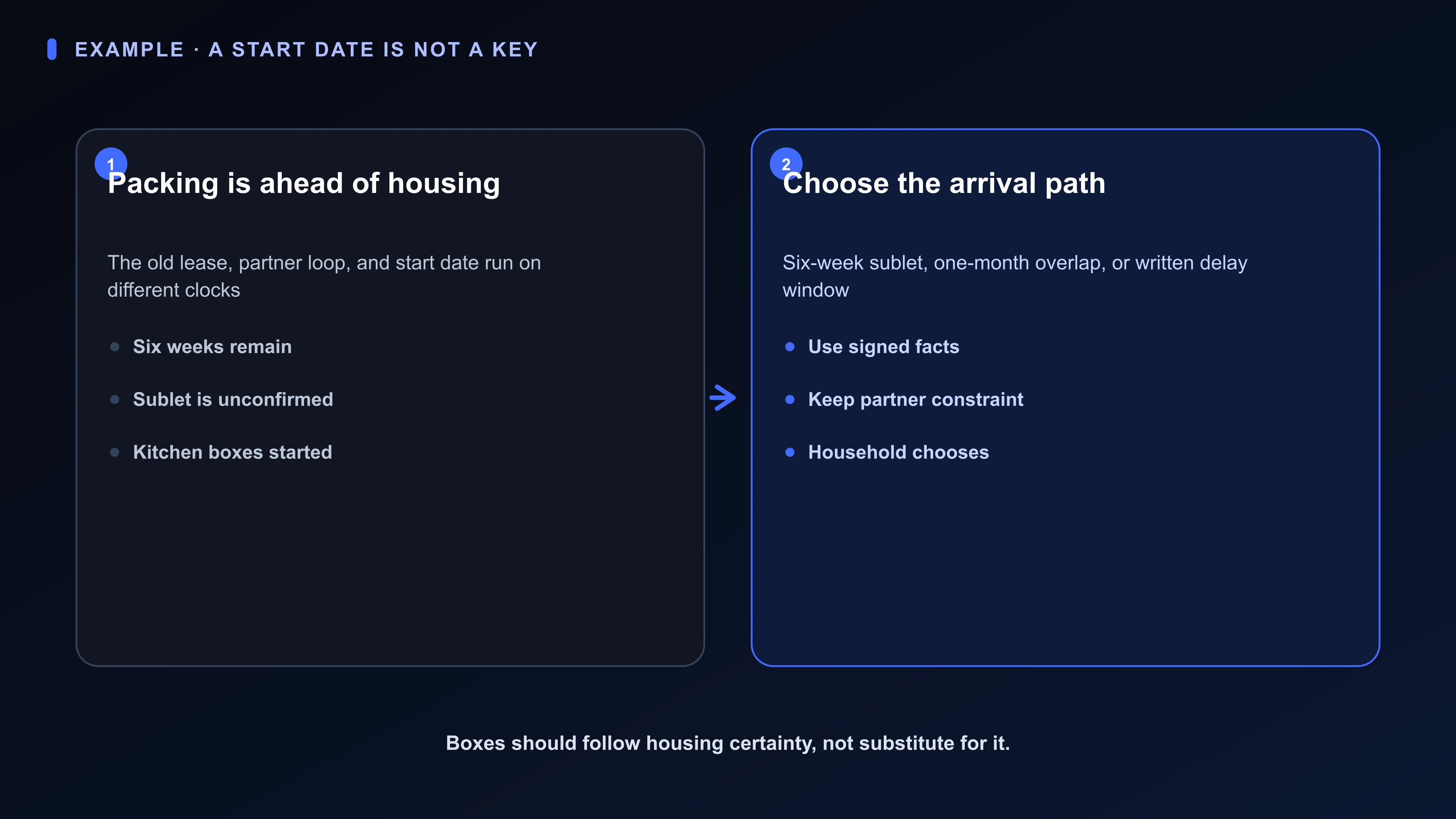
A start date is not a key, and packing is not a lease
This Board has one job: Arrive by start date with a place to sleep, a planned overlap with the old lease, and packing that matches housing certainty.
The decision still belongs to Will: Whether to take a six-week furnished sublet, overlap both rents for a month, or delay the start date using the written window in the offer.
You.one can keep the work, evidence, anything already waiting on another person or event, and the “Choose sublet, overlap, or delay start” decision visible through its Superboard view. Will still owns the call: Will and his partner choose housing and timing, talk to landlords and HR, and own every lease and job conversation.
Available today
Six-week relocation: one place for the mission
The Six-week relocation Board gives this mission one durable operating picture. Will can use familiar language instead of translating the situation into project-management jargon. Its five Lists separate the kinds of attention this situation actually requires.
The Board is not a master task list. It keeps the live choice, the facts that could change it, and any reply or outside event already in motion visible without pretending every uncertainty is work in progress.
Swipe or scroll sideways to see every column.
| List | What belongs here |
|---|---|
| Mission | Start date, a place to sleep, and the partner’s loop as a constraint |
| New city | Housing options and first-week needs |
| Old city | Lease, utilities, and closeout |
| Work dates | Start, written delay window, and travel |
| Replies and outside conditions | The partner interview loop already in motion |
Available today
Cards that sound like the real work
These Card titles come directly from Will's situation: “Choose sublet, overlap, or delay start” is the live choice, “Current lease end after start date” holds evidence, and “Partner interview loop still open” names something genuinely in motion outside Will's control. The point is recognition, not a perfect taxonomy.
Swipe or scroll sideways to see every column.
| Card | List | Job |
|---|---|---|
| A bed by day one | Mission | Keep start date beside housing certainty |
| Choose sublet, overlap, or delay start | Work dates | Compare furnished six-week, double-rent month, and written delay window |
| Current lease end after start date | Old city | Show the overlap the offer letter does not know about |
| Partner interview loop still open | Replies and outside conditions | Keep an unresolved household constraint from being ignored by packing |
| Kitchen boxes already started | Old city | Mark packing that is ahead of a housing yes |
| Furnished sublet maybe | New city | Hold an unconfirmed place so it is not already the plan |
| Offer letter: written delay window | Work dates | Keep the written timing option beside housing without implying HR has approved anything beyond the offer |
Available today
Keep the evidence with “Choose sublet, overlap, or delay start”
Opening the Card gives the visible item durable depth. Stage can hold Arrival-path brief: Place start date, written delay window, lease overlap, partner loop, and sublet / double-rent / delay options on one page. Chat keeps the request and response beside that artifact instead of in a detached thread. Notifications can bring this update forward: “Open decision: Will and his partner will choose an arrival path.”
A Card Chat request can ask Ava to prepare the specific comparison or extraction in “Choose sublet, overlap, or delay start” from the visible evidence. Ava can work from the context Will deliberately brings into this Card, List, or Board; she cannot monitor the rest of life, contact anyone, or inherit the decision.
Will's call remains explicit: Will and his partner choose housing and timing, talk to landlords and HR, and own every lease and job conversation.
Swipe or scroll sideways to see every column.
| Surface | Job in this example |
|---|---|
| Stage | Arrival-path brief: Place start date, written delay window, lease overlap, partner loop, and sublet / double-rent / delay options on one page |
| Chat | Keep Will's request and Ava's attributed response with the work |
| Notifications | Open decision: Will and his partner will choose an arrival path |
Start small and rename what feels artificial
Will should rename every List or Card that feels artificial. This recipe succeeds when “Choose sublet, overlap, or delay start” becomes easier to decide and fewer open loops depend on memory—not when the Board looks tidy.
Swipe or scroll sideways to see every column.
| Step | Action |
|---|---|
| 1. Put both dates on the Board | Start date and lease end |
| 2. Card housing options | Confirmed versus maybe |
| 3. Name household constraints | A partner’s loop is real |
| 4. Slow packing that is ahead of keys | Kitchen boxes are not a lease |
| 5. Choose sublet, overlap, or delay start | Open a Room before double rent happens by neglect |
An offer letter plus a rental-search tab can remain part of the system
An offer letter plus a rental-search tab can be enough while the situation stays simple: housing is signed and the old lease ends first.
It starts to break when a start date, a later lease end, and an open partner loop all claim week six.
The Six-week relocation Board earns its place only when the familiar tool—an offer letter plus a rental-search tab—can no longer keep the reason, Arrival-path brief, conversation, current state, decision, and history connected.
Where this example stops
- This is a fictional example, not a customer story.
- This is not legal, landlord-tenant, employment, or financial advice.
- It does not show Ava contacting HR or signing a lease.
- It is not a measured relocation result.