
Example
How a freelancer can stabilize a pipeline without saying yes to every maybe
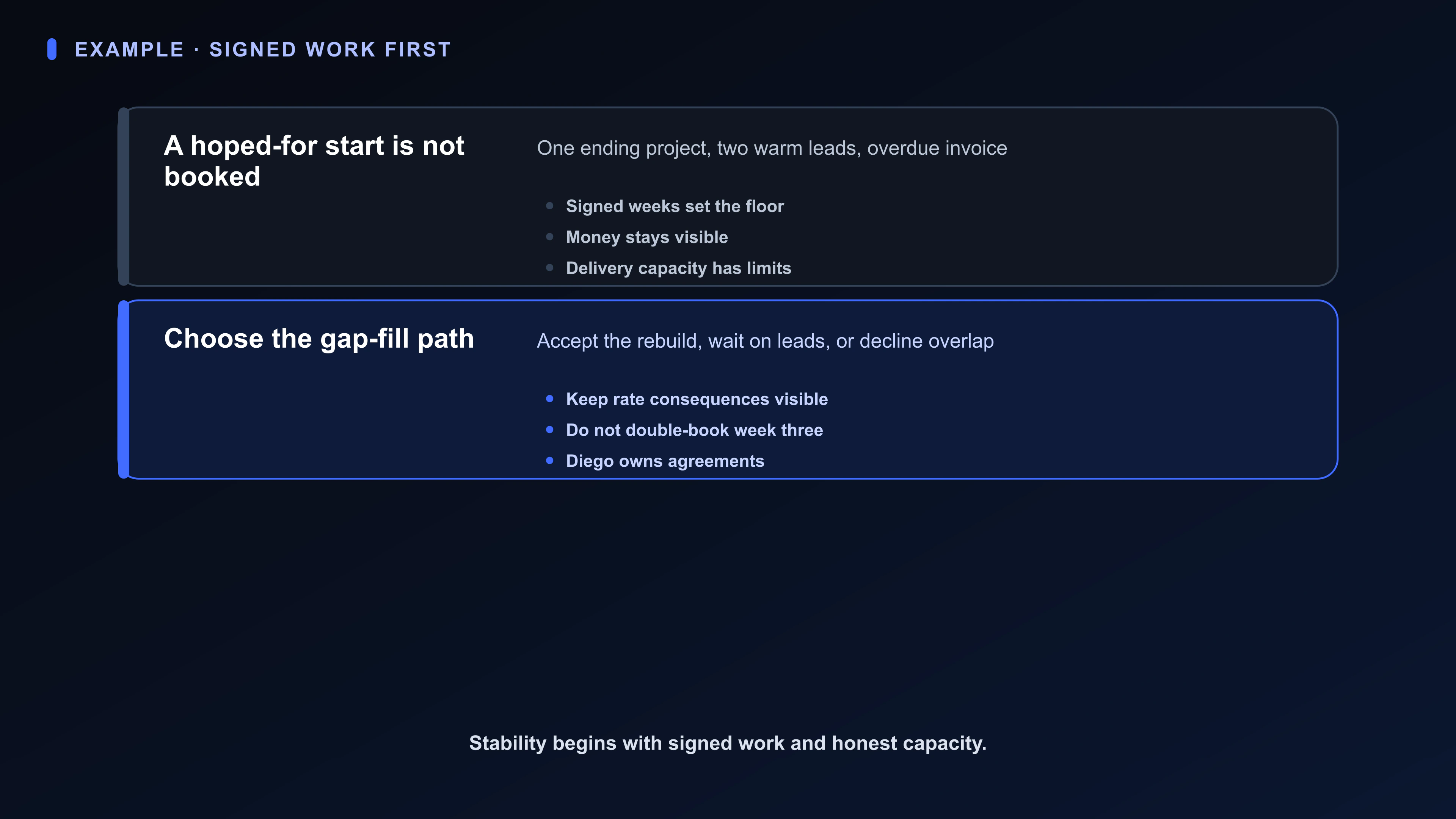
Diego's hoped-for starts make the calendar look fuller than the contracts do. He needs to choose whether to accept the below-floor rebuild, wait on unsigned leads, or decline a new request that overlaps week three.
Keep eight weeks of real work visible—signed, invoiced, or clearly waiting—without filling gaps by underpricing
Cash-flow floor and the rule that unsigned is not booked
Keep the cash-flow floor beside the rule that a maybe is not a booking
Signed work with delivery dates
Hold the ending project’s final-week tasks and review date
Conversations that are not contracts
Compare low-rate rebuild, waiting on unsigned leads, and declining the overlapping inbound
Keep a warm lead out of the Active list until it is signed
Hold the below-floor rebuild so filling the calendar stays a decision
Keep the second unsigned conversation out of Active until signed
Keep the overlapping request visible as an option Diego still controls
Invoices sent, due, and overdue
Make unpaid work as visible as future work
Signatures and client replies
Hold the sent agreement until the university client signs or declines
The Freelance pipeline Board separates signed delivery, leads, invoices, and replies already requested so an unsigned conversation never counts as booked work.
The Pipeline-gap Room keeps signed weeks, cash timing, overdue money, delivery capacity, and the three gap-fill paths together.
Ava can compare the visible pipeline facts. Diego sets his floor, prices and delivers the work, chooses clients, and sends every agreement and reply.
A full calendar is not the same as a stable pipeline
The work has a clear center: Keep eight weeks of real work visible—signed, invoiced, or clearly waiting—without filling gaps by underpricing.
Organizing the evidence does not authorize the software to decide: Whether to take the low-rate rebuild, wait on the two unsigned leads, or decline the inbound that overlaps final-week delivery.
You.one can keep the work, evidence, anything already waiting on another person or event, and the “Choose the gap-fill path” decision visible through its Superboard view. Diego still owns the call: Diego chooses what to accept, sends every client message, and owns pricing and invoices.
Available today
Name the work in plain language
These Card titles come directly from Diego's situation: “Choose the gap-fill path” is the live choice, “Finish: desert-college onboarding course” holds evidence, and “University signature requested” names something genuinely in motion outside Diego's control. The point is recognition, not a perfect taxonomy.
Swipe or scroll sideways to see every column.
| Card | List | Job |
|---|---|---|
| Eight weeks of real work | Mission | Keep the cash-flow floor beside the rule that a maybe is not a booking |
| Choose the gap-fill path | Leads | Compare low-rate rebuild, waiting on unsigned leads, and declining the overlapping inbound |
| Finish: desert-college onboarding course | Active | Hold the ending project’s final-week tasks and review date |
| Unsigned: university methods module | Leads | Keep a warm lead out of the Active list until it is signed |
| Low-rate course rebuild offer | Leads | Hold the below-floor rebuild so filling the calendar stays a decision |
| Unsigned: second warm lead | Leads | Keep the second unsigned conversation out of Active until signed |
| Invoice 118 overdue | Money | Make unpaid work as visible as future work |
| Inbound overlap in week three | Leads | Keep the overlapping request visible as an option Diego still controls |
| University signature requested | Replies already requested | Hold the sent agreement until the university client signs or declines |
Available today
Freelance pipeline: separate the kinds of attention
The Freelance pipeline Board gives this mission one durable operating picture. Diego can use familiar language instead of translating the situation into project-management jargon. Its five Lists separate the kinds of attention this situation actually requires.
The Lists use Diego's own language so actions, evidence, open questions, and decisions do not collapse into one queue. A separate place for replies is useful only after Diego has asked someone or a real outside event must happen first.
Swipe or scroll sideways to see every column.
| List | What belongs here |
|---|---|
| Mission | Cash-flow floor and the rule that unsigned is not booked |
| Active | Signed work with delivery dates |
| Leads | Conversations that are not contracts |
| Money | Invoices sent, due, and overdue |
| Replies already requested | Signatures and client replies |
Ask Ava to prepare the judgment—not make it
These requests stay with the facts Diego has made visible around “Choose the gap-fill path.” Diego supplies the evidence, checks Ava's work, and decides what belongs in the Room.
Current Ava can prepare help after an explicit request. She cannot make the choice, represent Diego, watch other work on her own, or contact anyone.
Diego owns pricing, contracts, invoices, and every client conversation. Ava does not send email, chase payment, or accept work.
A pipeline that tells the truth: eight weeks show signed versus maybe, an overdue invoice is visible, and a low-rate fill is a decision.
- Request idea: using only the context visible in this Card Room, compare taking the low-rate rebuild, waiting on unsigned leads, and declining the overlapping inbound. Do not email clients or choose for me.
- Request idea: use only the Pipeline-gap brief and notes the Owner has placed in this Card Room to separate facts, assumptions, and unanswered questions
- Request idea: in “Choose the gap-fill path,” group the visible evidence by option and leave the decision open
Available today
One Card Room for the consequential choice
Opening the Card gives the visible item durable depth. Stage can hold Pipeline-gap brief: Place signed weeks, overdue invoices, and the rebuild / wait / decline options on one page. Chat keeps the request and response beside that artifact instead of in a detached thread. Notifications can bring this update forward: “Open decision: Diego will choose how the next eight weeks get filled.”
A Card Chat request can ask Ava to prepare the specific comparison or extraction in “Choose the gap-fill path” from the visible evidence. Ava can work from the context Diego deliberately brings into this Card, List, or Board; she cannot monitor the rest of life, contact anyone, or inherit the decision.
Diego's call remains explicit: Diego chooses what to accept, sends every client message, and owns pricing and invoices.
Swipe or scroll sideways to see every column.
| Surface | Job in this example |
|---|---|
| Stage | Pipeline-gap brief: Place signed weeks, overdue invoices, and the rebuild / wait / decline options on one page |
| Chat | Keep Diego's request and Ava's attributed response with the work |
| Notifications | Open decision: Diego will choose how the next eight weeks get filled |
Build only enough Board to make the next decision
Diego should rename every List or Card that feels artificial. This recipe succeeds when “Choose the gap-fill path” becomes easier to decide and fewer open loops depend on memory—not when the Board looks tidy.
Swipe or scroll sideways to see every column.
| Step | Action |
|---|---|
| 1. Write the floor | How many signed weeks you need, and that unsigned is not booked |
| 2. List signed work | Only contracts and delivery dates on Active |
| 3. Keep leads honest | Warm conversations stay on Leads |
| 4. Surface money | Invoices due and overdue as Cards |
| 5. Choose the gap-fill path | Open a Room before a low-rate yes becomes the default |
Where this example stops
- This is a fictional example, not a customer story.
- This is not financial, tax, or legal advice.
- It does not show Ava emailing clients, collecting invoices, or signing work.
- It is not a measured revenue result or a client testimonial.