
Example
How to prepare an interview loop without letting each round wipe the last
Sophie has one evening and two real preparation paths. She must choose the written exercise, a mock panel, or a deliberate split while keeping her walk-away line and the employer’s implementation focus visible.
Walk each remaining round with the same story set, people map, and posting constraints, then decide with evidence rather than adrenaline
The role test and what would make Sophie walk away
Keep the walk-away line visible beside preparation
Keep the employer's role language beside Sophie's walk-away line and preparation choice
Each interviewer and what is known about them
Map who is in the room before Friday
Keep the recruiter's exact comment visible as context, not a promise about the panel
Evidence stories reused across rounds
Keep a reusable story with facts Sophie can stand behind
Hold a second reusable story with Sophie's decision, actions, and consequences separated from confidential detail
Written, panel, and director steps with dates
Compare written-exercise, mock-panel, and split-time options before Thursday
Hold the written prompt and its timebox as the current-round packet
Keep the panel date and preparation needs connected to Thursday's evidence
Keep a possible later round visible without treating it as scheduled
Scheduling, mock-panel times, and recruiter replies
Hold Sophie's sent scheduling request until Alex confirms a time before Thursday
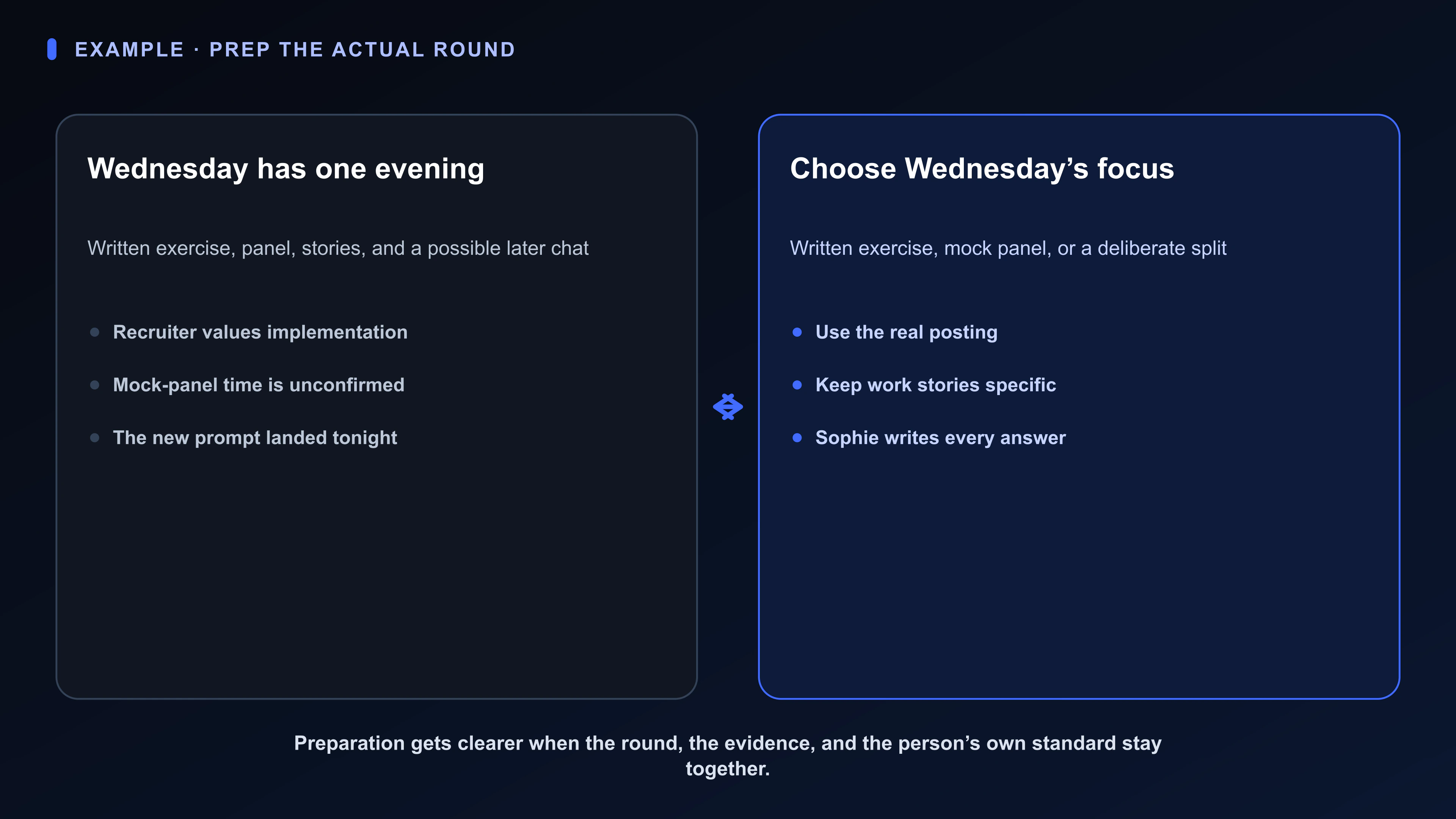
The Interview loop Board keeps rounds, people, specific stories, posting evidence, and open requests together without turning preparation into predicted success.
The Choose Wednesday’s prep focus Card becomes a Room for the prompt, recruiter note, panel names, mock request, and three time allocations.
Ava can compare visible preparation evidence. Sophie owns every answer, story, employer conversation, and continue-or-stop decision; Ava writes and attends nothing.
Each round needs the last round’s evidence
What belongs together is specific: Walk each remaining round with the same story set, people map, and posting constraints, then decide with evidence rather than adrenaline.
The consequential judgment remains human: Whether to use Wednesday night to sharpen the written exercise, run the mock panel, or split the remaining time between both.
You.one can keep the work, evidence, anything already waiting on another person or event, and the “Choose Wednesday's prep focus” decision visible through its Superboard view. Sophie still owns the call: Sophie chooses Wednesday's preparation focus, writes her own exercise, and owns every conversation with Alex and the recruiter.
What changes after a notebook plus the job PDF
A notebook plus the job PDF can be enough while the situation stays simple: there is one conversation.
It starts to break when a written round, a panel, and a walk-away line all have to survive the week.
The Interview loop Board earns its place only when the familiar tool—a notebook plus the job PDF—can no longer keep the reason, Prep-focus brief, conversation, current state, decision, and history connected.
Available today
A focused Interview loop Board
The Interview loop Board gives this mission one durable operating picture. Sophie can use familiar language instead of translating the situation into project-management jargon. Its five Lists separate the kinds of attention this situation actually requires.
The point is a fast scan: what is moving, what is known, what is unresolved, and what Sophie must choose. Questions not yet asked stay with Sophie; they do not move to a list for outside replies.
Swipe or scroll sideways to see every column.
| List | What belongs here |
|---|---|
| Mission | The role test and what would make Sophie walk away |
| People and replies | Each interviewer and what is known about them |
| Stories | Evidence stories reused across rounds |
| Rounds | Written, panel, and director steps with dates |
| Replies already requested | Scheduling, mock-panel times, and recruiter replies |
Available today
Inside the “Choose Wednesday's prep focus” Room
Opening the Card gives the visible item durable depth. Stage can hold Prep-focus brief: Place the written prompt, posting language, recruiter note, and Alex's pending time beside written / mock / split options. Chat keeps the request and response beside that artifact instead of in a detached thread. Notifications can bring this update forward: “Open decision: Sophie will choose written exercise, mock panel, or split-time preparation.”
A Card Chat request can ask Ava to prepare the specific comparison or extraction in “Choose Wednesday's prep focus” from the visible evidence. Ava can work from the context Sophie deliberately brings into this Card, List, or Board; she cannot monitor the rest of life, contact anyone, or inherit the decision.
Sophie's call remains explicit: Sophie chooses Wednesday's preparation focus, writes her own exercise, and owns every conversation with Alex and the recruiter.
Swipe or scroll sideways to see every column.
| Surface | Job in this example |
|---|---|
| Stage | Prep-focus brief: Place the written prompt, posting language, recruiter note, and Alex's pending time beside written / mock / split options |
| Chat | Keep Sophie's request and Ava's attributed response with the work |
| Notifications | Open decision: Sophie will choose written exercise, mock panel, or split-time preparation |
What Ava can prepare from visible context
These requests stay with the facts Sophie has made visible around “Choose Wednesday's prep focus.” Sophie supplies the evidence, checks Ava's work, and decides what belongs in the Room.
Current Ava can prepare help after an explicit request. She cannot make the choice, represent Sophie, watch other work on her own, or contact anyone.
Sophie owns her answers, her stories, and whether she continues. Ava does not write the exercise, attend interviews, or contact the recruiter.
A loop that remembers itself: Thursday’s prompt sits with the posting, stories are reusable, and Wednesday’s limited preparation time has a deliberate focus.
- Request idea: using only the context visible in this Card Room, compare using Wednesday for the written exercise, the mock panel, or a split between both. Do not write the exercise, contact Alex, or choose for me.
- Request idea: use only the Prep-focus brief and notes the Owner has placed in this Card Room to separate facts, assumptions, and unanswered questions
- Request idea: from “Choose Wednesday's prep focus,” draft a short decision note and name Sophie as the decider
A starter shape, not a prescribed workflow
Sophie should rename every List or Card that feels artificial. This recipe succeeds when “Choose Wednesday's prep focus” becomes easier to decide and fewer open loops depend on memory—not when the Board looks tidy.
Swipe or scroll sideways to see every column.
| Step | Action |
|---|---|
| 1. Write the walk-away line | Put it on the Mission Card before adrenaline writes it for you |
| 2. Card each round | Dates, prompts, and logistics in one place |
| 3. Build a story set | Reusable evidence, not a new personality each night |
| 4. Map people | Names and known focus for each interviewer |
| 5. Choose Wednesday's prep focus | Open a Room before the written exercise and mock-panel offer compete for the same night |
Where this example stops
- This is a fictional example, not a customer story.
- This is not interview coaching, a hiring prediction, or a claim Superboard contacted an employer.
- It does not show Ava writing answers or attending interviews.
- It is not a measured offer result.