
Example
How to finish a graduate thesis without losing the last month to scattered notes
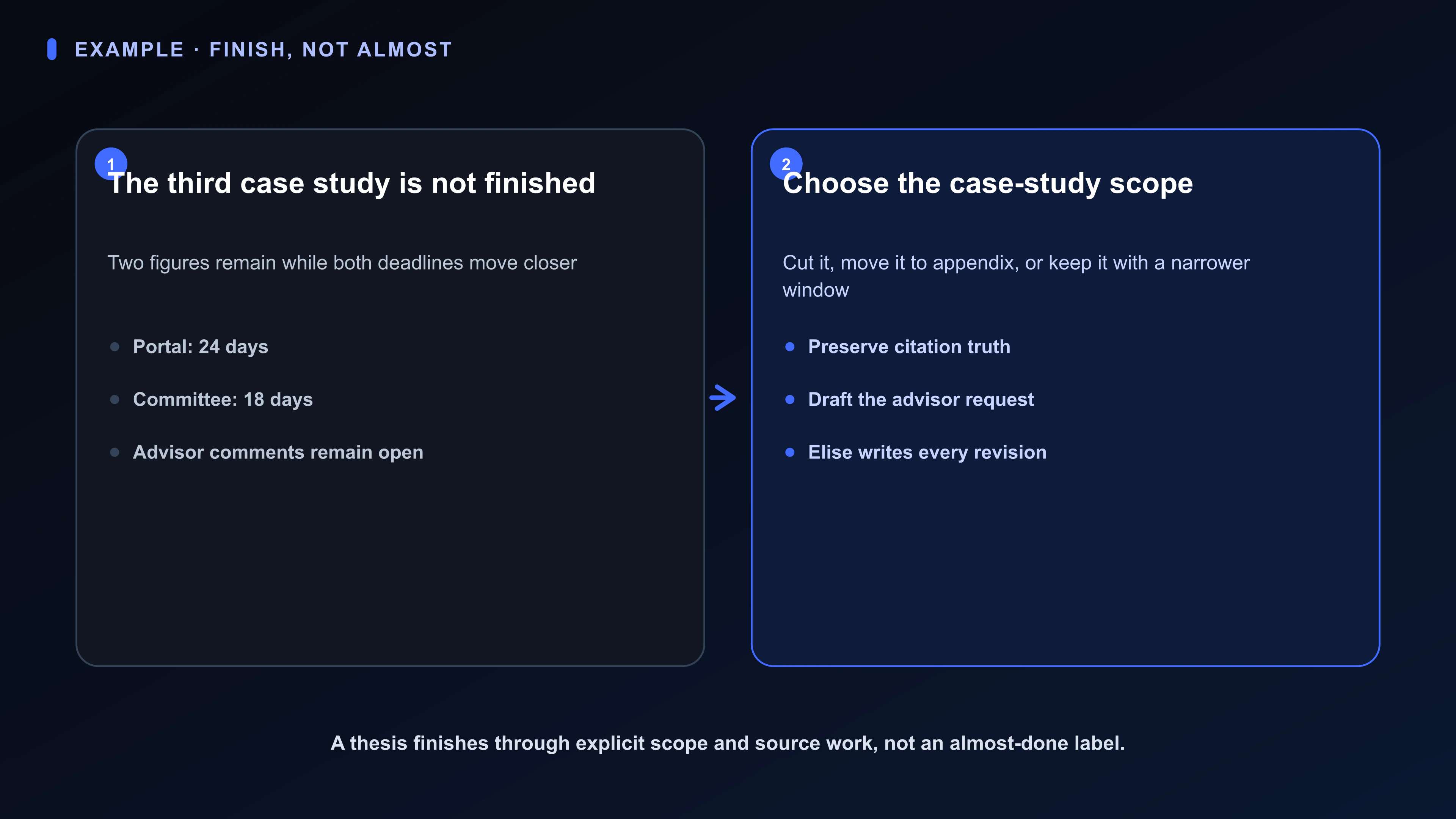
Elise has a complete draft and 24 days, but the third case study still contains two unfinished figures. She must cut it, move it to an appendix, or keep it in the body and ask for a narrower revision window.
Submit a complete, formatted thesis by the portal date without hiding unfinished figures inside chapters marked done
Submission date, degree requirement, and the quality line Elise will not fake
Keep the portal date and the rule that almost-done chapters are not done
Keep the remaining days visible beside every scope option
Keep the committee date from disappearing inside the final portal countdown
Each chapter or major section as its own Card
Compare cut, appendix, and keep-and-narrow options against remaining days
Show the actual state of the section being cut, moved, or kept
Keep an ordinary completed chapter beside the still-open case-study scope
Keep the other live chapter visible so scope is compared against the whole remaining month
Figures, tables, citations, and files that still have to be true
Keep the missing caption and citation visible instead of buried in a chapter file
Advisor and committee notes to apply, plus questions Elise still owns
Hold the advisor’s shortening request with the current paragraph, not as a vague memory
Preserve margin, heading, and citation-style comments as work, not as rereading
Hold the unsent request Elise would need to make if she keeps the case study in the body
Formatting, permissions, and portal steps
Separate PDF export, naming, and confirmation from the writing itself
The Thesis finish line Board keeps chapters, evidence, feedback requests, and production work separate while the whole submission stays visible.
The Decide the third case study Card becomes a Room for both dates, open figures, advisor comments, and the three scope paths.
Ava can compare visible evidence without writing the thesis. Elise owns the argument, citations, revisions, advisor conversation, and submission.
The last month is a sequence, not a feeling of almost done
What belongs together is specific: Submit a complete, formatted thesis by the portal date without hiding unfinished figures inside chapters marked done.
The consequential judgment remains human: Whether to cut the third case study, keep it as an appendix, or keep it in the body and ask the advisor for a narrower revision window.
You.one can keep the work, several kinds of evidence, and “Decide the third case study” decision visible through its Superboard view. The organized facts support Elise; they do not replace Elise's judgment: Elise chooses the case-study scope, writes the revision, and owns every conversation with her advisor and committee.
What changes after a long shared document plus email
A long shared document plus email can be enough while the situation stays simple: there is one reader, one draft, and one round of comments.
It starts to break when chapters, figures, formatting, and committee notes all claim to be the next hour.
The Thesis finish line Board earns its place only when the familiar tool—a long shared document plus email—can no longer keep the reason, Case-study options brief, conversation, current state, decision, and history connected.
Available today
A focused Thesis finish line Board
The Thesis finish line Board gives this mission one durable operating picture. Elise can use familiar language instead of translating the situation into project-management jargon. Its five Lists separate the kinds of attention this situation actually requires.
The point is a fast scan: what is moving, what is known, what is unresolved, and what Elise must choose. Questions not yet asked stay with Elise; they do not move to a list for outside replies.
Swipe or scroll sideways to see every column.
| List | What belongs here |
|---|---|
| Mission | Submission date, degree requirement, and the quality line Elise will not fake |
| Chapters | Each chapter or major section as its own Card |
| Evidence | Figures, tables, citations, and files that still have to be true |
| Feedback and requests | Advisor and committee notes to apply, plus questions Elise still owns |
| Production | Formatting, permissions, and portal steps |
Available today
Inside the “Decide the third case study” Room
Opening the Card gives the visible item durable depth. Stage can hold Case-study options brief: Place “Portal deadline: 24 days left,” “Committee review: 18 days left,” “Third case study: full draft, two figures unfinished,” “Discussion chapter: advisor comments open,” the unsent “Advisor request: narrower revision window,” and the cut / appendix / keep-in-body options on one page. Chat keeps the request and response beside that artifact instead of in a detached thread. Notifications can bring this update forward: “Open decision: Elise will choose the case-study scope.”
A Card Chat request can ask Ava to prepare the specific comparison or extraction in “Decide the third case study” from the visible evidence. Ava can work from the context Elise deliberately brings into this Card, List, or Board; she cannot monitor the rest of life, contact anyone, or inherit the decision.
Elise's call remains explicit: Elise chooses the case-study scope, writes the revision, and owns every conversation with her advisor and committee.
Swipe or scroll sideways to see every column.
| Surface | Job in this example |
|---|---|
| Stage | Case-study options brief: Place “Portal deadline: 24 days left,” “Committee review: 18 days left,” “Third case study: full draft, two figures unfinished,” “Discussion chapter: advisor comments open,” the unsent “Advisor request: narrower revision window,” and the cut / appendix / keep-in-body options on one page |
| Chat | Keep Elise's request and Ava's attributed response with the work |
| Notifications | Open decision: Elise will choose the case-study scope |
What Ava can prepare from visible context
These requests stay with the facts Elise has made visible around “Decide the third case study.” Elise supplies the evidence, checks Ava's work, and decides what belongs in the Room.
Current Ava can prepare help after an explicit request. She cannot make the choice, represent Elise, watch other work on her own, or contact anyone.
Elise owns the scholarly argument, cuts, citations, and committee conversations. Ava does not write the thesis, invent sources, or submit the portal package.
A finish-line picture: the third case study has a chosen fate, unfinished figures are not hiding inside “done,” and the portal steps are their own work.
- Request idea: using only “Portal deadline: 24 days left,” “Committee review: 18 days left,” “Third case study: full draft, two figures unfinished,” “Discussion chapter: advisor comments open,” and the unsent “Advisor request: narrower revision window,” compare cutting the third case study, moving it to an appendix, and keeping it in the body while sending the narrower-window request. Do not rewrite the chapter or choose for me.
- Request idea: use only the Case-study options brief and notes the Owner has placed in this Card Room to separate facts, assumptions, and unanswered questions
- Request idea: from “Decide the third case study,” draft a short decision note and name Elise as the decider
A starter shape, not a prescribed workflow
Elise should rename every List or Card that feels artificial. This recipe succeeds when “Decide the third case study” becomes easier to decide and fewer open loops depend on memory—not when the Board looks tidy.
Swipe or scroll sideways to see every column.
| Step | Action |
|---|---|
| 1. Put both dates on Mission | Record the submission-portal date and committee date before sequencing the month |
| 2. Split the document | Make one Card per chapter or major remaining section |
| 3. Surface evidence gaps | Create Cards for missing figures, captions, and citations |
| 4. Capture feedback as work | Turn advisor and committee notes into Cards, not rereading loops |
| 5. Isolate production | Keep formatting and portal steps off the writing lists |
| 6. Decide the third case study | Open a Room for the scope choice that unblocks the last month |
Where this example stops
- This is a fictional example, not a customer story.
- This is not academic editing, originality checking, or a claim Superboard accessed a thesis portal.
- It does not show Ava writing chapters, contacting a committee, or guaranteeing a defense result.
- It is not a measured completion rate or a recommended thesis structure.