
Example
How a nursing student can organize a clinical rotation week
Jordan has to choose among three schedule paths: take Tuesday’s quiz if the Friday clinical swap confirms, keep Wednesday clinical and take Tuesday’s quiz, or use the published Monday makeup. The Board organizes logistics, not clinical judgment.
Arrive at the first clinical week with onboarding, skills evidence, and transport settled, without hiding the medication-calculation quiz that still has to happen
What “ready for Monday” actually includes
Keep clinical start and the medication-calculation quiz on the same operating picture
Badges, modules, forms, and site rules
Hold desk hours and required ID so Monday morning is not an errand surprise
List unfinished required modules as work, not as a portal tab
Checklists, practice, and the medication-calculation quiz
Compare Friday 6:30 a.m. clinical swap if confirmed plus Tuesday quiz, keep Wednesday 6:30 a.m. plus Tuesday quiz, and next-Monday makeup against shift start times
Attach the practice set and the quiz date to the rotation week
Make the makeup path a dated option rather than an unnamed policy
Ground the two Tuesday-night paths in the actual quiz sitting
Preceptor, instructor, and start times
Ground the current clinical shift and commute in a named, visible schedule Card
Only the preceptor-swap request Jordan already sent
Keep the unanswered swap request from pretending to be a confirmed plan
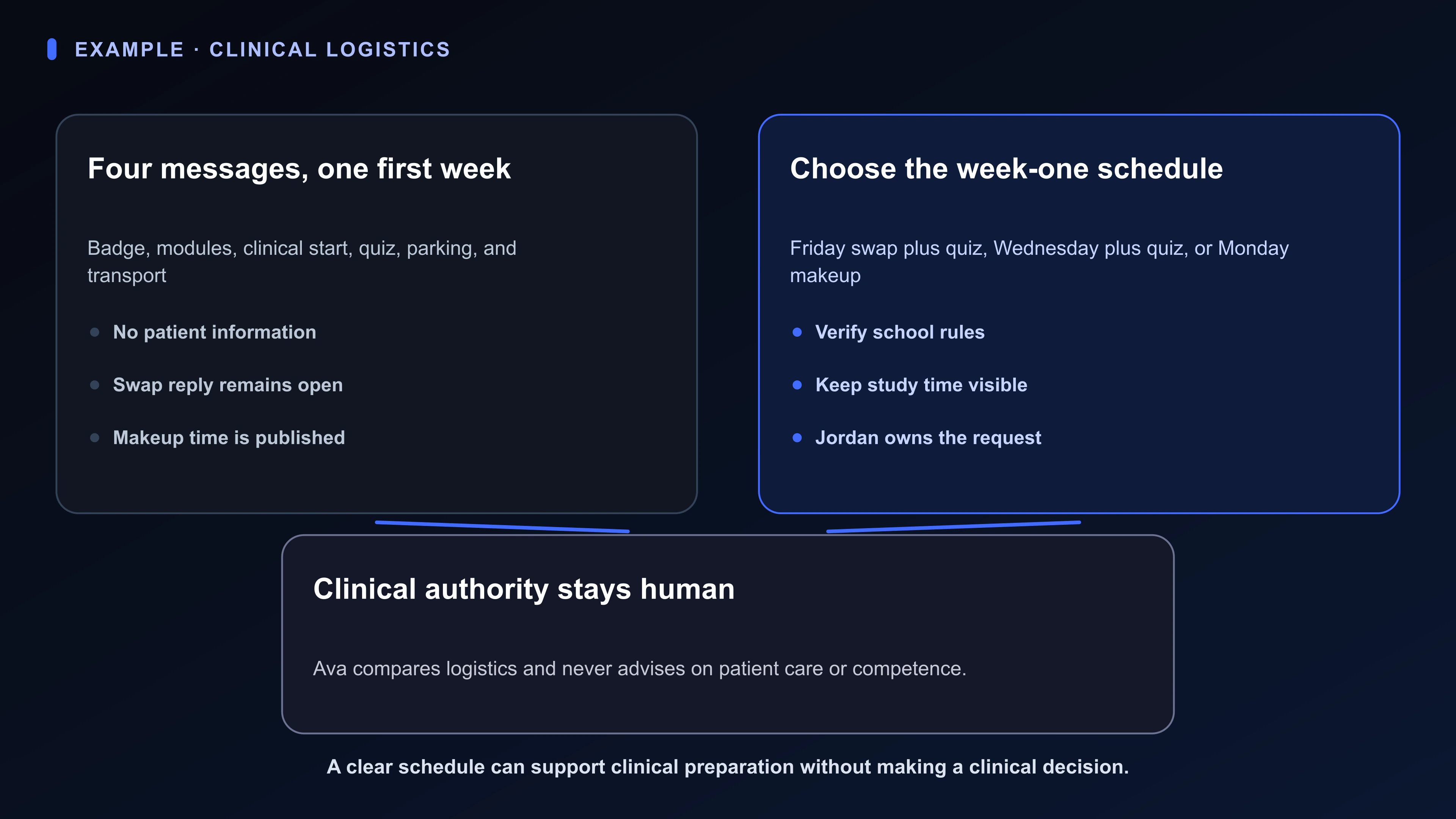
The Clinical week one Board keeps onboarding, skills study, transport, shifts, and real replies together without containing patient information.
The Choose how the quiz fits week one Card becomes a Room for the published times, sent swap request, and complete schedule options.
Ava can compare those logistics only. Jordan owns schoolwork, messages, patient safety, and clinical judgment; Ava gives no clinical advice and completes no modules.
The rotation is a week of proof, not a vibe of being ready
The mission is specific: Arrive at the first clinical week with onboarding, skills evidence, and transport settled, without hiding the medication-calculation quiz that still has to happen.
The consequential choice is not something a board or an AI should quietly make: Whether to take the Tuesday-night medication-calculation quiz if the Friday 6:30 a.m. clinical swap is confirmed, keep the Wednesday 6:30 a.m. clinical shift and take the Tuesday-night quiz, or keep Wednesday and take the published next-Monday makeup.
You.one can keep the work, evidence, anything already waiting on another person or event, and the “Choose how the quiz fits week one” decision visible through its Superboard view. Jordan still owns the call: Jordan chooses the schedule, writes any message to the preceptor or instructor, and owns their own clinical and exam work.
Available today
Clinical week one: the working map
The Clinical week one Board gives this mission one durable operating picture. Jordan can use familiar language instead of translating the situation into project-management jargon. Its five Lists separate the kinds of attention this situation actually requires.
The Lists separate what Jordan can move now, what is evidence, what is already waiting on a named person or event, and what still needs a decision.
Swipe or scroll sideways to see every column.
| List | What belongs here |
|---|---|
| Mission | What “ready for Monday” actually includes |
| Onboarding | Badges, modules, forms, and site rules |
| Skills and study | Checklists, practice, and the medication-calculation quiz |
| People and shifts | Preceptor, instructor, and start times |
| Replies already requested | Only the preceptor-swap request Jordan already sent |
Available today
Open one decision: Choose how the quiz fits week one
Opening the Card gives the visible item durable depth. Stage can hold Week-one schedule brief: Place “Preceptor Lee: Wednesday 6:30 a.m. start,” “Medication-calculation quiz: Tuesday 7 p.m.,” “Published quiz makeup: next Monday 5 p.m.,” “Preceptor swap request sent: Friday 6:30 a.m.,” and the three complete paths on one page. Chat keeps the request and response beside that artifact instead of in a detached thread. Notifications can bring this update forward: “Open decision: Jordan will choose how the quiz fits the first clinical week.”
A Card Chat request can ask Ava to prepare the specific comparison or extraction in “Choose how the quiz fits week one” from the visible evidence. Ava can work from the context Jordan deliberately brings into this Card, List, or Board; she cannot monitor the rest of life, contact anyone, or inherit the decision.
Jordan's call remains explicit: Jordan chooses the schedule, writes any message to the preceptor or instructor, and owns their own clinical and exam work.
Swipe or scroll sideways to see every column.
| Surface | Job in this example |
|---|---|
| Stage | Week-one schedule brief: Place “Preceptor Lee: Wednesday 6:30 a.m. start,” “Medication-calculation quiz: Tuesday 7 p.m.,” “Published quiz makeup: next Monday 5 p.m.,” “Preceptor swap request sent: Friday 6:30 a.m.,” and the three complete paths on one page |
| Chat | Keep Jordan's request and Ava's attributed response with the work |
| Notifications | Open decision: Jordan will choose how the quiz fits the first clinical week |
Useful Ava requests, with the boundary intact
These requests stay with the facts Jordan has made visible around “Choose how the quiz fits week one.” Jordan supplies the evidence, checks Ava's work, and decides what belongs in the Room.
Current Ava can prepare help after an explicit request. She cannot make the choice, represent Jordan, watch other work on her own, or contact anyone.
Jordan owns clinical judgment, patient safety, schoolwork, and every message to preceptor or instructor. Ava does not give clinical advice, complete modules, or speak to the site.
A first week Jordan can scan: onboarding is listed, the quiz has a chosen place, and a maybe-swap is no longer the hidden plan.
- Request idea: using only this Room, compare taking “Medication-calculation quiz: Tuesday 7 p.m.” if “Preceptor swap request sent: Friday 6:30 a.m.” is confirmed; taking the quiz while keeping “Preceptor Lee: Wednesday 6:30 a.m. start”; and keeping that clinical start while taking “Published quiz makeup: next Monday 5 p.m.” Do not contact the preceptor or choose for me.
- Request idea: use only the Week-one schedule brief and notes the Owner has placed in this Card Room to separate facts, assumptions, and unanswered questions
- Request idea: in “Choose how the quiz fits week one,” show which visible fact could reverse the current choice
The limit of school email plus a printed skills booklet
School email plus a printed skills booklet can be enough while the situation stays simple: onboarding is already done and the week is simple.
It starts to break when hospital modules, badge pickup, a preceptor, and a quiz all claim to be Monday.
The Clinical week one Board earns its place only when the familiar tool—school email plus a printed skills booklet—can no longer keep the reason, Week-one schedule brief, conversation, current state, decision, and history connected.
A practical way to start the Clinical week one Board
Jordan should rename every List or Card that feels artificial. This recipe succeeds when “Choose how the quiz fits week one” becomes easier to decide and fewer open loops depend on memory—not when the Board looks tidy.
Swipe or scroll sideways to see every column.
| Step | Action |
|---|---|
| 1. Define ready | Write what Monday actually requires: badge, modules, transport, skills |
| 2. Capture onboarding | One Card per unfinished form, module, or pickup |
| 3. Place people and hours | Add the preceptor and start times as Cards; do not invent an instructor-contact Card |
| 4. Park only sent asks | Keep “Preceptor swap request sent: Friday 6:30 a.m.” in Replies already requested until it is answered |
| 5. Decide how the quiz fits | Open the “Choose how the quiz fits week one” Room and compare the Friday swap if confirmed, keep-Wednesday, and next-Monday-makeup paths |
Where this example stops
- This is a fictional example, not a customer story.
- This is not clinical, medical, or licensing advice, and it is not a hospital onboarding system.
- It does not show Ava contacting a preceptor, completing modules, or making a patient-care judgment.
- It is not a claim about any school’s rotation policy or a measured student result.