
Example
How to plan a homeschool semester without turning the kitchen into the system
Drew needs to choose whether science waits for the kit, shifts to a library-based unit if the hold confirms, or splits into two six-week tracks that require four adult hours each week.
Run a spring semester with two clear weekly loads, co-op days honored, and no unit pretending to start before its materials exist
Semester aims and the household time actually available
Keep available adult hours beside the rule that a missing kit is not a Monday start
That child’s work, not a combined chart
Give the younger child’s math its own Card instead of a combined checklist
That child’s work at a different pace
Hold the older child’s longer writing work where it can accumulate drafts
Co-op, outings, and work that needs an adult
Compare delay, library substitute if its hold is available, and split-track options
Honor a standing out-of-house commitment on the same Board as home days
Keep the younger child's proposed split-track option as decision evidence until Drew chooses it
Keep the older child's proposed split-track option as decision evidence until Drew chooses it
Ground the split-track path in the additional adult time it consumes
Kits, library holds, and co-op replies
Keep the missing materials from occupying the start-this-week list
Keep the substitute unit and its library-material availability visible as a real second path
The Spring semester Board keeps each child’s work, shared days, materials, and real outside replies visible without pretending both children move at one pace.
The Decide the science-unit delay Card becomes a Room for the kit, library hold, two track plans, and adult-time cost.
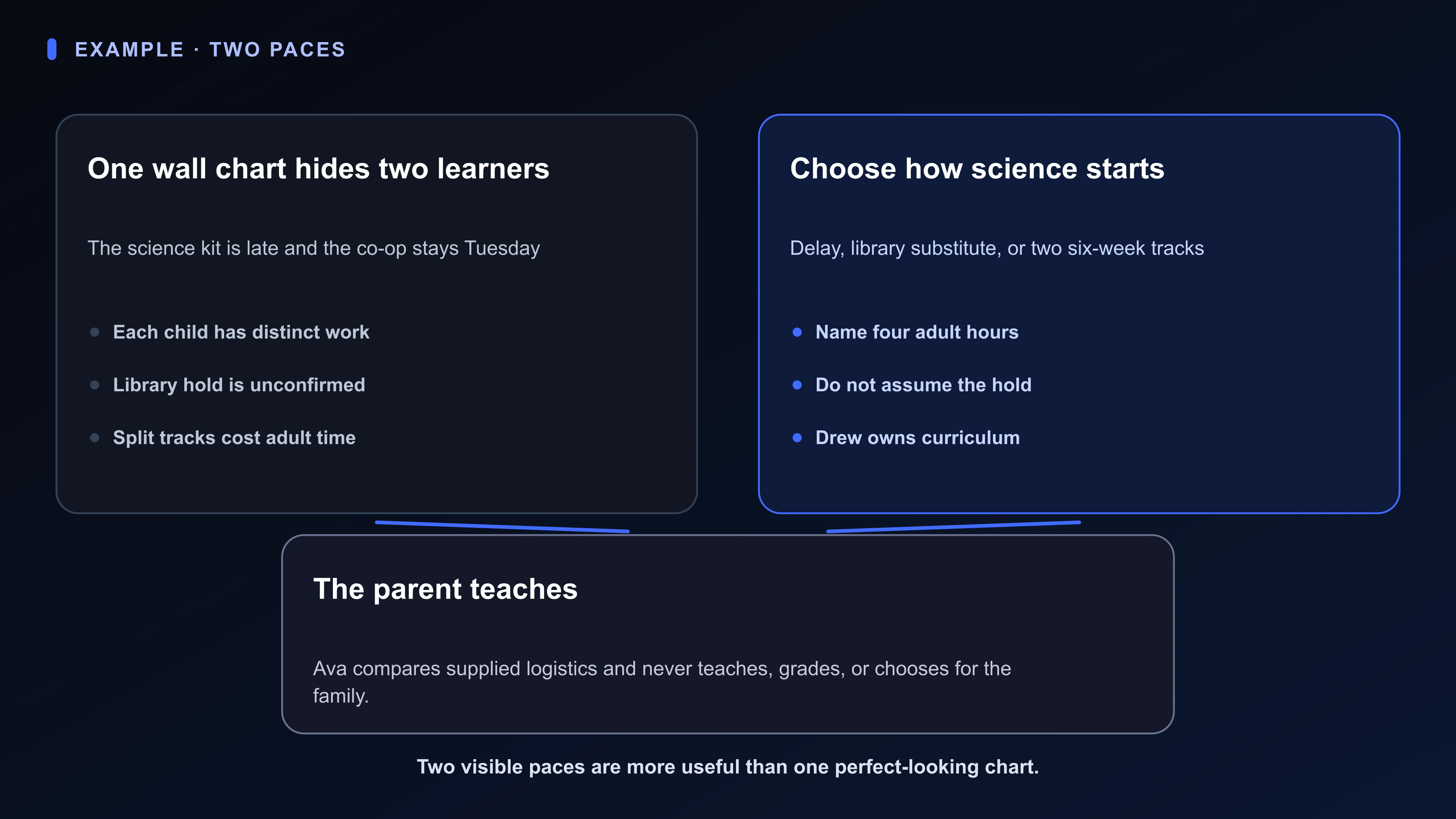
Ava can compare supplied logistics. Drew owns curriculum, purchases, teaching, co-op communication, and the children’s actual work; Ava teaches and grades nothing.
Two ages means two paces, not one colorful chart
What belongs together is specific: Run a spring semester with two clear weekly loads, co-op days honored, and no unit pretending to start before its materials exist.
The consequential judgment remains human: Whether to delay the science unit until the kit arrives, substitute the library-based unit if the hold is available, or split the children onto different science tracks for six weeks.
You.one can keep the work, evidence, anything already waiting on another person or event, and the “Decide the science-unit delay” decision visible through its Superboard view. Drew still owns the call: Drew chooses the science plan, spends any money, and owns teaching, co-op communication, and the children’s actual work.
What changes after a wall chart on the fridge
A wall chart on the fridge can be enough while the situation stays simple: one child is learning and the needed materials are already in the house.
It starts to break when two paces, a co-op, and a back-ordered kit all claim to start Monday.
The Spring semester Board earns its place only when the familiar tool—a wall chart on the fridge—can no longer keep the reason, Science-unit options brief, conversation, current state, decision, and history connected.
Available today
A focused Spring semester Board
The Spring semester Board gives this mission one durable operating picture. Drew can use familiar language instead of translating the situation into project-management jargon. Its five Lists separate the kinds of attention this situation actually requires.
The point is a fast scan: what is moving, what is known, what is unresolved, and what Drew must choose. Questions not yet asked stay with Drew; they do not move to a list for outside replies.
Swipe or scroll sideways to see every column.
| List | What belongs here |
|---|---|
| Mission | Semester aims and the household time actually available |
| Ten-year-old | That child’s work, not a combined chart |
| Thirteen-year-old | That child’s work at a different pace |
| Shared days | Co-op, outings, and work that needs an adult |
| Replies already requested | Kits, library holds, and co-op replies |
Available today
Inside the “Decide the science-unit delay” Room
Opening the Card gives the visible item durable depth. Stage can hold Science-unit options brief: Place “Science kit back order,” “Library-based science unit hold,” “Ten-year-old: six-week nature study,” “Thirteen-year-old: six-week kitchen-physics track,” “Split-track adult time: four hours weekly,” and the delay / substitute / split options on one page. Chat keeps the request and response beside that artifact instead of in a detached thread. Notifications can bring this update forward: “Open decision: Drew will choose how science starts this semester.”
A Card Chat request can ask Ava to prepare the specific comparison or extraction in “Decide the science-unit delay” from the visible evidence. Ava can work from the context Drew deliberately brings into this Card, List, or Board; she cannot monitor the rest of life, contact anyone, or inherit the decision.
Drew's call remains explicit: Drew chooses the science plan, spends any money, and owns teaching, co-op communication, and the children’s actual work.
Swipe or scroll sideways to see every column.
| Surface | Job in this example |
|---|---|
| Stage | Science-unit options brief: Place “Science kit back order,” “Library-based science unit hold,” “Ten-year-old: six-week nature study,” “Thirteen-year-old: six-week kitchen-physics track,” “Split-track adult time: four hours weekly,” and the delay / substitute / split options on one page |
| Chat | Keep Drew's request and Ava's attributed response with the work |
| Notifications | Open decision: Drew will choose how science starts this semester |
What Ava can prepare from visible context
These requests stay with the facts Drew has made visible around “Decide the science-unit delay.” Drew supplies the evidence, checks Ava's work, and decides what belongs in the Room.
Current Ava can prepare help after an explicit request. She cannot make the choice, represent Drew, watch other work on her own, or contact anyone.
Drew owns curriculum choices, purchases, teaching, and co-op conversations. Ava does not teach the children, buy a kit, or grade work.
A semester picture with two paces: co-op is honored, the kit is not pretending to have arrived, and science has a chosen start.
- Request idea: using “Science kit back order,” “Library-based science unit hold,” “Ten-year-old: six-week nature study,” “Thirteen-year-old: six-week kitchen-physics track,” and “Split-track adult time: four hours weekly,” compare delaying science, using the library-based unit if its hold is available, and splitting tracks for six weeks. Do not buy anything or choose for me.
- Request idea: use only the Science-unit options brief and notes the Owner has placed in this Card Room to separate facts, assumptions, and unanswered questions
- Request idea: from “Decide the science-unit delay,” draft a short decision note and name Drew as the decider
A starter shape, not a prescribed workflow
Drew should rename every List or Card that feels artificial. This recipe succeeds when “Decide the science-unit delay” becomes easier to decide and fewer open loops depend on memory—not when the Board looks tidy.
Swipe or scroll sideways to see every column.
| Step | Action |
|---|---|
| 1. Split the children | Give each child a list so pace differences stay visible |
| 2. Add shared days | Put co-op and adult-needed work on their own list |
| 3. Capture materials | Create Replies already requested Cards for kits and holds that have not arrived |
| 4. Keep starts honest | Keep “Science kit back order” and “Library-based science unit hold” in Replies already requested; keep the “Decide the science-unit delay” Card and both split-track evidence Cards on Shared days until Drew records one path |
| 5. Decide blocked units | Open the Decide the science-unit delay Room and record delay, library substitute, or split tracks before moving chosen work to either child's List |
Where this example stops
- This is a fictional example, not a customer story.
- This is not homeschool legal, curricular, or child-development advice.
- It does not show Ava teaching, purchasing, or contacting a co-op.
- It is not a measured learning outcome or a recommended curriculum.