
Example
How to keep a year of language learning visible without a streak app
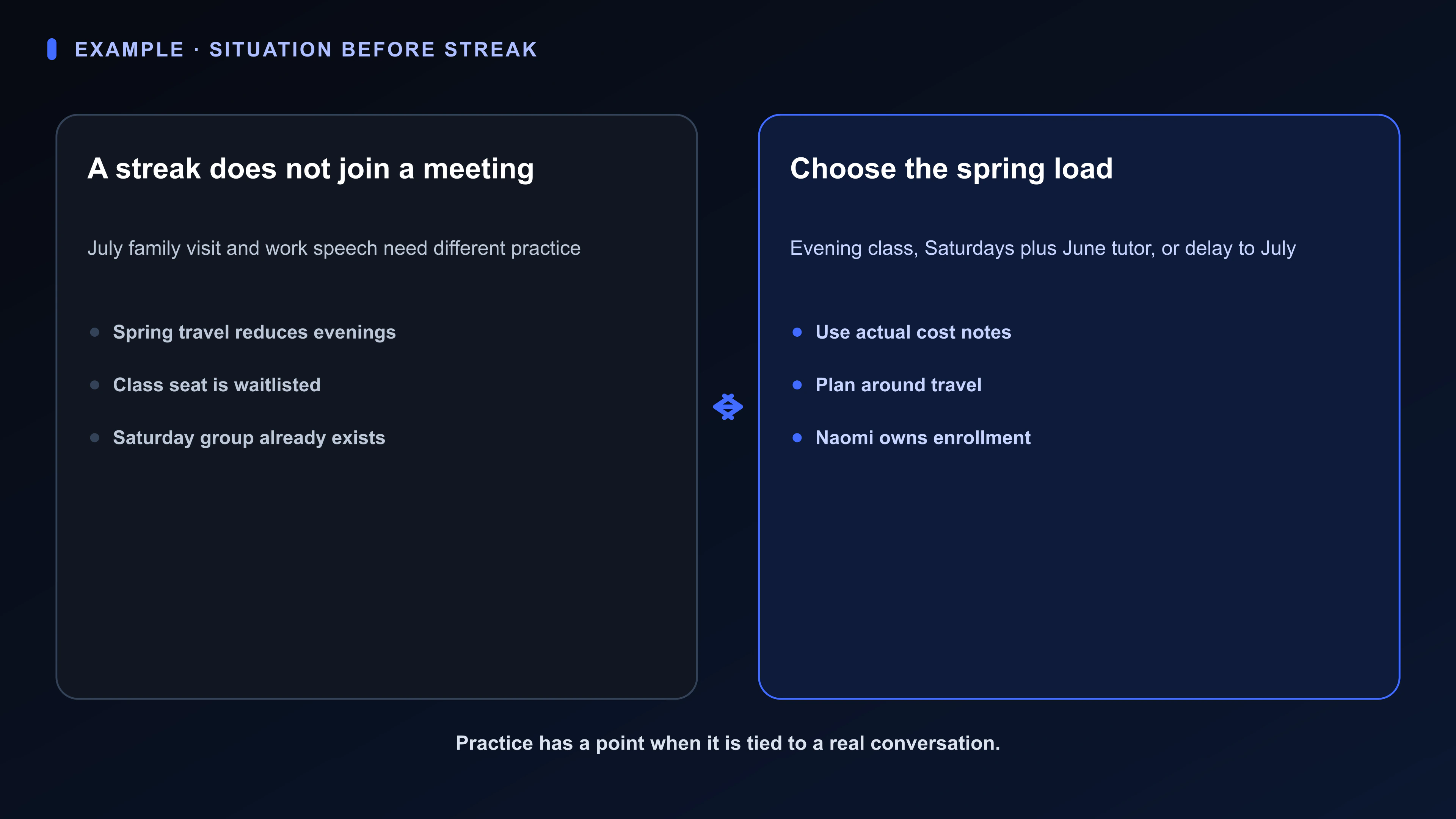
Naomi has a Saturday conversation group, March and April work travel, a class waitlist, and a possible June tutor. She needs to choose a spring practice load that reflects the situations where she wants to speak.
Build a year of French practice aimed at work meetings and a July family visit, without pretending an app streak is the plan
The July visit and the work-meeting situations that define enough
Keep the July family visit and standup phrases as the definition of progress
Keep the months with reduced practice capacity beside the spring decision
Weekly habits that are specific, not streak theater
Treat the group as a standing practice Card with what she wants to try each week
Keep one current listening piece attached to the week instead of an infinite saved folder
Real conversations, meetings, and visits to prepare for
Collect the actual phrases from her team’s standup rather than generic textbook dialogues
Keep the July conversations as a dated situation, not a streak
Classes, tutors, shows, and clippings actually in use
Compare twice-weekly class, Saturday-plus-June-tutor, and July-visit-as-deadline options
Ground the three spring options in the prices, Tuesday-and-Thursday class hours, and tutor availability Naomi actually captured
Class seats, tutor replies, and calendar holds
Hold the unconfirmed seat so it is not already in the plan
The French year Board connects practice, real speaking situations, resources, travel, costs, and replies already requested.
The Choose the spring class load Card becomes a Room for the waitlisted class, Saturdays, June tutoring, and July deadline.
Ava can organize those facts. Naomi owns enrollment, spending, practice, and every real conversation; Ava does not teach, book, or speak for her.
A streak is not the same as a speaking situation
The work has a clear center: Build a year of French practice aimed at work meetings and a July family visit, without pretending an app streak is the plan.
Organizing the evidence does not authorize the software to decide: Whether to take the twice-weekly evening class if the waitlist seat is confirmed, keep Saturdays only and add tutoring in June, or delay the class and use the July family visit as the deadline.
You.one can keep the work, evidence, anything already waiting on another person or event, and the “Choose the spring class load” decision visible through its Superboard view. Naomi still owns the call: Naomi chooses the class load, spends any tuition, and shows up for her own practice.
Available today
Name the work in plain language
These Card titles come directly from Naomi's situation: “Choose the spring class load” is the live choice, “Saturday conversation group” holds evidence, and “Twice-weekly evening class waitlist” names something genuinely in motion outside Naomi's control. The point is recognition, not a perfect taxonomy.
Swipe or scroll sideways to see every column.
| Card | List | Job |
|---|---|---|
| Be ready for July conversations | Mission | Keep the July family visit and standup phrases as the definition of progress |
| Choose the spring class load | Resources | Compare twice-weekly class, Saturday-plus-June-tutor, and July-visit-as-deadline options |
| Saturday conversation group | Practice | Treat the group as a standing practice Card with what she wants to try each week |
| Standup meeting phrases | Situations | Collect the actual phrases from her team’s standup rather than generic textbook dialogues |
| Twice-weekly evening class waitlist | Replies already requested | Hold the unconfirmed seat so it is not already in the plan |
| Radio-Canada clip this week | Practice | Keep one current listening piece attached to the week instead of an infinite saved folder |
| March and April work travel | Mission | Keep the months with reduced practice capacity beside the spring decision |
| July family visit | Situations | Keep the July conversations as a dated situation, not a streak |
| Class and tutor cost notes | Resources | Ground the three spring options in the prices, Tuesday-and-Thursday class hours, and tutor availability Naomi actually captured |
Available today
French year: separate the kinds of attention
The French year Board gives this mission one durable operating picture. Naomi can use familiar language instead of translating the situation into project-management jargon. Its five Lists separate the kinds of attention this situation actually requires.
The Lists use Naomi's own language so actions, evidence, open questions, and decisions do not collapse into one queue. A separate place for replies is useful only after Naomi has asked someone or a real outside event must happen first.
Swipe or scroll sideways to see every column.
| List | What belongs here |
|---|---|
| Mission | The July visit and the work-meeting situations that define enough |
| Practice | Weekly habits that are specific, not streak theater |
| Situations | Real conversations, meetings, and visits to prepare for |
| Resources | Classes, tutors, shows, and clippings actually in use |
| Replies already requested | Class seats, tutor replies, and calendar holds |
Ask Ava to prepare the judgment—not make it
These requests stay with the facts Naomi has made visible around “Choose the spring class load.” Naomi supplies the evidence, checks Ava's work, and decides what belongs in the Room.
Current Ava can prepare help after an explicit request. She cannot make the choice, represent Naomi, watch other work on her own, or contact anyone.
Naomi owns enrollment, spending, practice, and every real conversation. Ava does not teach French, book a class, or speak for her at work.
A year with a chosen spring load: July is the mission, standup phrases have a Card, and a streak is no longer pretending to be a plan.
- Request idea: using only the context visible in this Card Room, compare taking the twice-weekly evening class if its waitlist seat is confirmed, Saturday-plus-June-tutor, and delaying the class while using the July family visit as the deadline. Treat the class seat as waitlisted, not enrolled. Do not enroll me or choose for me.
- Request idea: use only the Spring practice brief and notes the Owner has placed in this Card Room to separate facts, assumptions, and unanswered questions
- Request idea: in “Choose the spring class load,” group the visible evidence by option and leave the decision open
Available today
One Card Room for the consequential choice
Opening the Card gives the visible item durable depth. Stage can hold Spring practice brief: Place “March and April work travel,” “July family visit,” “Saturday conversation group,” “Class and tutor cost notes,” and “Twice-weekly evening class waitlist” beside the three options. Chat keeps the request and response beside that artifact instead of in a detached thread. Notifications can bring this update forward: “Open decision: Naomi will choose the spring practice load.”
A Card Chat request can ask Ava to prepare the specific comparison or extraction in “Choose the spring class load” from the visible evidence. Ava can work from the context Naomi deliberately brings into this Card, List, or Board; she cannot monitor the rest of life, contact anyone, or inherit the decision.
Naomi's call remains explicit: Naomi chooses the class load, spends any tuition, and shows up for her own practice.
Swipe or scroll sideways to see every column.
| Surface | Job in this example |
|---|---|
| Stage | Spring practice brief: Place “March and April work travel,” “July family visit,” “Saturday conversation group,” “Class and tutor cost notes,” and “Twice-weekly evening class waitlist” beside the three options |
| Chat | Keep Naomi's request and Ava's attributed response with the work |
| Notifications | Open decision: Naomi will choose the spring practice load |
Build only enough Board to make the next decision
Naomi should rename every List or Card that feels artificial. This recipe succeeds when “Choose the spring class load” becomes easier to decide and fewer open loops depend on memory—not when the Board looks tidy.
Swipe or scroll sideways to see every column.
| Step | Action |
|---|---|
| 1. Name the situations | Write the July visit and the work meetings that define enough |
| 2. Make practice specific | Replace streak minutes with Cards for group, listening, and phrases |
| 3. Capture resources | Add only the class, tutor, or show actually in play |
| 4. Add spring constraints | Put work-travel months and the current class or tutor costs on the Board |
| 5. Park waitlists | Keep unconfirmed seats out of the plan |
| 6. Choose the spring class load | Open a Room before paying for a class that collides with travel |
Where this example stops
- This is a fictional example, not a customer story.
- This is not a language-learning method, fluency claim, or measured progress score.
- It does not show Ava tutoring, enrolling Naomi, or joining a work meeting.
- It is not a testimonial for any app, school, or tutor.