
Example
How a mobile mechanic can run a workflow without losing parts, miles, or promises
Cole has a no-start across town, a brake job near home, brake pads already in the van, and a parts hold that ends at 5. The hidden risk is squeezing an undefined favor between two paying jobs.
Run tomorrow with a route that hits the parts-store clock, promised arrival windows, and no untimed quick look hiding in the middle
Parts-store clock and promised windows
Keep closing time and promised windows on the same mission as the work
Each vehicle with address and promise
Hold address and the window already texted
Keep the second paid job visible with its address and promised window
Mark an unbounded ask sitting between paying jobs
What is in the van versus what must be bought
Count on-hand parts so a store run is not automatic
Order of the day, including drive time
Compare three complete day orders that resolve the no-start, brake job, quick look, and 5 p.m. parts hold
Customer replies and parts counter holds
Keep the possible no-start pickup tied to the real 5 p.m. counter clock without implying diagnosis or purchase
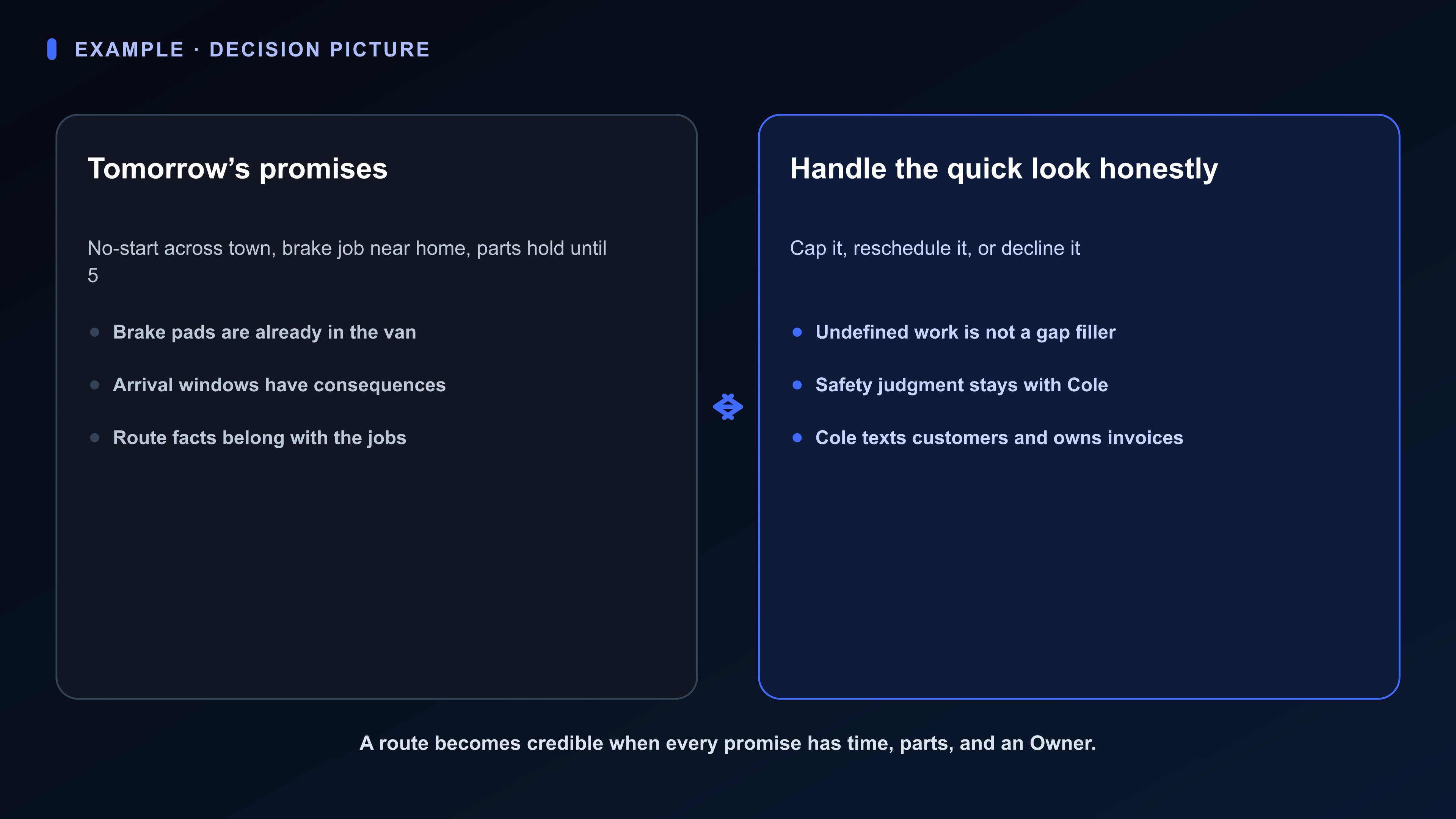
The Tomorrow’s van Board keeps jobs, parts, route evidence, and anything already waiting on a supplier or customer visible without pretending a text inbox is a schedule.
The route Room compares two-job sequences with a third capped-look path and makes the reschedule or decline decision visible.
Ava can compare the evidence Cole supplies. Cole diagnoses, decides the safe work, sets the route, texts customers, and owns every invoice.
Miles and parts closing time are the real calendar
The mission is specific: Run tomorrow with a route that hits the parts-store clock, promised arrival windows, and no untimed quick look hiding in the middle.
The consequential choice is not something a board or an AI should quietly make: Whether to run no-start then brakes and decline the quick look, run brakes then no-start and decline the quick look, or run no-start then a capped quick look and reschedule the brake job.
You.one can keep the work, evidence, anything already waiting on another person or event, and the “Choose tomorrow’s order” decision visible through its Superboard view. Cole still owns the call: Cole chooses the route, texts customers, and owns diagnosis, safety, and invoices.
Available today
Tomorrow’s van: the working map
The Tomorrow’s van Board gives this mission one durable operating picture. Cole can use familiar language instead of translating the situation into project-management jargon. Its five Lists separate the kinds of attention this situation actually requires.
The Lists separate what Cole can move now, what is evidence, what is already waiting on a named person or event, and what still needs a decision.
Swipe or scroll sideways to see every column.
| List | What belongs here |
|---|---|
| Mission | Parts-store clock and promised windows |
| Jobs | Each vehicle with address and promise |
| Parts | What is in the van versus what must be bought |
| Route | Order of the day, including drive time |
| Replies and outside events | Customer replies and parts counter holds |
Available today
Open one decision: Choose tomorrow’s order
Opening the Card gives the visible item durable depth. Stage can hold Route brief: Place both paid jobs, the uncapped quick look, addresses, the 5 p.m. parts hold, and the three complete day orders on one page. Chat keeps the request and response beside that artifact instead of in a detached thread. Notifications can bring this update forward: “Open decision: Cole will choose tomorrow’s route.”
A Card Chat request can ask Ava to prepare the specific comparison or extraction in “Choose tomorrow’s order” from the visible evidence. Ava can work from the context Cole deliberately brings into this Card, List, or Board; she cannot monitor the rest of life, contact anyone, or inherit the decision.
Cole's call remains explicit: Cole chooses the route, texts customers, and owns diagnosis, safety, and invoices.
Swipe or scroll sideways to see every column.
| Surface | Job in this example |
|---|---|
| Stage | Route brief: Place both paid jobs, the uncapped quick look, addresses, the 5 p.m. parts hold, and the three complete day orders on one page |
| Chat | Keep Cole's request and Ava's attributed response with the work |
| Notifications | Open decision: Cole will choose tomorrow’s route |
Useful Ava requests, with the boundary intact
These requests stay with the facts Cole has made visible around “Choose tomorrow’s order.” Cole supplies the evidence, checks Ava's work, and decides what belongs in the Room.
Current Ava can prepare help after an explicit request. She cannot make the choice, represent Cole, watch other work on her own, or contact anyone.
Cole owns diagnosis, safety, pricing, and customer messages. Ava does not text customers, buy parts, or repair vehicles.
A tomorrow that can be driven: the parts clock is on the Board, the quick look is a yes or no, and promised windows have an order.
- Request idea: using only the context visible in this Card Room, compare no-start then brakes with the quick look declined, brakes then no-start with the quick look declined, and no-start then a capped quick look with the brake job rescheduled. Do not text customers, assume a time cap, or choose for me.
- Request idea: use only the Route brief and notes the Owner has placed in this Card Room to separate facts, assumptions, and unanswered questions
- Request idea: in “Choose tomorrow’s order,” show which visible fact could reverse the current choice
The limit of voicemail plus a paper invoice pad
Voicemail plus a paper invoice pad can be enough while the situation stays simple: one job and parts already in the van.
It starts to break when two addresses, a 5 p.m. counter, and a quick look all claim the afternoon.
The Tomorrow’s van Board earns its place only when the familiar tool—voicemail plus a paper invoice pad—can no longer keep the reason, Route brief, conversation, current state, decision, and history connected.
A practical way to start the Tomorrow’s van Board
Cole should rename every List or Card that feels artificial. This recipe succeeds when “Choose tomorrow’s order” becomes easier to decide and fewer open loops depend on memory—not when the Board looks tidy.
Swipe or scroll sideways to see every column.
| Step | Action |
|---|---|
| 1. Write the clock | Parts-store hours on the Mission Card |
| 2. Card each job | Address and promised window |
| 3. Count van parts | Store runs are work |
| 4. Mark unbounded asks | Quick looks need a time cap or a no |
| 5. Choose tomorrow’s order | Open a Room the night before the route |
Where this example stops
- This is a fictional example, not a customer story.
- This is not mechanical, safety, or pricing advice.
- It does not show Ava contacting customers or buying parts.
- It is not a measured job or revenue result.