
Example
How a salon can run appointment operations without a double-booked chair
Gloria can fill the day. The risk is filling it from voicemail, texts, and memory without seeing that one chair, one colorist, and a regular client’s standing time are already committed.
Run the next two Saturdays with chairs, people, and color stock visible, without taking a wedding party that breaks standing appointments
Chair capacity and the standing-appointment rule
Keep chair count and the regulars rule visible beside growth
Who is working which seat, including absences
Show a missing chair before Friday bookings pile in
Standing regulars, inquiries, and walk-in policy
Compare stagger-four-across-three-chairs, Sunday-offer, and two-here-two-referred options
Hold a regular’s time so an inbox yes cannot overwrite it quietly
Color and supplies that the week actually needs
Count cabinet inventory against the party request
Owned client messages that have not been sent
Keep an unsent answer from counting as a booking
Use one Saturday operations Board for the resources and promises that have to agree before the doors open.
Put the wedding-party request in a Room with timing, chair capacity, supply needs, and the accept-change-decline decision.
Ava can organize the details Gloria enters and prepare options. Superboard does not book clients, send confirmations, take deposits, or override the salon’s judgment.
Why Saturday operations needs an operating picture
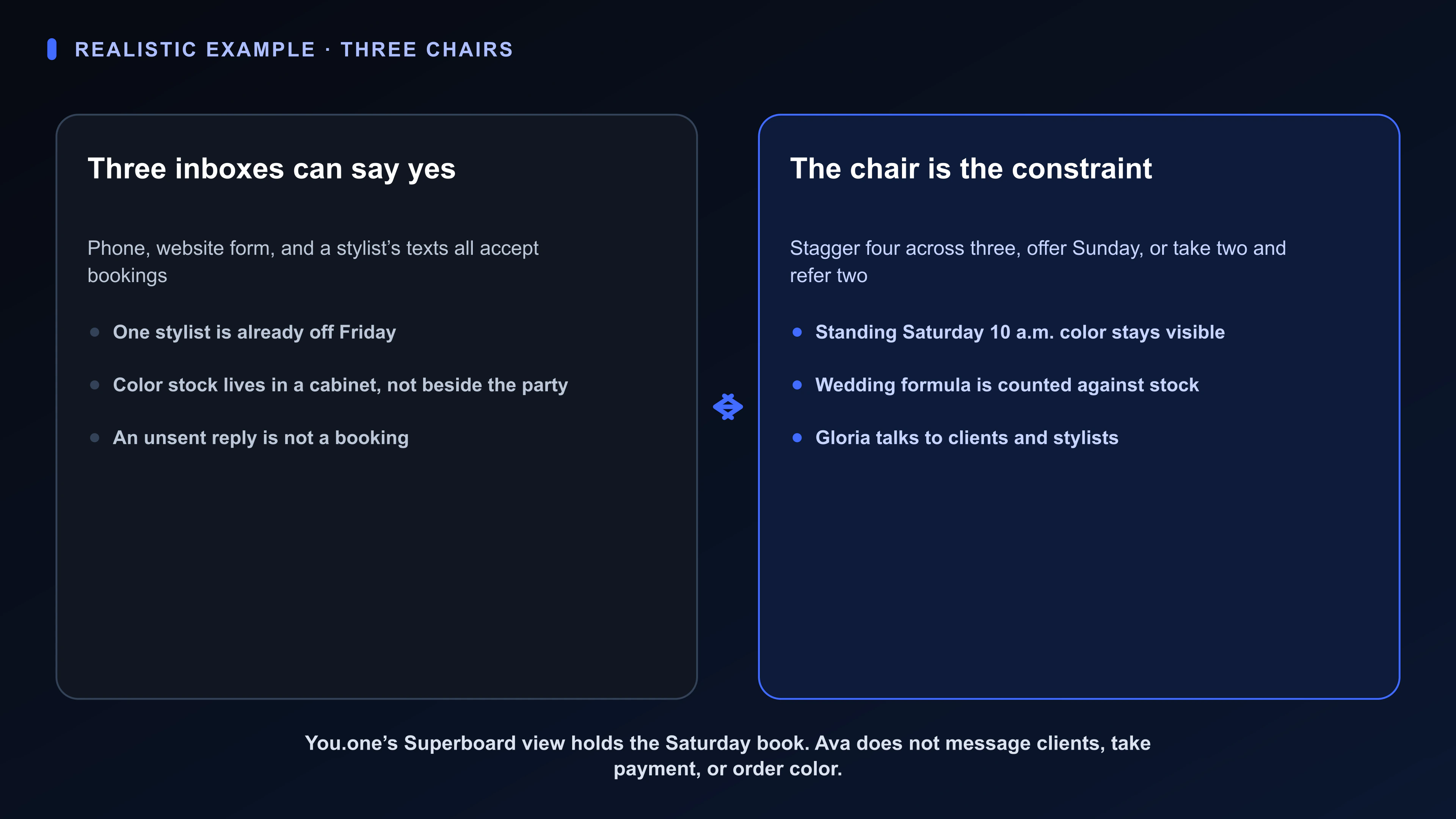
Gloria is a fictional 39-year-old owner of a three-chair salon in Chicago, Illinois. Gloria’s salon books from a phone, a website form, and walk-ins. One stylist is out Fridays. Color stock is counted on receipts. A wedding party asked for four simultaneous chairs on a Saturday that already has regulars.
The website form, voicemail, and a stylist’s personal texts all accept yes.
Color that is “probably enough” lives in a cabinet, not beside the wedding-party Card.
In You.one's Superboard view, Gloria can give “Run the next two Saturdays with chairs, people, and color stock visible, without taking a wedding party that breaks standing appointments” a Board of its own. That Board connects customer promises, operating evidence, capacity, and the owner's judgment; opening “Choose the wedding-party request” creates a Room for its evidence, discussion, state, and decision.
The chair is the constraint; the inbox is not the calendar
The mission is specific: Run the next two Saturdays with chairs, people, and color stock visible, without taking a wedding party that breaks standing appointments.
The consequential choice is not something a board or an AI should quietly make: Whether to stagger four party guests across three chairs after moving two regulars, decline Saturday and offer Sunday, or take two Saturday guests and refer the other two.
You.one can keep the work, evidence, and “Choose the wedding-party request” decision visible through its Superboard view. Authority does not move to the software: Gloria chooses the booking, talks to clients and stylists, and owns pricing and stock.
Available today
Saturday operations: one Board shape to adapt
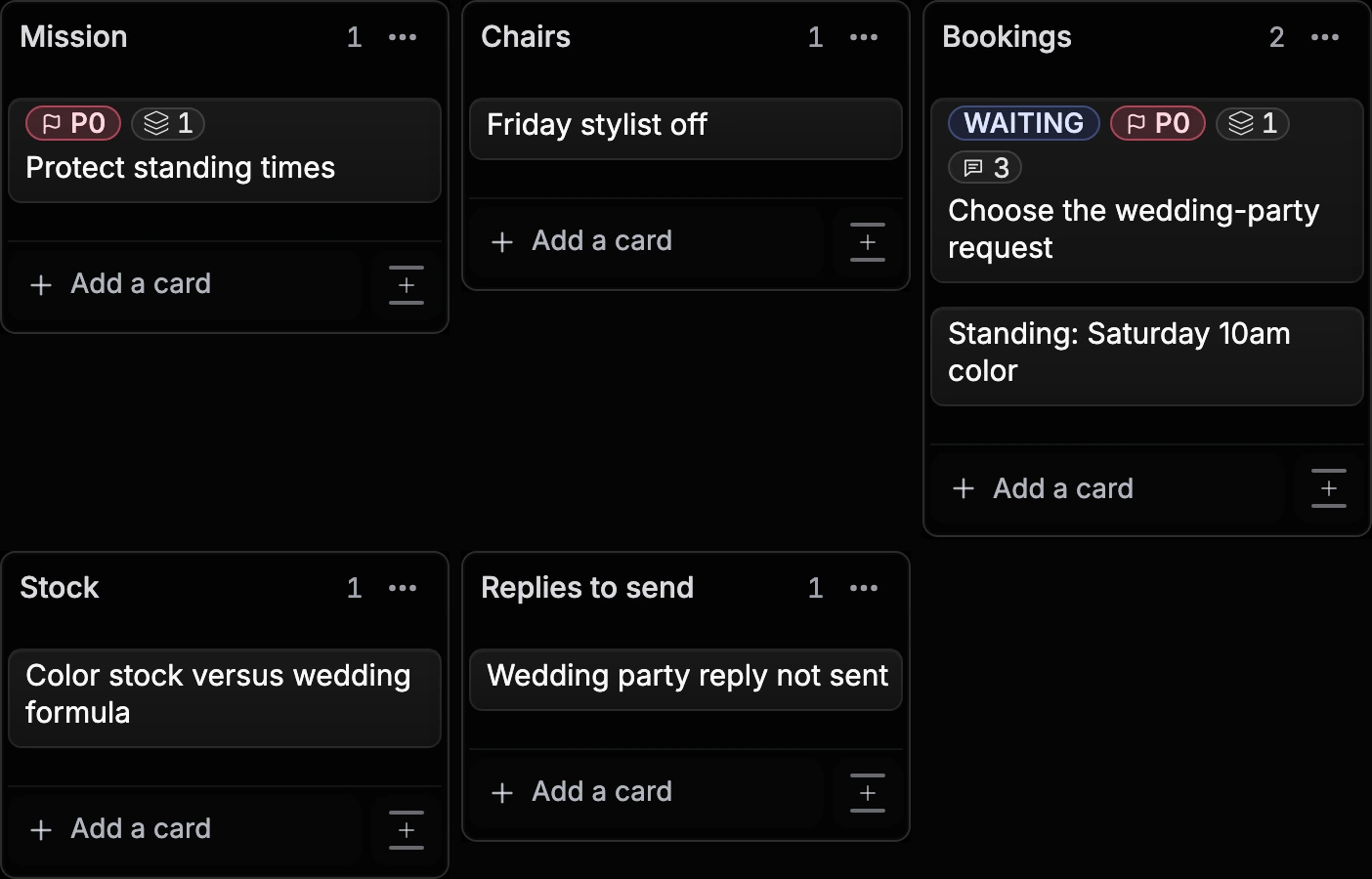
The Saturday operations Board gives this mission one durable operating picture. Gloria can use familiar language instead of translating the situation into project-management jargon. Its five Lists separate the kinds of attention this situation actually requires.
Its Cards deliberately distinguish actions, evidence, and decisions while keeping unsent questions in owned work. A Waiting List would be premature until a named request or outside condition is actually in motion. That separation makes the current choice, evidence, and next move easier to scan.
Swipe or scroll sideways to see every column.
| List | What belongs here |
|---|---|
| Mission | Chair capacity and the standing-appointment rule |
| Chairs | Who is working which seat, including absences |
| Bookings | Standing regulars, inquiries, and walk-in policy |
| Stock | Color and supplies that the week actually needs |
| Replies to send | Owned client messages that have not been sent |
Available today
The Cards make the operating picture concrete
These Card titles come directly from Gloria's situation: “Choose the wedding-party request” is the live choice, “Friday stylist off” holds evidence, and “Color stock versus wedding formula” is still work Gloria controls—not something already awaiting another person. The point is recognition, not a perfect taxonomy.
Swipe or scroll sideways to see every column.
| Card | List | Job |
|---|---|---|
| Protect standing times | Mission | Keep chair count and the regulars rule visible beside growth |
| Choose the wedding-party request | Bookings | Compare stagger-four-across-three-chairs, Sunday-offer, and two-here-two-referred options |
| Friday stylist off | Chairs | Show a missing chair before Friday bookings pile in |
| Standing: Saturday 10am color | Bookings | Hold a regular’s time so an inbox yes cannot overwrite it quietly |
| Color stock versus wedding formula | Stock | Count cabinet inventory against the party request |
| Wedding party reply not sent | Replies to send | Keep an unsent answer from counting as a booking |
Available today
Available today: Choose the wedding-party request becomes a Room
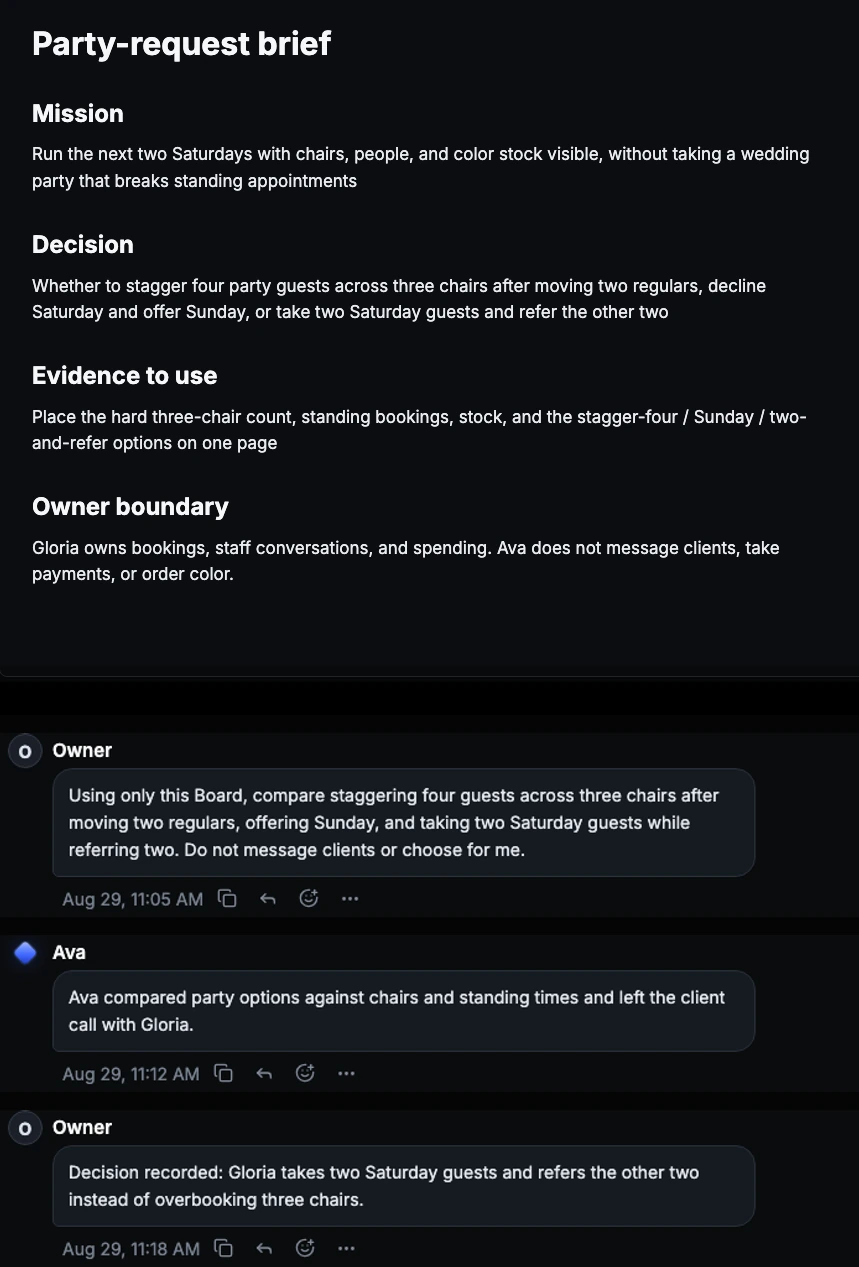
Opening the Card gives the visible item durable depth. Stage can hold Party-request brief: Place the hard three-chair count, standing bookings, stock, and the stagger-four / Sunday / two-and-refer options on one page. Chat keeps the request and response beside that artifact instead of in a detached thread. Notifications can bring this update forward: “Open decision: Gloria will choose how the wedding-party request is answered.”
A Card Chat request can ask Ava to prepare the specific comparison or extraction in “Choose the wedding-party request” from the visible evidence. Ava can work from the context Gloria deliberately brings into this Card, List, or Board; she cannot monitor the rest of life, contact anyone, or inherit the decision.
Gloria's call remains explicit: Gloria chooses the booking, talks to clients and stylists, and owns pricing and stock.
Swipe or scroll sideways to see every column.
| Surface | Job in this example |
|---|---|
| Stage | Party-request brief: Place the hard three-chair count, standing bookings, stock, and the stagger-four / Sunday / two-and-refer options on one page |
| Chat | Keep Gloria's request and Ava's attributed response with the work |
| Notifications | Open decision: Gloria will choose how the wedding-party request is answered |
What to ask Ava—and what not to assume
These requests stay with the facts Gloria has made visible around “Choose the wedding-party request.” Gloria supplies the evidence, checks Ava's work, and decides what belongs in the Room.
Current Ava can prepare help after an explicit request. She cannot make the choice, represent Gloria, watch other work on her own, or contact anyone.
Gloria owns bookings, staff conversations, and spending. Ava does not message clients, take payments, or order color.
A Saturday that matches chairs: standing times stay visible, stock is counted, and the wedding party is a chosen yes or no.
- Request idea: using only the context visible in this Card Room, compare staggering four guests across three chairs after moving two regulars, offering Sunday, and taking two Saturday guests while referring two. Do not message clients or choose for me.
- Request idea: use only the Party-request brief and notes the Owner has placed in this Card Room to separate facts, assumptions, and unanswered questions
- Request idea: name which visible Room note could most change the comparison; do not watch other Lists or follow up autonomously
What Phone voicemail plus a paper book can still handle
Phone voicemail plus a paper book can be enough while the situation stays simple: one chair and no special requests.
It starts to break when three intake channels, a missing stylist, and a four-chair party all say yes.
The Saturday operations Board earns its place only when the familiar tool—phone voicemail plus a paper book—can no longer keep the reason, Party-request brief, conversation, current state, decision, and history connected.
A starter recipe to adapt, not obey
Gloria should rename every List or Card that feels artificial. This recipe succeeds when “Choose the wedding-party request” becomes easier to decide and fewer open loops depend on memory—not when the Board looks tidy.
Swipe or scroll sideways to see every column.
| Step | Action |
|---|---|
| 1. Map chairs | Who is working, including days off |
| 2. Protect standing bookings | Regulars as Cards, not assumed memory |
| 3. Count stock against requests | Cabinet facts beside special formulas |
| 4. Park unsent answers | An inquiry is not a yes |
| 5. Choose the wedding-party request | Open a Room before an inbox overwrites the book |
Direction
Direction, not a current promise
Later, Ava may help this Board notice when a booking Card exceeds visible chair Cards, still leaving every client message with Gloria.
A future unified You.one experience could carry relevant context from “Choose the wedding-party request” across guidance and the Superboard view. Broad proactive coordination, cross-surface personalized memory, realtime shared editing, and general external execution are not available today. Any future action would still require the applicable capability, connection, grant, and human authority.
What this realistic example does not claim
- Gloria is fictional and is not a customer, testimonial, research participant, or disguised real person.
- This is not a booking-system integration or a claim Superboard messaged clients.
- It does not show Ava taking payments, ordering supplies, or managing staff.
- It is not a measured revenue result.