
Example
How an adult can organize a trade certification without losing work hours
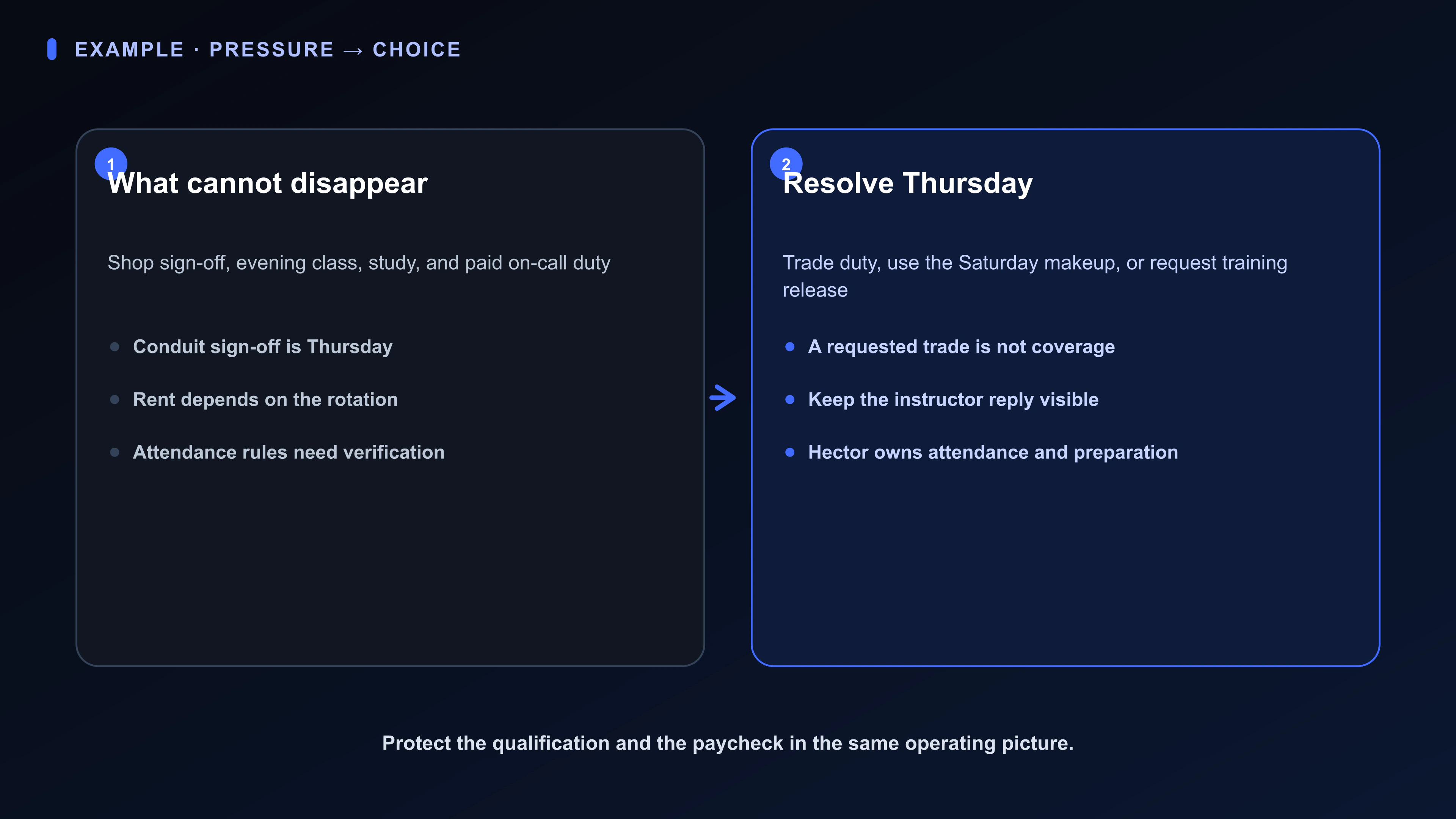
Hector is preparing for an electrical apprenticeship while protecting the income that keeps rent steady. Thursday’s conduit sign-off overlaps on-call duty, but a requested trade, a Saturday makeup, and one training-release night create three honest paths.
Complete this certificate term with required shop sign-offs while keeping enough paid on-call nights to hold rent steady
License-path goal and the income constraint
Keep the certificate goal and Hector's recurring two-night on-call income constraint in one Mission Card
Nights that require being present
Mark an in-person skill that cannot be replaced by reading
Ground the keep-on-call path in the school's stated alternative
Exam objectives, practice, and readings
Keep exam practice visible on nights that are actually free
On-call rotation and coworker trades
Compare a Thursday trade, Saturday makeup shop, and the available training-release night
Show the nights the group text still treats as fluid
Ground the attend-Thursday path in an available work benefit
Hold the exact paid-coverage collision with Thursday's in-person sign-off
Instructor and coworker replies
Keep Hector's sent request from counting as a confirmed trade
Use a Certificate term Board for the specific shop work, study evidence, work coverage, and replies that can change the plan.
The shop-week Card Room holds the calendar facts and keeps the trade, makeup, and training-release decision explicit.
Ava can organize and compare what Hector places in the Room. Hector talks to his coworker and instructor and owns attendance and exam preparation.
The certificate only works if on-call is a Card, not a hope
This Board has one job: Complete this certificate term with required shop sign-offs while keeping enough paid on-call nights to hold rent steady.
The decision still belongs to Hector: Whether to trade Thursday on-call with the coworker already asked, keep Thursday on-call and use the published Saturday makeup shop, or use the employer's available training-release night to attend Thursday's sign-off.
You.one can keep the work, evidence, anything already waiting on another person or event, and the “Choose coverage for shop week three” decision visible through its Superboard view. Hector still owns the call: Hector chooses the coverage plan, talks to his coworker and instructor, and owns attendance and exam preparation.
Available today
Certificate term: one place for the mission
The Certificate term Board gives this mission one durable operating picture. Hector can use familiar language instead of translating the situation into project-management jargon. Its five Lists separate the kinds of attention this situation actually requires.
The Board is not a master task list. It keeps the live choice, the facts that could change it, and any reply or outside event already in motion visible without pretending every uncertainty is work in progress.
Swipe or scroll sideways to see every column.
| List | What belongs here |
|---|---|
| Mission | License-path goal and the income constraint |
| Shop and class | Nights that require being present |
| Study | Exam objectives, practice, and readings |
| Work coverage | On-call rotation and coworker trades |
| Replies and outside events | Instructor and coworker replies |
Available today
Cards that sound like the real work
These Card titles come directly from Hector's situation: “Choose coverage for shop week three” is the live choice, “Conduit-bending sign-off Thursday” holds evidence, and “Thursday trade request sent” names something genuinely in motion outside Hector's control. The point is recognition, not a perfect taxonomy.
Swipe or scroll sideways to see every column.
| Card | List | Job |
|---|---|---|
| Finish the certificate term with two on-call nights a week | Mission | Keep the certificate goal and Hector's recurring two-night on-call income constraint in one Mission Card |
| Choose coverage for shop week three | Work coverage | Compare a Thursday trade, Saturday makeup shop, and the available training-release night |
| Conduit-bending sign-off Thursday | Shop and class | Mark an in-person skill that cannot be replaced by reading |
| On-call rotation this month | Work coverage | Show the nights the group text still treats as fluid |
| Thursday trade request sent | Replies and outside events | Keep Hector's sent request from counting as a confirmed trade |
| Published Saturday makeup shop | Shop and class | Ground the keep-on-call path in the school's stated alternative |
| One employer training-release night | Work coverage | Ground the attend-Thursday path in an available work benefit |
| Code-book practice set 2 | Study | Keep exam practice visible on nights that are actually free |
| Thursday on-call | Work coverage | Hold the exact paid-coverage collision with Thursday's in-person sign-off |
Available today
Keep the evidence with “Choose coverage for shop week three”
Opening the Card gives the visible item durable depth. Stage can hold Shop-week coverage brief: Place “Finish the certificate term with two on-call nights a week,” “Conduit-bending sign-off Thursday,” “Thursday on-call,” “Thursday trade request sent,” “Published Saturday makeup shop,” “One employer training-release night,” and the three complete paths on one page. Chat keeps the request and response beside that artifact instead of in a detached thread. Notifications can bring this update forward: “Open decision: Hector will choose how shop week three gets coverage.”
A Card Chat request can ask Ava to prepare the specific comparison or extraction in “Choose coverage for shop week three” from the visible evidence. Ava can work from the context Hector deliberately brings into this Card, List, or Board; she cannot monitor the rest of life, contact anyone, or inherit the decision.
Hector's call remains explicit: Hector chooses the coverage plan, talks to his coworker and instructor, and owns attendance and exam preparation.
Swipe or scroll sideways to see every column.
| Surface | Job in this example |
|---|---|
| Stage | Shop-week coverage brief: Place “Finish the certificate term with two on-call nights a week,” “Conduit-bending sign-off Thursday,” “Thursday on-call,” “Thursday trade request sent,” “Published Saturday makeup shop,” “One employer training-release night,” and the three complete paths on one page |
| Chat | Keep Hector's request and Ava's attributed response with the work |
| Notifications | Open decision: Hector will choose how shop week three gets coverage |
Start small and rename what feels artificial
Hector should rename every List or Card that feels artificial. This recipe succeeds when “Choose coverage for shop week three” becomes easier to decide and fewer open loops depend on memory—not when the Board looks tidy.
Swipe or scroll sideways to see every column.
| Step | Action |
|---|---|
| 1. Write the income constraint | Put required on-call nights on the Mission Card |
| 2. List presence nights | Create Cards for shop sign-offs and required classes |
| 3. Map on-call | Capture the current rotation as work coverage, not a text thread |
| 4. Separate the sent request | Keep the sent trade request under Replies and outside events until the trade is confirmed |
| 5. Choose coverage for shop week three | Open a Room for the first shop week that collides with on-call |
A truck notebook plus a group text can remain part of the system
A truck notebook plus a group text can be enough while the situation stays simple: on-call nights never overlap shop.
It starts to break when a sign-off night and an on-call night both claim Thursday.
The Certificate term Board earns its place only when the familiar tool—a truck notebook plus a group text—can no longer keep the reason, Shop-week coverage brief, conversation, current state, decision, and history connected.
Where this example stops
- This is a fictional example, not a customer story.
- This is not licensing advice, an employer policy, or a claim Superboard contacted a coworker.
- It does not show Ava completing shop skills or guaranteeing exam results.
- It is not a measured wage or certification outcome.