
Example
How to finish the college applications that matter most
The pressure is not a missing spreadsheet. It is a December 15 deadline, a recommendation still outstanding, and one extra essay that could turn an ambitious list into five unfinished applications.
Submit a truthful, complete first-choice application on time without letting the other four programs disappear into the same fog
What this season is for and the workload Samira can actually finish
Keep the first-choice deadline beside the limit on how many extra essays are still honest
Each university program as its own Card
Compare keep, drop, and replace-with-no-essay options against remaining writing days
Hold the first-choice deadline and remaining supplement beside the actual draft
Keep a current-list program with its deadline and remaining shared statement work
Keep the program deadline and one remaining response visible
Keep the fourth current program and its remaining work in the list-size comparison
Name the farthest-fit fifth program and the writing cost of keeping it
Make the replacement path a specific fictional program with a deadline and no additional writing requirement
Essays and supplements in progress
Hold the shared-statement draft and the December 15 first-choice deadline it must meet, not a spreadsheet status
Separate this program’s extra questions from the shared personal statement
Recommenders, counselor, and family review
Track the hallway yes, the form link, and the date it still needs to be sent
Portal confirms, teacher replies, and transcript requests
Keep a submitted office request from occupying the same list as unwritten essays
In You.one’s Superboard view, Samira keeps each program, essay, deadline, recommendation request, and confirmed portal state on one Application season Board.
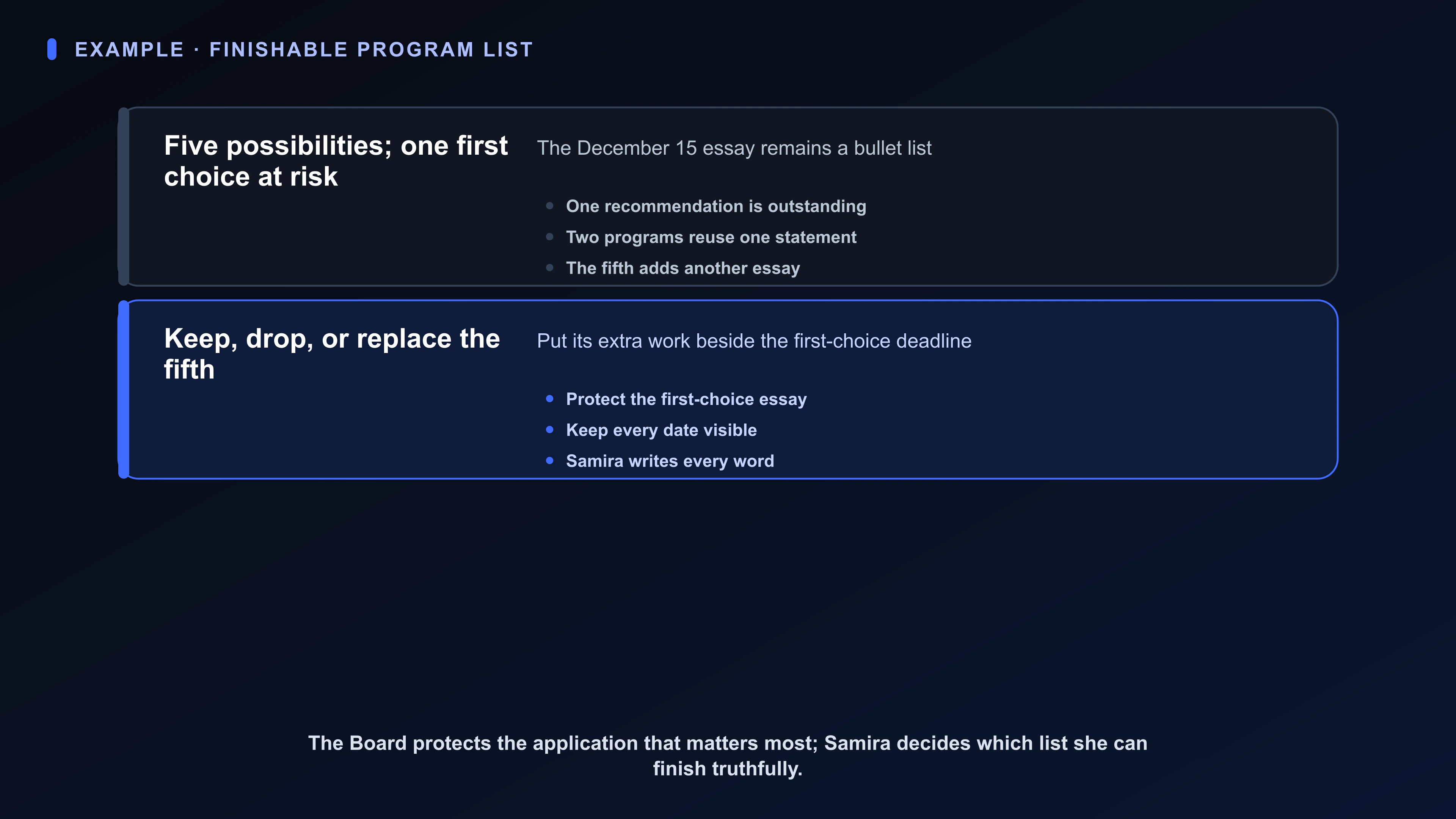
One Card holds the real decision: keep Ridgefield, drop it, or replace it with Lakeview. Its Room keeps the extra essay beside the first-choice work it would displace.
On that Card, Ava can help compare the visible workload and keep the tradeoff attached to the dates. Samira writes every essay and owns program choices and requests; a parent or guardian owns required fees and consent.
The list is not the work; the next artifact is
This Board has one job: Submit a truthful, complete first-choice application on time without letting the other four programs disappear into the same fog.
The decision still belongs to Samira: Whether to keep all five programs, drop Ridgefield Data Science as the farthest-fit fifth, or replace it with Lakeview Information Systems, which has no extra essay.
You.one can keep the work, evidence, anything already waiting on another person or event, and the “Decide whether the fifth program stays” decision visible through its Superboard view. Samira still owns the call: Samira chooses which programs to keep, writes her own essays, and sends teacher and office requests. A parent or guardian owns fees, portal accounts, and any consent the programs require.
Available today
Application season: one place for the mission
The Application season Board gives this mission one durable operating picture. Samira can use familiar language instead of translating the situation into project-management jargon. Its five Lists separate the kinds of attention this situation actually requires.
The Board is not a master task list. It keeps the live choice, the facts that could change it, and any reply or outside event already in motion visible without pretending every uncertainty is work in progress.
Swipe or scroll sideways to see every column.
| List | What belongs here |
|---|---|
| Mission | What this season is for and the workload Samira can actually finish |
| Programs | Each university program as its own Card |
| Writing | Essays and supplements in progress |
| People and replies | Recommenders, counselor, and family review |
| Replies already requested | Portal confirms, teacher replies, and transcript requests |
Available today
Cards that sound like the real work
These Card titles come directly from Samira's situation: “Decide whether the fifth program stays” is the live choice, “Early-deadline personal statement” holds evidence, and “Transcript request at the office” names something genuinely in motion outside Samira's control. The point is recognition, not a perfect taxonomy.
Swipe or scroll sideways to see every column.
| Card | List | Job |
|---|---|---|
| Submit a list I can actually finish | Mission | Keep the first-choice deadline beside the limit on how many extra essays are still honest |
| Decide whether the fifth program stays | Programs | Compare keep, drop, and replace-with-no-essay options against remaining writing days |
| Early-deadline personal statement | Writing | Hold the shared-statement draft and the December 15 first-choice deadline it must meet, not a spreadsheet status |
| Teacher recommendation: Ms. Patel | People and replies | Track the hallway yes, the form link, and the date it still needs to be sent |
| Transcript request at the office | Replies already requested | Keep a submitted office request from occupying the same list as unwritten essays |
| Westbridge engineering supplement | Writing | Separate this program’s extra questions from the shared personal statement |
| Westbridge Engineering — December 15 — supplement open | Programs | Hold the first-choice deadline and remaining supplement beside the actual draft |
| Northside Business — January 8 — shared statement only | Programs | Keep a current-list program with its deadline and remaining shared statement work |
| Harbor Public Policy — January 10 — short response open | Programs | Keep the program deadline and one remaining response visible |
| Central Economics — January 12 — shared statement only | Programs | Keep the fourth current program and its remaining work in the list-size comparison |
| Ridgefield Data Science — January 5 — extra essay open | Programs | Name the farthest-fit fifth program and the writing cost of keeping it |
| Lakeview Information Systems — January 12 — no extra essay | Programs | Make the replacement path a specific fictional program with a deadline and no additional writing requirement |
Available today
Keep the evidence with “Decide whether the fifth program stays”
Opening the Card gives the visible item durable depth. Stage can hold Application-list brief: Place “Early-deadline personal statement,” “Westbridge Engineering — December 15 — supplement open,” “Ridgefield Data Science — January 5 — extra essay open,” “Lakeview Information Systems — January 12 — no extra essay,” and the keep / drop / replace options beside the program Cards. Chat keeps the request and response beside that artifact instead of in a detached thread. Notifications can bring this update forward: “Open decision: Samira will choose whether Ridgefield Data Science stays, is dropped, or is replaced with Lakeview Information Systems.”
A Card Chat request can ask Ava to prepare the specific comparison or extraction in “Decide whether the fifth program stays” from the visible evidence. Ava can work from the context Samira deliberately brings into this Card, List, or Board; she cannot monitor the rest of life, contact anyone, or inherit the decision.
Samira's call remains explicit: Samira chooses which programs to keep, writes her own essays, and sends teacher and office requests. A parent or guardian owns fees, portal accounts, and any consent the programs require.
Swipe or scroll sideways to see every column.
| Surface | Job in this example |
|---|---|
| Stage | Application-list brief: Place “Early-deadline personal statement,” “Westbridge Engineering — December 15 — supplement open,” “Ridgefield Data Science — January 5 — extra essay open,” “Lakeview Information Systems — January 12 — no extra essay,” and the keep / drop / replace options beside the program Cards |
| Chat | Keep Samira's request and Ava's attributed response with the work |
| Notifications | Open decision: Samira will choose whether Ridgefield Data Science stays, is dropped, or is replaced with Lakeview Information Systems |
Start small and rename what feels artificial
Samira should rename every List or Card that feels artificial. This recipe succeeds when “Decide whether the fifth program stays” becomes easier to decide and fewer open loops depend on memory—not when the Board looks tidy.
Swipe or scroll sideways to see every column.
| Step | Action |
|---|---|
| 1. One Card per program | Stop using a status word as a substitute for the actual remaining work |
| 2. Split writing | Make a Card for each essay or supplement with its real due date |
| 3. Track people | Create Cards for recommenders and office requests |
| 4. Park portals | Move submitted requests and unconfirmed uploads to Replies already requested |
| 5. Decide list size | Open the “Decide whether the fifth program stays” Room and record keep, drop, or replace-with-Lakeview |
A color-coded spreadsheet can remain part of the system
A color-coded spreadsheet can be enough while the situation stays simple: deadlines are far and no extra essays exist.
It starts to break when drafts, hallway promises, and portals all disagree about what “in progress” means.
The Application season Board earns its place only when the familiar tool—a color-coded spreadsheet—can no longer keep the reason, Application-list brief, conversation, current state, decision, and history connected.
Where this example stops
- This is a fictional example, not a customer story.
- This is not admissions counseling, an acceptance prediction, or a claim Superboard accessed OUAC or any portal.
- It does not show Ava writing essays, emailing teachers, or ranking universities.
- It is not a measured admissions result or a recommended school list.